The Zakat Filing Lifecycle: Where Compliance Teams Lose Control
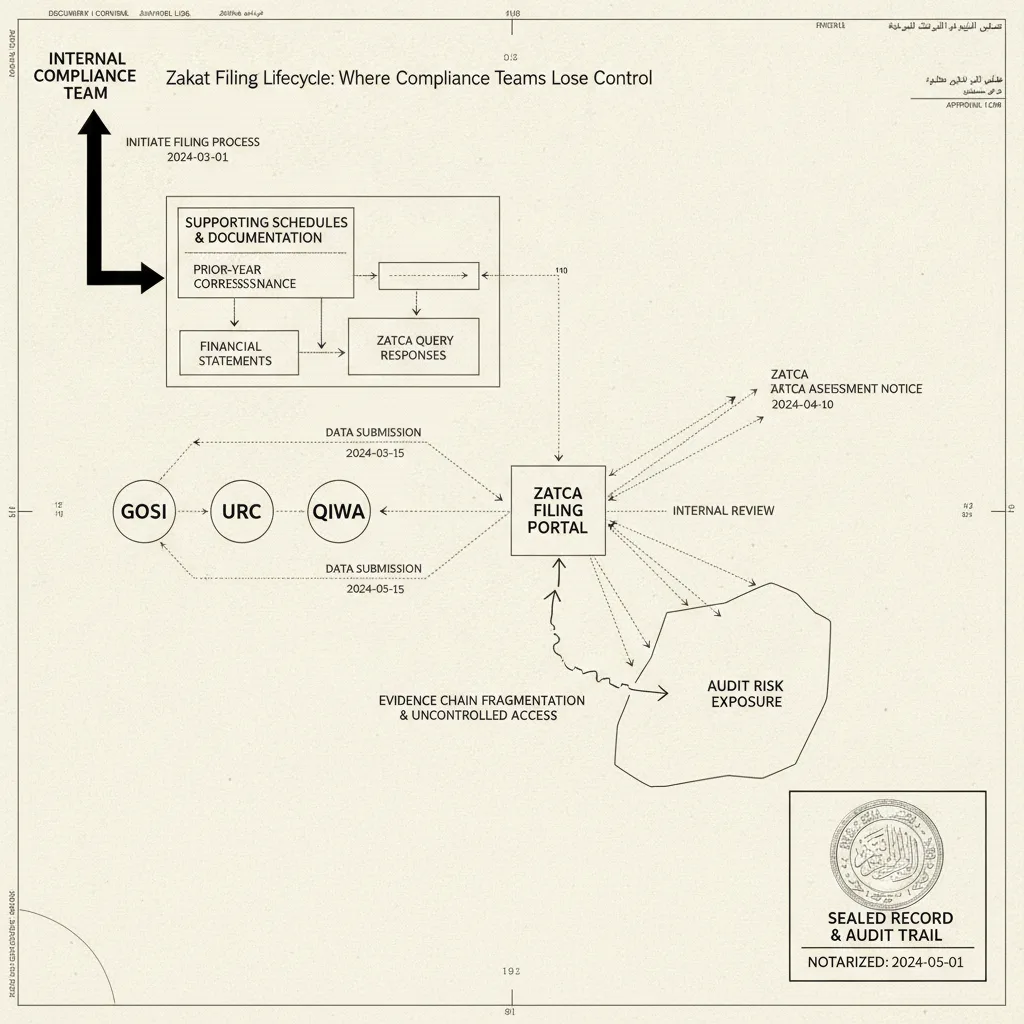
A compliance manager at a Saudi mid-cap receives a ZATCA assessment query in March — three months after the annual Zakat return was submitted. The query references a specific line in the zakatable asset schedule. The problem: that schedule was prepared by the external tax advisor in November, emailed to the CFO's personal inbox, and never formally archived. The compliance manager owns the deadline on record. The advisor owns the file in practice. No one owns the custody chain.
This is not an edge case. It is the structural condition of Zakat compliance at most Saudi corporates: deadline accountability sits inside the organisation; evidence accountability does not.
How the Zakat filing obligation is actually structured
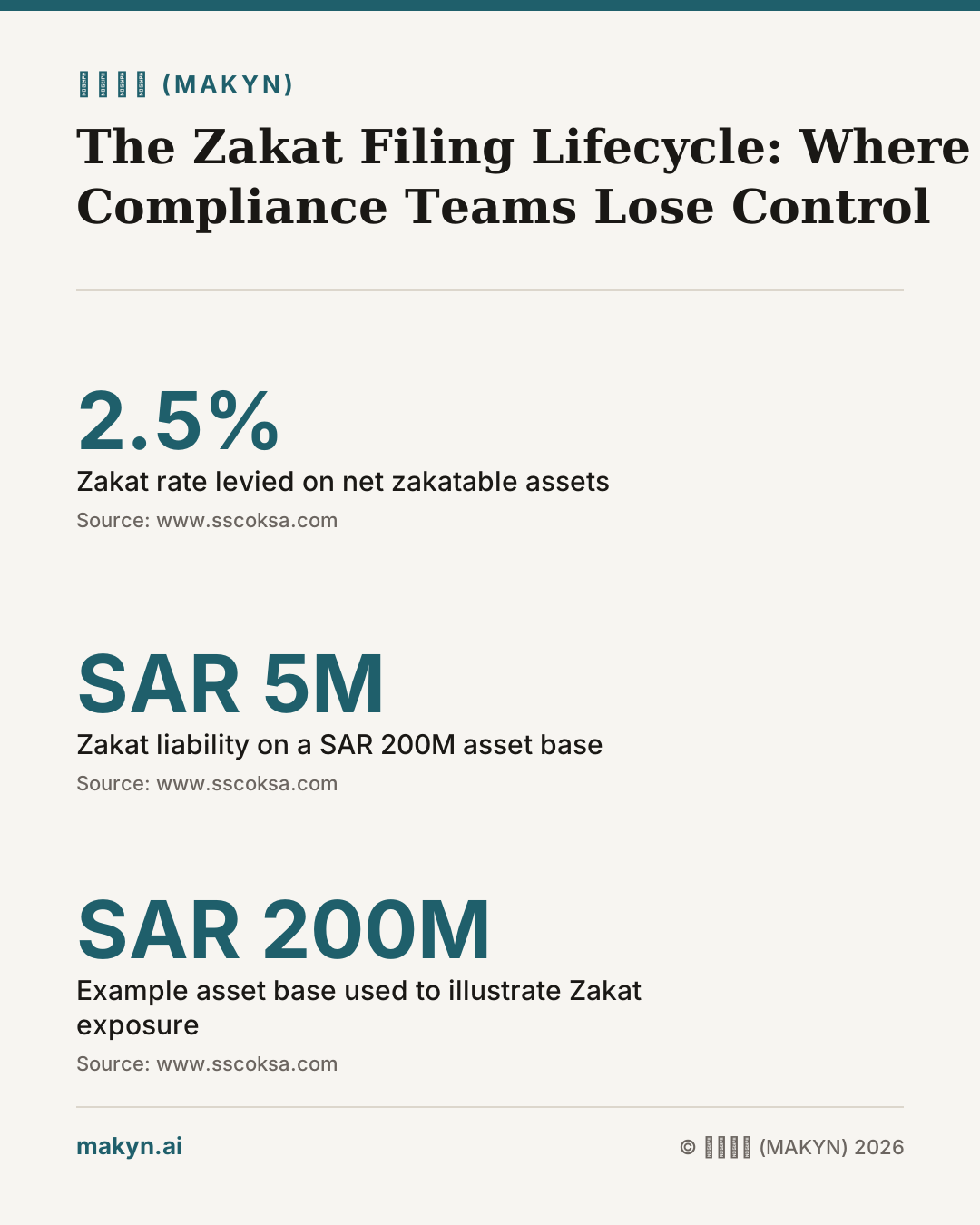
Zakat in Saudi Arabia is a religious financial levy assessed on Saudi and GCC-owned businesses. It is calculated at 2.5% on net zakatable assets — the sum of cash, trade receivables, inventory, investments, and other qualifying assets, after deducting eligible liabilities [3]. Because the base is asset-driven rather than profit-driven, the calculation requires reconciling balance sheet positions at year-end to a separate Zakat schedule, not simply reading the income statement [3].
The Zakat, Tax and Customs Authority (هيئة الزكاة والضريبة والجمارك — ZATCA) administers the return, oversees audit supervision, and enforces penalties for non-compliance [2]. ZATCA's audit posture has become materially more demanding: the authority scrutinises how a business computes its base, documents its adjustments, and produces evidence under examination — not merely whether the filing was submitted on time [2].
This means the filing itself is only the beginning of the compliance obligation. The document package behind the return is the real asset.
The three handoff points where custody breaks
Mapping the Zakat filing lifecycle reveals a consistent pattern: document custody does not break randomly. It breaks at three predictable transition points.
Handoff 1 — Financial close to compliance function. The Zakat base is built from financial data owned by the accounting team. When year-end closes, trial balances, asset registers, and receivables aging reports move — informally, usually by email — to whoever is preparing the Zakat schedule. If that person is an external advisor, the documents leave the organisation entirely. If they are internal, the schedules sit in a personal drive rather than a shared compliance repository. Either way, the compliance function receives the return to review but not the underlying workpapers. From this point, the organisation technically holds the submission but not the evidence.
Handoff 2 — External advisor review. Most Saudi corporates engage a tax advisor to prepare or review the Zakat computation. That advisor works with a copy of the financials and produces a set of schedules. Those schedules — the reconciliation of zakatable assets, the liability deduction logic, the adjustments for prior-year differences — are the exact documents ZATCA will request in an assessment dispute. They are also the documents most likely to exist only in the advisor's file, not in the client's archive. When the engagement ends, the deliverable is the signed return. The working file stays with the advisor.
Handoff 3 — Post-submission query response. ZATCA issues queries through its online portal. The notification arrives as a system message, typically addressed to the entity's registered portal account. Who monitors that account varies by organisation — sometimes the CFO, sometimes a finance coordinator, sometimes no one on a consistent basis. A query that is not seen within the response window creates a default position unfavourable to the taxpayer. A query that is seen but answered without reference to the original schedules produces an inconsistent record. Both outcomes damage the entity's position in any subsequent dispute. This is precisely where a برنامج متابعة إشعارات هيئة الزكاة والضريبة — a structured ZATCA notice-tracking system — changes the outcome.
What ZATCA actually examines in an assessment
ZATCA's forensic-level scrutiny, as its own compliance posture makes clear, extends to how figures are computed and how adjustments are documented — not only to the final number [2]. In a Zakat dispute, the authority will typically want:
- The closing trial balance used to derive the Zakat base
- Reconciliation schedules showing how each zakatable asset category was quantified
- Supporting documentation for any deductions from the base (eligible liabilities, specific exclusions)
- Prior-year correspondence, including any adjustments agreed with ZATCA in earlier cycles
- Responses to any queries issued during or after the assessment process
Items 1 through 3 are produced at financial close. Items 4 and 5 accumulate across years. An organisation that does not maintain a continuous, structured archive of all five categories cannot reconstruct a defensible position on short notice — and ZATCA's query timelines rarely offer long notice.
The Zakat base's sensitivity to a single schedule is not trivial. A 2.5% levy on a SAR 200 million asset base produces a SAR 5 million liability. A disputed adjustment to one receivables category, if unsupported by documentation, can alter the base materially and expose the entity to a reassessment plus penalties [3].
The controls that keep compliance teams in the chain of custody
The solution is not to eliminate external advisors or to centralise all work internally. It is to establish formal custody controls at each of the three handoff points — controls that ensure the compliance function holds a complete, retrievable archive regardless of who performs the work.
Control 1 — Document intake at financial close. Every file transferred to the Zakat preparation process must be logged: filename, date, version, sender, and recipient. The compliance function — not the accounting team, not the advisor — holds the master copy. This is not about distrust; it is about establishing an unambiguous custody record from the first day of the preparation cycle.
Control 2 — Advisor deliverable protocol. The engagement letter with any external tax advisor should specify that all working schedules, not only the final return, are deliverables to the client. Version-controlled files, not PDFs of final computations, must be part of the handoff. The compliance function archives these under the relevant tax year, linked to the submission reference number on the ZATCA portal.
Control 3 — Portal monitoring with structured escalation. The ZATCA portal account must have a designated, named monitor — not a shared login with no ownership. Every inbound notification is logged with a timestamp, assigned to a responsible individual, linked to the relevant filing period and its document package, and tracked to closure. Response drafts must reference the original schedule, not reconstruct figures from memory. For organisations managing multiple entities or portfolios, this control is impossible to sustain manually; it requires a dedicated compliance tracking system.
Makyn's view: the custody gap is a governance failure, not a technology gap
The instinct in many organisations is to solve the custody problem by buying software. The instinct is partially correct but misses the root cause. Software does not prevent a handoff from being informal. What prevents that is a governance decision: the compliance function must be the institutional owner of the filing evidence chain, not merely the entity that signs the submission.
This requires three decisions before any system is implemented. First, the compliance function must have the authority to require document deliverables from both the accounting team and external advisors — not just from its own staff. Second, the portal monitoring function must be owned by compliance, not delegated upward to the CFO or downward to an unmonitored coordinator. Third, the audit trail for every ZATCA notice — receipt, routing, response, closure — must be maintained as a compliance record, not as an email thread.
Once those governance decisions are made, a برنامج متابعة إشعارات هيئة الزكاة والضريبة becomes the technical layer that enforces them consistently. It reads inbound notifications, timestamps them, routes them to the named owner, links them to the filing period's document package, and flags overdue responses. The compliance team does not have to remember to check the portal; the system surfaces the obligation at the moment it requires action.
For holding groups managing Zakat filings across multiple legal entities, the structural version of this problem is documented in our analysis of compliance aggregation for Saudi holding groups. The entity-level custody problem described here scales linearly with the number of subsidiaries — and the consequences of a gap in one entity's archive can affect the group's consolidated position.
Organisations preparing for ZATCA's increasingly forensic audit environment may also find value in reviewing the Phase Two e-invoicing audit readiness checklist, which addresses the document retention standards ZATCA applies across its digital compliance mandate — standards that are directionally consistent with what it expects from the Zakat filing archive.
The custody chain for a Zakat return is not a filing-season problem. It is a year-round governance obligation. The compliance teams that recognise this early — and put the controls in place before ZATCA sends a query — are the ones that do not spend March reconstructing what should have been archived in December.
To see how Makyn structures custody and notice tracking for Saudi compliance teams, اطلب عرضاً توضيحياً.
Frequently asked
- What is the Zakat filing deadline for Saudi and GCC-owned companies?
- Saudi and GCC-owned businesses must submit their annual Zakat return within 120 days of the fiscal year-end. ZATCA administers this obligation, and late submission exposes the entity to penalties and potential assessment adjustments. Maintaining a complete, time-stamped document trail from financial close through submission is essential to defending any figures the authority may later query.
- What documents does ZATCA require to support a Zakat return?
- ZATCA expects reconciliation schedules linking the Zakat base — cash, trade receivables, inventory, investments, and other zakatable assets less eligible liabilities — back to the audited financial statements. Prior-year correspondence, asset registers, and any adjustment workpapers must also be retained. Without these, a compliance team cannot adequately respond to a ZATCA query or defend a disputed assessment.
- Where do internal compliance teams most commonly lose document custody during the filing cycle?
- Custody typically breaks at three points: during financial close when schedules sit with the accounting team rather than the compliance function; during external advisor review when files transfer to a third party without a formal handoff log; and after submission when ZATCA query responses are handled ad hoc by whoever receives the portal notification, with no central record created.
- How does a ZATCA notice-tracking system prevent assessment disputes from escalating?
- A structured notice-tracking system — برنامج متابعة إشعارات هيئة الزكاة والضريبة — assigns every inbound ZATCA notification a time-stamped owner, links it to the relevant filing period's document package, and enforces a response deadline. This means the compliance team holds a continuous custody record rather than reconstructing the evidence chain only after a dispute is already in progress.
Sources
- 1. ZATCA Compliance Guide for Businesses in KSA — www.sscoksa.com
- 2. Complete Guide to Saudi Zakat, VAT & Corporate Tax Compliance – Saudi Compliance Institute — saudicomplianceinstitute.com