IFRS Transition Deadlines: What Saudi PIEs Must Do Now
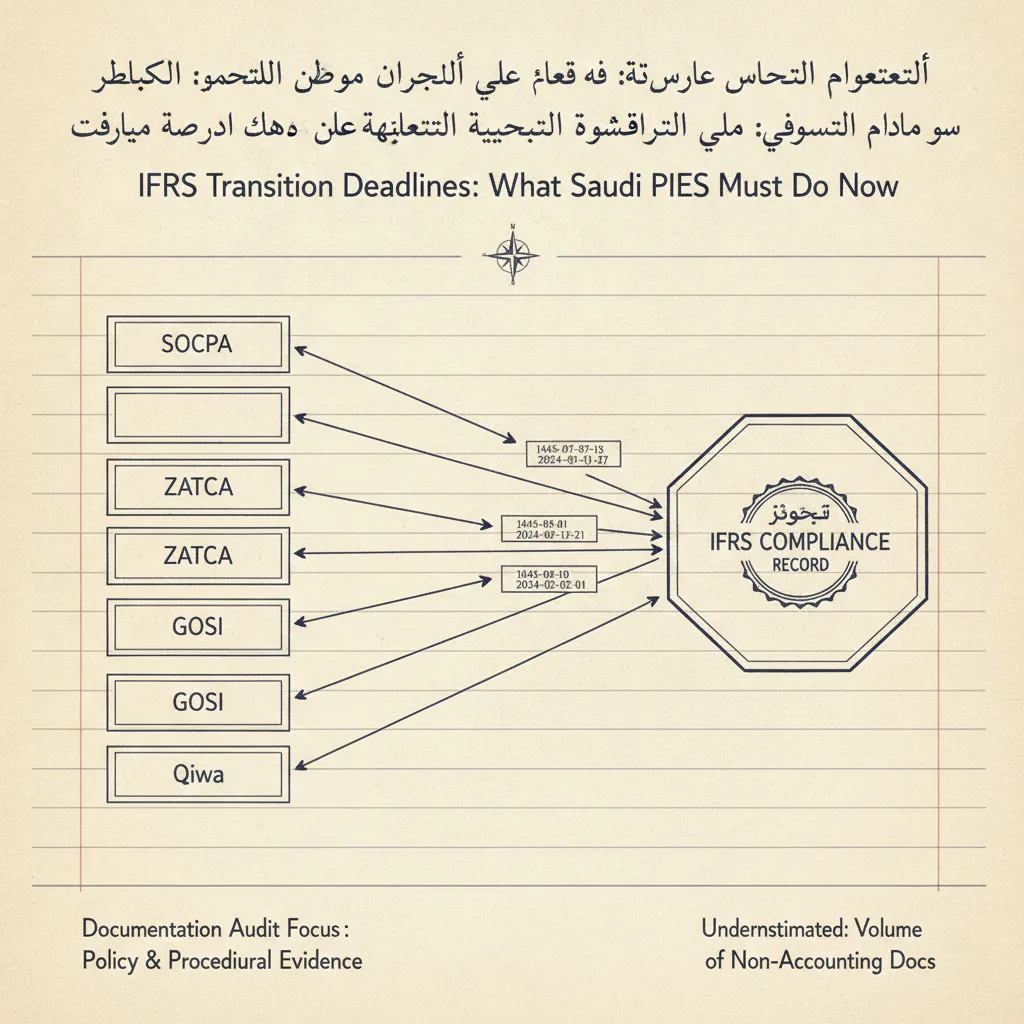
Saudi accounting offices handling public interest entity (PIE) accounts entered 2025 facing a specific, compressible problem: the Saudi Organization for Chartered and Professional Accountants (SOCPA) is actively reviewing IFRS readiness, and the reviews are not what most firms prepared for. The inspection is less concerned with whether you adopted the right standard and more concerned with whether you can prove, document by document, that the adoption was deliberate, authorized, and traceable 1.
What SOCPA's IFRS Compliance Reviews Actually Examine
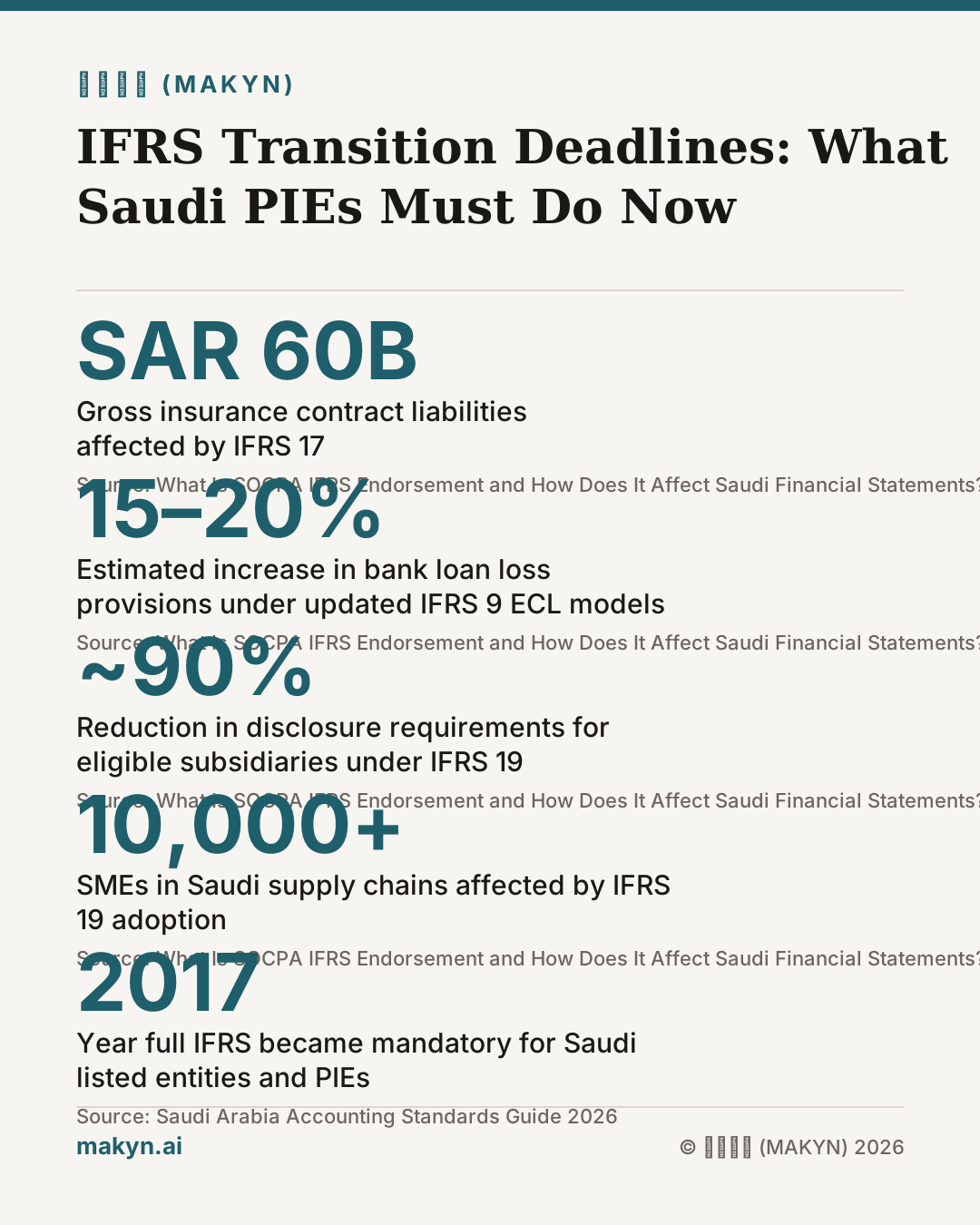
SOCPA's mandate covers the endorsement and enforcement of IFRS standards across the Kingdom. Listed entities and other PIEs have been required to apply full IFRS since 2017 2. What has changed is the depth of the compliance review cycle. Inspectors are now examining the process of adoption — not just the output.
A review typically probes four questions that go beyond the financial statements themselves:
- Policy authorization — Was each accounting policy decision signed off by the appropriate governance level (board, audit committee, CFO)?
- Timeline evidence — Can the entity demonstrate the policy was documented and communicated before the reporting period it governs, not retrospectively?
- Staff acknowledgment — Is there evidence that the relevant accounting personnel were informed and trained?
- Comparatives and restatements — Are the prior-period comparative adjustments supported by working papers that show the calculation methodology, not just the result?
Most Saudi accounting offices preparing PIE financial statements have strong technical IFRS knowledge. The failure mode is procedural: the audit trail that proves the process happened is thin or missing entirely.
The Five Disclosure and Documentation Checkpoints PIEs Fail Most Often
Based on the current SOCPA review landscape and the standards now in active transition, five checkpoints generate the most findings:
-
IFRS 17 transition workings — IFRS 17 (Insurance Contracts), effective from 2025, requires reporting liabilities using current estimates rather than historical costs. Saudi Central Bank (SAMA) data indicates this affects over SAR 60 billion in gross insurance contract liabilities across the market 1. The common failure is not the accounting model itself but the absence of a documented business case explaining why a particular transition approach (full retrospective, modified retrospective, or fair value) was selected over the alternatives.
-
IFRS 9 Expected Credit Loss model documentation — New SOCPA amendments to IFRS 9 take effect for 2026 reporting, tightening the Expected Credit Loss (ECL) models. Quantitative impact studies suggest banks in the Kingdom may need to increase loan loss provisions by an average of 15–20% to comply with the updated forward-looking economic scenarios 1. The ECL model inputs and assumptions must be documented, version-controlled, and reviewed at each reporting date. Reviewers want to see that history; many firms have only the period-end output.
-
IFRS 19 eligibility determination — IFRS 19 (Subsidiaries without Public Accountability) was formally adopted in Saudi Arabia in December 2024 1. The standard is expected to reduce disclosure requirements for eligible subsidiaries by nearly 90%, affecting over 10,000 SMEs operating in Saudi supply chains 1. The eligibility decision — whether a subsidiary qualifies for the reduced framework — must itself be documented and approved. Firms treating IFRS 19 adoption as automatic are creating an eligibility-determination gap.
-
IFRS 16 lease liability reconciliation — Lease reclassifications under IFRS 16 frequently produce residual differences when compared with prior GAAP figures. The reconciliation working papers must explain each line, not simply present a net difference.
-
Transition disclosure note completeness — The financial statement notes must include quantified impact disclosures for each standard adopted or amended in the period. Reviewers check whether the note was drafted before the financial statements were finalized or appended retrospectively. Metadata on file creation dates has become a practical inspection tool.
For a broader view of why documentation gaps are structurally difficult to close after the fact, see our analysis of audit trails for regulatory notices in Saudi Arabia.
How the Transition Intersects with ZATCA Reporting and Zakat Base Adjustments
The Zakat, Tax and Customs Authority (هيئة الزكاة والضريبة والجمارك — ZATCA) calculates Zakat liability against a statutory base that references the entity's financial statements. IFRS transition adjustments — reclassifying lease liabilities under IFRS 16, recognizing previously off-balance-sheet items, or restating financial instrument values under IFRS 9 — can materially change the figures ZATCA uses 2.
This creates a dual audit-trail obligation that most firms are not operationally structured to meet:
- The IFRS trail — documenting why the accounting treatment changed and how comparatives were restated.
- The Zakat trail — documenting how each IFRS movement was treated for Zakat base purposes: included, excluded, or adjusted under the Zakat regulations that govern each item category.
A single restatement project — even a technically excellent one — cannot satisfy both obligations simultaneously, because the two trails answer different questions to different regulators on different timelines. ZATCA's review of Zakat base adjustments is not synchronized with SOCPA's IFRS inspection cycle. Both can occur, independently, years after the transition date 2.
For teams managing the Zakat filing side of this equation, the Zakat filing lifecycle and where internal compliance teams lose control is directly relevant.
Building an Audit Trail That Survives a SOCPA Inspection
The structural requirement is a living compliance register, not a year-end documentation exercise. An audit trail that survives a SOCPA inspection has three properties:
It is timestamped at the point of decision, not at the point of filing. Every policy election — the IFRS 17 transition approach, the IFRS 9 ECL model calibration, the IFRS 19 eligibility determination — must be recorded with a creation date that predates the period the decision governs. Retrospective documentation is traceable and will be identified.
It carries a named approval. The document must identify who authorized the decision, in what capacity, and with reference to the governance instrument (board resolution, audit committee minute, CFO authorization policy) that gives them that authority. Anonymous or undated sign-offs do not satisfy the procedural standard.
It cross-references the Zakat and tax treatment. Each IFRS accounting decision that affects a balance sheet line should be accompanied by a note — however brief — explaining whether and how the Zakat or VAT treatment diverges. This cross-reference is what allows the two regulatory trails to stay consistent without being conflated.
Teams managing multi-client portfolios face a compounding version of this problem: the same policy elections must be tracked separately for each PIE client, with client-specific approval chains and timelines. Managing multi-client compliance without delegation failure covers the structural controls that prevent cross-contamination of client records.
The AI Bookkeeping Tools Miss What Saudi Offices Actually Need article documents a parallel failure mode: automation tools that handle transaction processing competently but generate no governance-level documentation trail — exactly the layer SOCPA is now inspecting.
MAKYN's View: Treat IFRS Transition as a Process Problem, Not an Accounting Problem
The technical accounting knowledge required to implement IFRS 17, IFRS 9, or IFRS 16 correctly exists in Saudi accounting offices. The gap is not in the accounting. It is in the infrastructure that produces, stores, routes, and timestamps the decisions that precede the accounting entries.
SOCPA's inspection methodology reflects a regulatory maturity that the Kingdom's financial reporting framework has been building toward since the 2017 full-IFRS mandate. The 2024–2026 wave of standard amendments — IFRS 17 affecting SAR 60 billion in insurance liabilities, IFRS 9 ECL model tightening, IFRS 19 for SME subsidiaries 1 — is not a one-time event. It is the rhythm of a living standards framework. Every endorsement cycle produces new elections that require the same documented-approval structure.
Firms that respond to this by hiring one IFRS specialist and building a static transition memo are solving the wrong problem. The compliance operations question is: how does your office ensure that every future policy election, for every PIE client, is documented, approved, timestamped, cross-referenced to Zakat treatment, and retrievable in under two hours when a SOCPA inspector arrives?
That is a process and system design question, not an accounting question. Offices that answer it with a workflow rather than a memo will not need to rebuild their audit trail from scratch when the next standard amendment arrives.
If your office is assessing where the documentation gaps sit across your PIE client base, request a walkthrough of how MAKYN structures compliance-operations workflows for accounting firms managing SOCPA and ZATCA obligations simultaneously.
Footnotes
Frequently asked
- What does SOCPA actually review during an IFRS compliance inspection?
- SOCPA inspections go beyond verifying which standards a company has adopted. Reviewers examine whether each policy decision was documented, approved by a competent authority, and communicated to relevant stakeholders on time. The absence of that approval chain—even when the accounting treatment is technically correct—is itself a compliance failure that can result in qualified audit opinions or regulatory referral.
- Which IFRS standards carry the most immediate risk for Saudi public interest entities in 2025–2026?
- IFRS 17, effective 2025, requires insurers to report liabilities using current estimates rather than historical costs, affecting over SAR 60 billion in gross insurance contract liabilities across the Saudi market. IFRS 9 amendments effective for 2026 tighten Expected Credit Loss models, potentially requiring Saudi banks to increase loan loss provisions by 15–20%. Both demand documented transition plans, not just restated numbers.
- How does IFRS transition affect a company's Zakat base with ZATCA?
- IFRS transition adjustments—reclassifying lease liabilities under IFRS 16, recognising previously off-balance-sheet items, or restating financial instrument values under IFRS 9—can materially alter the figures ZATCA uses to calculate the Zakat base. Each adjustment requires a separate documented reconciliation trail that demonstrates how the IFRS movement was treated for Zakat purposes. Without it, the Zakat filing and the financial statements tell contradictory stories.
- What is IFRS 19 and which Saudi entities does it affect?
- IFRS 19 (Subsidiaries without Public Accountability) was formally adopted in Saudi Arabia in December 2024. It reduces disclosure requirements for eligible subsidiaries by nearly 90%, significantly lowering compliance costs. The standard is expected to affect over 10,000 SMEs operating within Saudi supply chains. Entities must confirm eligibility and document the decision to apply the reduced framework—eligibility is not assumed automatically.