Digital Compliance in Saudi Arabia: What Accounting Offices Need
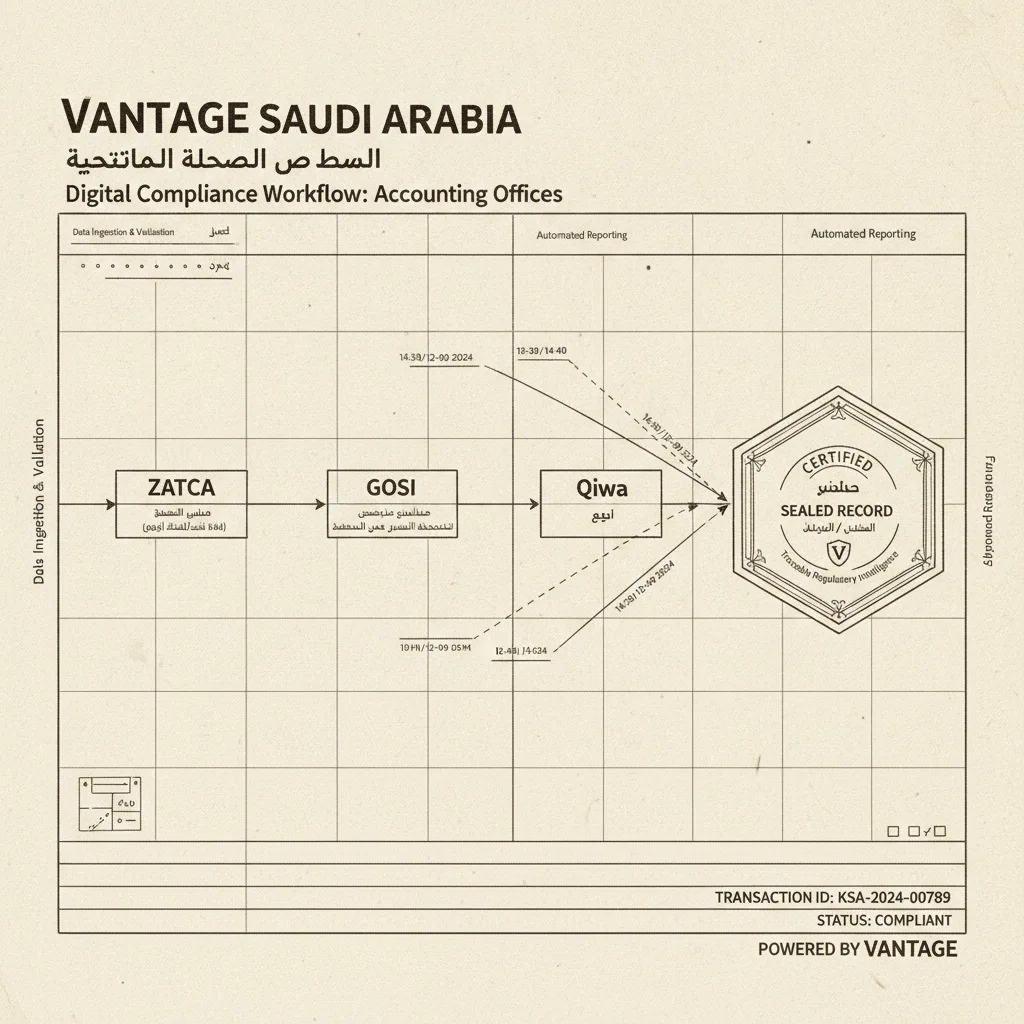
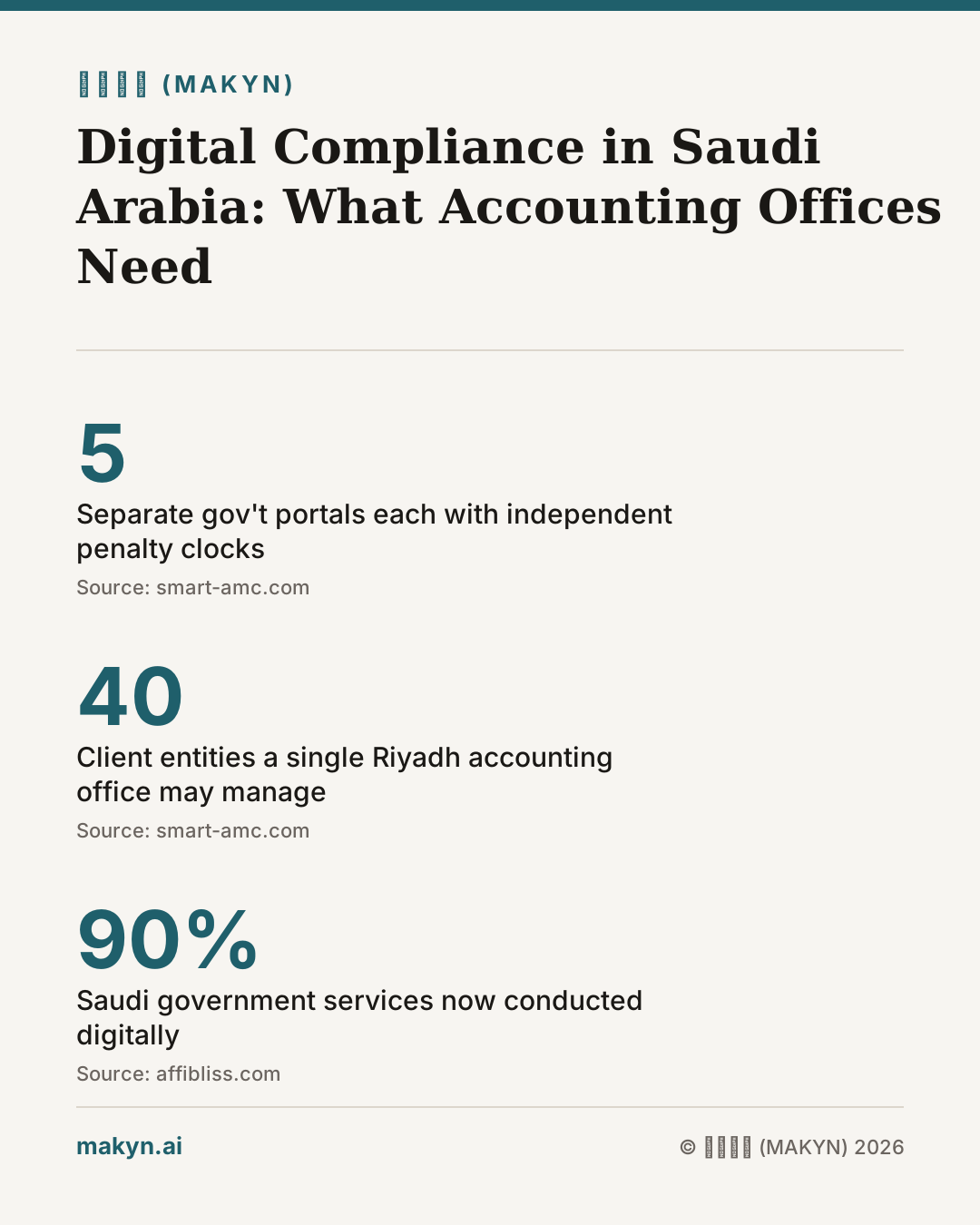
An accounting office in Riyadh managing forty client entities faces a specific, concrete problem: five government portals — هيئة الزكاة والضريبة والجمارك (ZATCA), the General Organization for Social Insurance (GOSI), Qiwa, Nitaqat, and Mudad — each issue notices through separate interfaces, on independent schedules, with independent penalty clocks. [1] Missing one notice is not a workflow inconvenience; it is the start of a penalty exposure that an audit committee will ask to see documented, end to end.
Into that environment, Vantage has launched a digitally streamlined corporate services platform across Saudi Arabia and the UAE, combining senior-led advisory with digital onboarding, automation, and "traceable workflows." [2] The launch is a credible signal that the Gulf market is consolidating around the idea of integrated compliance delivery. It is not, however, a solution to the notification blindspot. The two problems are related but structurally distinct.
What 'Digital Compliance Services' Actually Means in the Saudi Market
The phrase covers a wide range of operational realities. At the entry level, it means replacing paper-based client onboarding with digital forms, consolidating service requests under one account manager, and providing clients a portal where they can track progress on company formation, licensing, or payroll setup.
At the infrastructure level — where regulatory risk actually lives — it means continuous, machine-readable ingestion of notices from each government platform, automatic extraction of the specific obligation embedded in each notice, and a timestamped record of what was done about it. These two levels are not the same product, and the market rarely distinguishes between them cleanly.
Vantage's model is explicit about traceable workflows and reduced administrative friction. [2] What remains unclear in any such platform launch is whether the traceability extends to the notice layer — the moment a ZATCA portal flags a rejected invoice batch, or a GOSI contribution ceiling changes, or a Qiwa service request approaches its SLA limit — rather than to the service-delivery workflow that happens afterward.
The Three Regulatory Channels Most Offices Still Monitor Manually
Saudi Arabia now operates a multi-platform compliance architecture that no single team can track with spreadsheets and periodic logins. [1] Three channels carry disproportionate risk:
-
هيئة الزكاة والضريبة والجمارك (ZATCA) — e-invoicing and tax filings. Phase 2 of Fatoorah requires live integration with ZATCA's clearance and reporting APIs. [1] A rejected invoice batch triggers a status change in the portal. If that change is not caught within the SLA window, the downstream penalties accumulate before a human review cycle discovers them. Cloud accounting adoption is accelerating precisely because ZATCA's Phase 2 makes real-time transaction reporting mandatory, not optional. [3]
-
GOSI — social insurance contributions. Contribution rates, salary ceilings, and calculation rules for both Saudi and non-Saudi employees have changed multiple times recently. [1] Static payroll logic drifts out of compliance quietly — no alert, no notice in an obvious channel, just a growing gap between what was filed and what the current regulation requires.
-
Qiwa — labor relations and work permits. Employment contracts, job-nationality percentages, and work-permit transfers each carry strict SLA deadlines. [1] An overdue Qiwa service request does not produce a dramatic error; it produces a silent freeze on company services that typically becomes visible only when a downstream transaction fails.
All three of these channels require active, continuous monitoring at the notice level. Monitoring them manually — logging into each portal on a human-determined schedule — is structurally inadequate for a portfolio of multiple client entities.
Why Streamlined Delivery ≠ Closed Notification Gaps
The distinction that matters here is architectural, not cosmetic. A streamlined compliance-delivery model solves the coordination problem: one account manager, one client portal, one invoice. That is genuine operational value for a business entering the Saudi market or managing payroll across multiple entities.
What it does not solve is the ingestion problem: the automatic, timestamped capture of a regulatory notice at the moment it is issued, the extraction of the specific obligation embedded in it, and the routing of that obligation to the person or system responsible for acting within the required window.
Consider the workflow failure mode: a GOSI contribution ceiling changes on a Tuesday. The change is reflected in the GOSI portal. An accounting office that logs into that portal every Thursday misses two days of exposure. If that office manages 40 clients, the compounding exposure across entities is not a trivial administrative gap — it is a documentable compliance failure.
Ninety percent of Saudi government services are now conducted digitally, with Qiwa and other platforms requiring integrated business software to interact with them properly. [3] That level of digital penetration does not reduce the monitoring burden; it increases it, because the volume of machine-issued notices scales with the number of digitized touchpoints.
For a deeper look at how audit trails function at the invoice level under ZATCA's framework, see our piece on سجل المراجعة للفواتير الإلكترونية: متطلبات زاتكا والفجوة الخفية.
MAKYN's View: The Audit-Trail Problem Nobody Is Selling Against
The market is moving toward digital delivery. That is the right direction. But the product category being built — "digital compliance services" — is largely being defined around service-delivery traceability rather than regulatory-notice traceability. The two are not equivalent, and the gap between them is where penalties accumulate.
Here is the specific failure mode that a genuine regulatory-intelligence layer must address:
- A notice arrives from ZATCA, GOSI, or Qiwa.
- The notice contains a specific obligation with a specific deadline.
- The obligation must be extracted, not just stored.
- The extraction must be timestamped — when was it read, by what system.
- The obligation must be routed to the responsible party, with a deadline.
- The action taken must be recorded against the original notice.
- The complete chain — notice, extraction, routing, action — must be retrievable in full for audit.
None of steps 2 through 7 are solved by a well-designed client portal or a streamlined onboarding workflow. They require a system that treats the regulatory notice as the primary data object, not the service request it might eventually generate.
This is not a theoretical concern. When a Saudi holding group faces a VAT assessment dispute or a GOSI contribution challenge, the auditor asks: when did you know, what did you do, and can you prove it? A traceable workflow answers the third question only if it begins at the notice, not at the service ticket.
For holding groups managing compliance across multiple entities, the structural version of this problem is examined in detail in Compliance Aggregation for Saudi Holding Groups: The Structural Problem.
What a Real Regulatory-Intelligence Layer Looks Like in Practice
A regulatory-intelligence layer, as distinct from a compliance-delivery platform, has four functional requirements:
-
Source-level ingestion. The system connects directly to ZATCA, GOSI, Qiwa, Nitaqat, and Mudad portals — not through periodic exports, but through continuous or near-continuous reads that capture notices at or near the time of issuance. [1]
-
Obligation extraction. Each notice contains a specific obligation: a deadline, a filing requirement, a document request, a status change. The system must extract that obligation as a structured data object, separate from the notice text, so it can be tracked, assigned, and closed independently.
-
Arabic as source of truth. Saudi regulatory notices are issued in Arabic. Any system that translates, summarizes, or paraphrases before extracting obligations introduces interpretive risk. The Arabic text of the notice must be the authoritative record.
-
Closed-loop audit trail. Every step from ingestion to action must be logged with a timestamp and a responsible party. The audit trail must be exportable in a format that an external auditor or regulator can review without depending on the platform vendor's cooperation.
This architecture is what separates a monitoring system from an intelligence layer. Accounting offices and holding-group finance teams that are evaluating new compliance platforms should ask, specifically, which of these four capabilities the platform delivers — and request a demonstration of the audit trail under a simulated ZATCA notice scenario.
For an evaluation framework applicable to current Saudi compliance software offerings, see Evaluating Saudi Compliance Management Software: A Buying Framework. And for the specific question of how AI verification must sit alongside any automated reading of regulatory notices, see لماذا لا تكفي الذكاء الاصطناعي وحده في الامتثال الضريبي.
If your office is ready to move from a service-delivery model to a regulatory-intelligence layer, اطلب عرضاً توضيحياً to see how MAKYN handles the full notice-to-audit-trail chain across ZATCA, GOSI, and Qiwa clients.
Frequently asked
- What does 'digital compliance' actually mean for Saudi accounting offices?
- The term covers a wide spectrum. At the surface level, it means digital onboarding, traceable workflows, and consolidated reporting across service lines. At the infrastructure level, it means real-time ingestion of regulatory notices from ZATCA, GOSI, and Qiwa, extraction of obligations, deadline mapping, and a timestamped audit trail for every action taken. Most market offerings today operate at the surface level only.
- Why is monitoring هيئة الزكاة والضريبة والجمارك manually still a risk in 2026?
- ZATCA's Phase 2 e-invoicing integration requires live clearance and reporting API connections. A missed notice — a compliance query, a rejected invoice batch, a portal status change — can trigger penalties before a team that logs in periodically discovers the issue. Manual monitoring assumes the team checks at the right frequency; regulators do not wait for that cadence.
- What is the difference between a traceable workflow and a regulatory audit trail?
- A traceable workflow records what a service provider did for a client. A regulatory audit trail records what obligation arrived, when it was read, who was assigned to act, what action was taken, and when. The second is what Saudi regulators and internal audit committees require when a penalty is disputed or a VAT assessment is challenged. The two are not the same product.
- Which Saudi government platforms carry the highest unmonitored notification risk?
- GOSI, Qiwa, and ZATCA each issue notices through separate portals with independent SLA clocks. GOSI contribution rates and salary ceilings have changed multiple times recently, creating silent drift in payroll compliance. Qiwa carries strict service-request SLAs. ZATCA's clearance API can reject invoice batches in real time. All three require continuous monitoring, not periodic manual checks.
Sources
- 1. Saudi HR-Compliance Automation (Nitaqat, GOSI, Qiwa, WPS, ZATCA) Explained | Smart AMC — smart-amc.com
- 2. Vantage Launches Digital Corporate Services Platform Across Saudi Arabia and the UAE — techrevolt.news
- 3. Cloud Accounting for SMEs in Saudi Arabia 2026 – affibliss — affibliss.com