What Software Accreditation Really Means for ZATCA Compliance
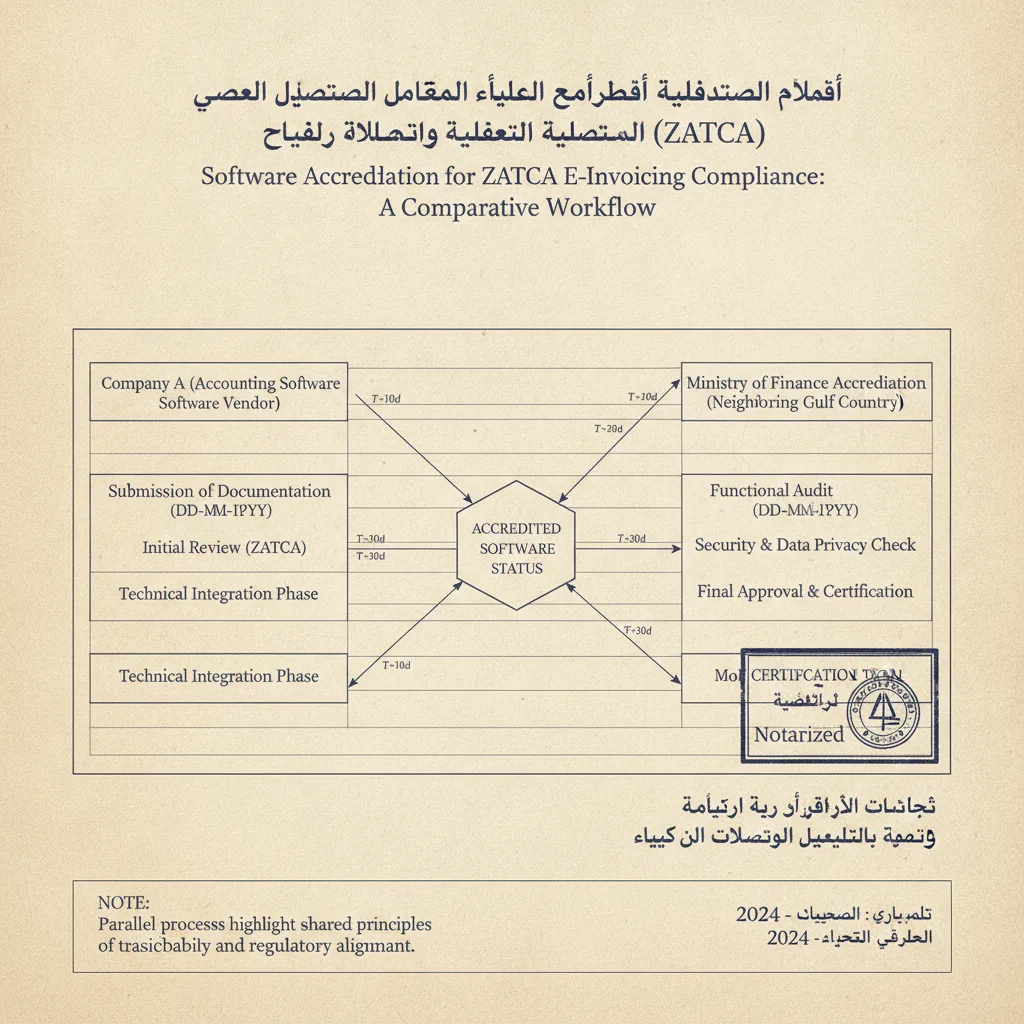
A Saudi accounting office onboards a new billing tool in late 2024. The vendor's website carries the word "ZATCA-compliant" in bold. The contract is signed, the invoices flow, and the compliance box is mentally ticked. What the office does not check — because the question was never asked — is whether the software holds a formal integration accreditation, or whether it merely generates invoices that look correct without the cryptographic stamps, UUID references, and real-time FATOORA connectivity that Phase 2 actually requires. The audit that surfaces this distinction may arrive in 2026 or 2027. By then, the transaction record is fixed and the options are few.
What "accredited service provider" actually means — and why it is not just a badge
In the context of ZATCA's e-invoicing framework, accreditation is a technical certification, not a brand endorsement. It means the software has been tested against ZATCA's published e-invoicing detailed guidelines — the FATOORAH documentation — and confirmed to produce invoices that meet structural, cryptographic, and transmission requirements.<sup>1</sup>
The distinction matters because Phase 2 is an integration requirement, not merely a formatting one. A system that outputs a valid-looking XML invoice but cannot connect to the FATOORA platform, cannot apply the required cryptographic stamp, or routes data through an intermediary that itself lacks accreditation does not satisfy Phase 2 obligations.<sup>2</sup> The invoice exists; the compliance chain does not.
Accreditation confirms three things simultaneously: the software's output format is correct; the transmission pathway is authenticated; and the resulting data is auditable by ZATCA in real time. A vendor that claims "compliance" without the accreditation certificate conflates the first item with all three.
ZATCA's e-invoicing integration tiers: where most Saudi offices currently sit
ZATCA's Phase 2 roll-out follows a wave structure, onboarding successive taxpayer groups into real-time integration with the FATOORA platform.<sup>1</sup> Each wave raises the evidentiary floor for what an audit will demand. The practical result is a tiered landscape:
- Fully integrated: The accounting system connects directly to FATOORA, stamps invoices cryptographically, and receives clearance or reporting confirmation in real time. Audit exposure is minimal — the trail is continuous and ZATCA-readable.
- Phase 1 compliant only: The system generates structured e-invoices meeting Phase 1 format requirements but has not been upgraded for Phase 2 integration. The invoice record exists; the real-time link does not. This gap is invisible today and consequential tomorrow.
- Informally compliant: The system exports invoices in a format that resembles compliance but has not been tested or certified. Marketing copy substitutes for technical documentation. This is the highest-risk category.
Most Saudi accounting offices that adopted billing software between 2021 and 2023 sit in the second or third tier. The urgency of Phase 2 waves was not yet apparent at procurement; the question of FATOORA integration was not a standard due-diligence item. It must become one now.
The audit-trail exposure hiding inside unaccredited software connections
ZATCA's updated e-invoicing detailed guidelines clarify exactly what auditors will examine when a taxpayer group is called for review.<sup>1</sup> The evidentiary standard includes: a complete invoice archive in the prescribed XML format; cryptographic stamps that prove the invoice was not altered after issuance; and FATOORA clearance references or reporting confirmations for each applicable transaction.<sup>2</sup>
Unaccredited software typically cannot produce items two and three retroactively. A cryptographic stamp is applied at the moment of issuance; it cannot be backdated. A FATOORA clearance reference presupposes a live integration at the time the invoice was issued. Neither can be reconstructed from a PDF export or a database dump.
This is the deferred nature of the risk. The office that ran unaccredited software in 2024 will not receive a notice in 2024. It will receive one when ZATCA's audit wave reaches its taxpayer tier — potentially in 2026 or beyond — and the examiner asks for the cryptographic archive. The answer "our old system did not support that" is not a mitigation; it is a confirmed finding. Preparing for ZATCA audits now means understanding that real-time integration visibility means the historical record, once incomplete, cannot be quietly completed later.<sup>1</sup>
For a structured approach to tracking ZATCA notifications before they become audit findings, see How Accounting Firms Should Track ZATCA Notifications Systematically.
How to evaluate a vendor's ZATCA compliance posture before you sign
Treating accreditation as a procurement gate means building specific checks into the vendor evaluation process. The following framework applies to any new software acquisition or renewal decision:
- Request the accreditation certificate directly. ZATCA maintains records of accredited solution providers. Ask the vendor for its certificate reference and verify it independently. "We are ZATCA-compliant" without a certificate number is not verifiable.
- Establish the integration tier. Ask which Phase 2 wave the vendor was onboarded to, and confirm that the integration covers the entity types in your client portfolio — including simplified invoices if applicable.
- Confirm FATOORA connectivity and cryptographic stamp support. Ask for technical documentation, not a sales deck. The documentation should specify how stamps are applied and how clearance references are stored and retrievable.
- Test the audit-recall function. Can the system produce a structured XML archive with cryptographic stamps for a defined historical period, on demand? A 3-year recall window is the practical minimum for audit readiness.
- Check the intermediary chain. If the vendor routes invoices through a third-party clearing service, that service must also be accredited. A compliant front-end feeding an unaccredited intermediary inherits the intermediary's gap.
For a broader evaluation framework covering Saudi compliance software across functions, the Evaluating Saudi Compliance Management Software: A Buying Framework provides a structured buying methodology.
MAKYN's view: accreditation is a floor, not a ceiling — what comes after
The accreditation requirement is necessary but not sufficient. An accredited system that requires manual intervention to reconcile invoices, that does not surface ZATCA notifications within the action window, or that cannot present audit-ready documentation to a non-technical manager has met the legal minimum while leaving operational risk unaddressed.
The 80/20 inversion that defines most Saudi accounting offices' compliance posture — where the majority of staff time goes to reading and cross-referencing notices rather than acting on them — does not disappear because the invoicing software is accredited. It continues in a different register: now the bottleneck is not the invoice itself but the workflow that surrounds it. Who received the ZATCA notice? Was it opened? Was the two-minute action window identified? Was the correct entity mapped to the correct response obligation?
Accreditation resolves the data-origin question. It does not resolve the workflow question. MAKYN is built for the latter: reading every ZATCA notification at source, extracting the entity, deadline, and required action, and routing it to the responsible person without the notice sitting unread in a shared inbox. The accreditation certificate tells you the invoice was correctly issued. MAKYN tells you what ZATCA has said about it since — and what needs to happen next.
For firms also managing GOSI and Qiwa obligations alongside ZATCA, the compliance surface is wider. The What a Qiwa–GOSI Compliance Dashboard Must Show an Accountant article maps that parallel obligation landscape.
Accreditation is the starting line. If your current invoicing software cannot produce a certified FATOORA integration reference, the time to correct that is before the next audit wave, not during it. اطلب عرضاً توضيحياً لمعرفة كيف تدير مكتبك بمسار تدقيق متكامل ومتوافق.
Frequently asked
- What does it mean for accounting software to be ZATCA-accredited?
- ZATCA accreditation means the software has been tested and approved to generate e-invoices that meet the Authority's technical and procedural requirements — including XML structure, cryptographic stamps, and real-time integration with the FATOORA platform under Phase 2. It is a formal compliance credential, not a self-declared marketing claim, and it determines whether invoices are legally recognised during an audit.
- What is the difference between Phase 1 and Phase 2 of ZATCA e-invoicing?
- Phase 1 required businesses to generate structured electronic invoices but did not mandate real-time reporting to ZATCA. Phase 2 adds continuous integration: invoices must be cryptographically stamped and reported to the FATOORA platform, giving ZATCA auditors live visibility into invoicing data. Phase 2 is being rolled out in successive waves, progressively expanding to more taxpayer groups.
- What audit risk does unaccredited software create for a Saudi accounting office?
- Unaccredited software typically cannot produce the cryptographic stamps, UUID references, and XML formats ZATCA requires under Phase 2. If audited, the office cannot demonstrate a compliant invoice trail for past periods. Because ZATCA retains the right to audit historical transactions, this gap may surface years after the fact — when corrective options are limited and penalties accumulate.
- How should a Saudi accounting office assess a vendor's ZATCA compliance posture?
- Request the vendor's official ZATCA accreditation certificate and its integration tier classification. Verify FATOORA platform connectivity and ask for documented evidence of cryptographic stamp support. Check which Phase 2 wave the vendor was onboarded to and confirm that the integration covers your client entity types. Marketing materials are not a substitute for documented technical certification.