Nitaqat Compliance for Accounting Offices in Saudi Arabia
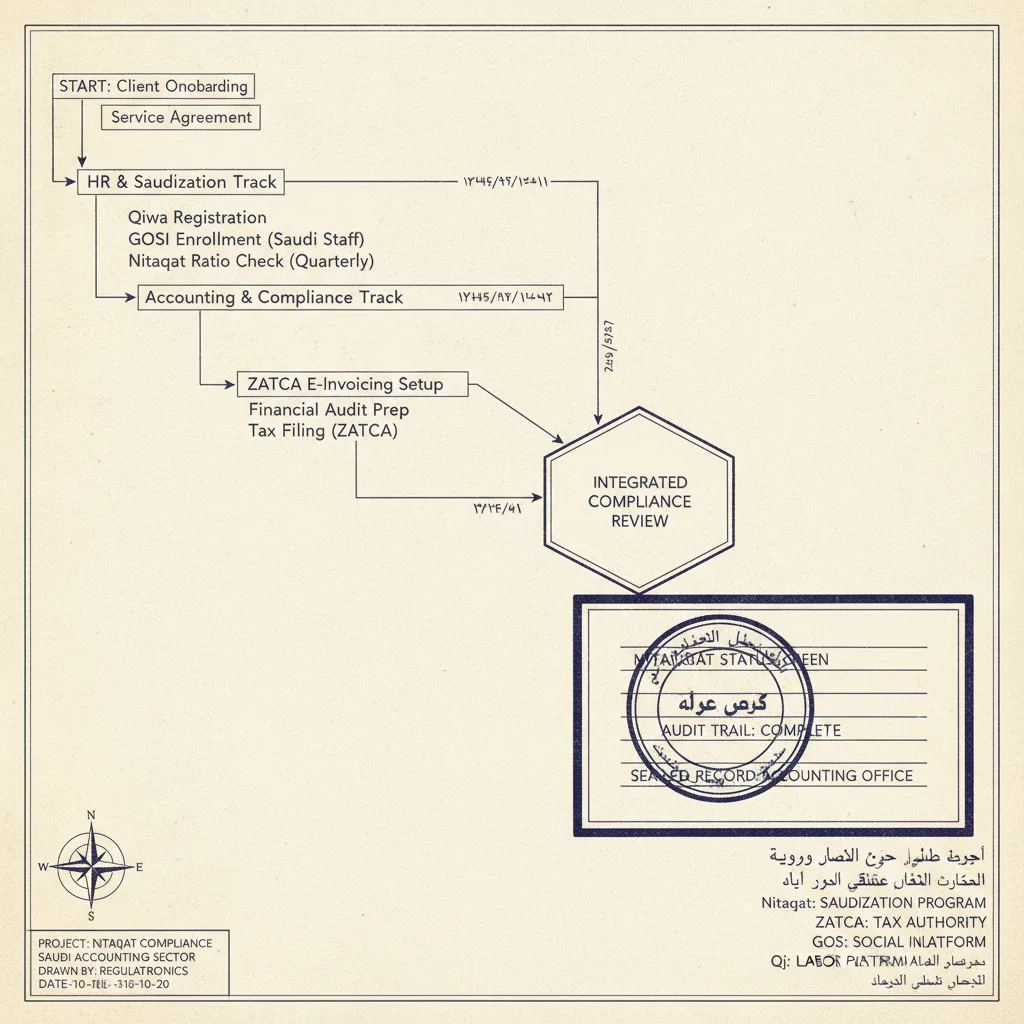
An accounting office that loses a single senior Saudi employee in October — weeks before the General Authority of Zakat, Tax and Customs Authority's quarterly deadlines — can find itself reclassified from High Green to Red before its managing partner realizes anything has changed. That reclassification is not an HR statistic. It is a licensing event.
Yet the majority of accounting and consulting offices in the Kingdom still delegate Nitaqat monitoring to their HR coordinators, treat it as a payroll side-task, and produce documentation only when an inspector requests it. The program managed by the Ministry of Human Resources and Social Development (MHRSD) is precise, sector-sensitive, and periodically recalculated — and the professional services sector sits at the stricter end of its tolerance range [1].
How the Nitaqat Band System Actually Works
Nitaqat classifies every private-sector establishment into one of five color-coded bands: Platinum, High Green, Medium Green, Low Green, and Red. Classification is driven by the ratio of Saudi nationals to total workforce, cross-referenced against firm size and sector [1].
The consequences of each band are not symmetrical. Platinum status gives a firm expedited processing at the MHRSD and priority handling on labor applications. Red status does the opposite: it blocks the issuance of new expatriate work permits and prevents the renewal of existing ones [1]. For a mid-sized accounting office where two or three specialized foreign accountants carry the VAT and zakat workload, an inability to renew their permits is an immediate capacity crisis.
What firms in the professional services sector consistently underestimate is that there is no single annual recalculation date. Band status is updated periodically against live workforce data [2]. A departure, a contract-type change, or an unregistered secondment can shift the ratio before the next compliance review cycle.
Why Accounting Firms Face Stricter Enforcement Than Contractors
The professional services sector — which includes accounting, auditing, tax advisory, and management consulting — operates under Saudization targets that are generally higher than those applied to the construction and contracting sector. The rationale is policy-driven: these are knowledge-economy roles the Kingdom's Vision 2030 employment agenda specifically targets for Saudi nationals.
This means the buffer a contracting firm might have between its current Saudi headcount and its minimum threshold does not translate to a professional services firm of equivalent size. A contracting company with 50 employees may have a considerably lower required Saudization percentage than an accounting office with the same headcount [2].
The practical consequence: accounting offices are closer to band boundaries at any given moment. Staff turnover, maternity leave not reflected in active employment records, or a Saudi employee whose Qiwa contract registration has lapsed can all constitute de facto headcount reductions in the MHRSD's calculation. None of these scenarios require any deliberate non-compliance — they are administrative gaps that compound into reclassification risk.
The Five Risk Scenarios That Trigger Reclassification
Offices that have been reclassified unexpectedly tend to trace the cause to one of five operational failures:
- Unregistered departures — A Saudi employee resigns, but the Qiwa contract is not terminated promptly. The employee stops appearing in GOSI contribution records but remains on the payroll system. MHRSD's calculation uses GOSI-confirmed, actively enrolled nationals; the mismatch creates a phantom headcount.
- Secondment without reregistration — A Saudi national is lent to a client engagement and registered on the client's GOSI file temporarily. The home office's ratio drops during the secondment period.
- Part-time misclassification — Part-time Saudi employees may count at a fractional rate toward Saudization targets depending on MHRSD sector rules. Offices that count them at full weight overstate their compliant headcount.
- New expatriate hire without ratio check — A partner approves a foreign specialist hire to meet a project deadline without verifying that the new hire will push the expatriate-to-Saudi ratio past the band threshold.
- Ownership-level changes — A restructuring that changes the commercial registration category, even without changing the workforce, can shift which sector's Saudization target applies.
Each of these is preventable with a monitoring structure that connects payroll, GOSI enrollment, and Qiwa registration data in real time — rather than reconciling them manually each quarter [3].
What Penalties Are Triggered at Each Threshold
The Red band is the most visible penalty, but the cascade begins before a firm reaches it [1]:
- Low Green: The firm retains permit issuance rights but loses access to MHRSD premium services. It cannot recruit from certain nationalities subject to protected-ratio rules. Processing times for any labor application lengthen.
- Red: New work permit issuance is suspended. Existing expatriate permits may still be renewed, but the path narrows. If the firm's Red status persists across consecutive recalculation cycles, it begins to affect the firm's standing with other regulators — including the Ministry of Commerce for commercial license renewals.
- Sustained Red (multi-cycle): At this stage, the licensing consequences extend beyond MHRSD. A firm whose commercial registration renewal is flagged against Red Nitaqat status faces a practical licensing suspension, which in an accounting context means it cannot legally represent clients before ZATCA, GOSI, or other authorities [2].
The licensing linkage is the element most principals miss. They understand that Red means permit trouble. They do not always understand that sustained Red can translate into the firm being unable to operate in a regulated advisory capacity.
The Documentation Standard for Contesting a Reclassification
When an accounting office believes its reclassification is wrong — a genuine administrative error rather than a substantive ratio shortfall — it must file a formal challenge with the MHRSD. The challenge will not succeed on assertion alone. Three document categories form the minimum defensible file:
- Payroll records with active employment proof — Not just payslips, but bank transfer records showing salary credits to Saudi national employees for the disputed period. MHRSD examiners require evidence that the employment relationship was active, not merely registered.
- GOSI contribution histories — Monthly GOSI contribution receipts for each Saudi national whose headcount is being contested. The contribution history must be continuous and match the employment period exactly. Gaps of even one month create a presumption of non-employment that the firm must affirmatively rebut.
- Qiwa contract registrations — Every Saudi national's employment contract must be registered and current on the Qiwa platform. An unregistered contract means the employee does not exist in MHRSD's administrative universe, regardless of what payroll records show.
All three document types must be timestamped, internally consistent, and retrievable on demand. An office that maintains these records across a shared digital register — rather than in department-specific folders or individual client files — is measurably better positioned to mount a challenge within the response window [3].
For firms managing compliance across multiple client engagements alongside their own internal obligations, the recordkeeping architecture matters as much as the records themselves. A unified approach to maintaining regulatory documentation, as outlined in The Case for a Unified Compliance Register Across Client Portfolios, reduces the retrieval risk that undermines otherwise valid challenges.
Continuous Monitoring Is the Only Defensible Operating Model
The structure of Nitaqat enforcement — periodic recalculation, no fixed review date, sector-specific thresholds — means that point-in-time compliance snapshots are structurally inadequate. An office that checks its band status quarterly may find itself outside the window to act on a reclassification that occurred six weeks earlier.
The Qiwa and GOSI platforms each generate status signals that, read together, give a near-real-time view of an office's Saudization position. What most offices lack is the workflow to route those signals to the person responsible for acting on them within the time window that matters. The audit trail and notice-tracking discipline this requires is not conceptually different from what offices already manage for ZATCA notification deadlines — it is simply applied to a different regulatory data stream. Firms building that capability will find How Accounting Firms Should Track ZATCA Notifications Systematically a useful structural parallel.
The documentation standard for a reclassification challenge — payroll records, GOSI histories, Qiwa registrations — is also exactly the audit trail that a well-run compliance function maintains routinely, not reactively. Offices that have read Audit Trails for Regulatory Notices: What Saudi Law Actually Requires will recognize the overlap.
Makyn's View
Accounting offices occupy an exposed position in the Nitaqat system: higher thresholds than many comparable-size employers in other sectors, a workforce composition that is vulnerable to small headcount changes, and a licensing structure that amplifies the consequences of sustained non-compliance into operational shutdown territory.
The offices that manage this well do not treat Nitaqat as an HR matter. They treat it as a regulated data problem — one that requires the same precision, audit readiness, and real-time visibility they apply to ZATCA filings or GOSI contribution cycles. The documentation does not change; the organizational habit of maintaining it does.
MAKYN reads the compliance signals these platforms generate, extracts the status changes that matter, and routes them to the responsible principal before the recalculation window closes. If your office's current process depends on a quarterly HR report, اطلب عرضاً توضيحياً to see what a continuous monitoring model looks like in practice.
Frequently asked
- What Nitaqat band do accounting and consulting firms typically need to maintain?
- Professional services firms — including accounting and consulting offices — must meet sector-specific Saudization percentages set by the Ministry of Human Resources and Social Development. The exact ratio depends on firm size, but the professional services sector generally carries higher thresholds than contracting. Platinum or High Green status unlocks expedited permit processing; Red status suspends it entirely.
- What happens if an accounting firm drops to the Red Nitaqat band?
- A Red classification means the firm cannot obtain new expatriate work permits or renew existing ones. For an accounting office that relies on specialized foreign professionals during peak ZATCA filing or audit periods, this is a direct operational threat — not merely an HR inconvenience. The restriction persists until the Saudization ratio is restored and the band upgrades.
- Which documents does an accounting firm need to contest a Nitaqat reclassification?
- At minimum, a firm contesting a reclassification should hold: timestamped payroll records proving active salary payments to Saudi nationals, General Organization for Social Insurance contribution histories confirming ongoing enrollment, and Qiwa platform contract registrations for every Saudi employee. Gaps in any of these records weaken a challenge before the Ministry of Human Resources and Social Development.
- How often is Nitaqat status recalculated, and who is responsible for tracking it?
- The Ministry of Human Resources and Social Development recalculates band classifications periodically based on current workforce snapshots. There is no single annual review date — classifications can shift whenever headcount changes. Responsibility falls on the licensed entity, not its HR provider. Treating Nitaqat monitoring as a continuous compliance obligation, rather than a periodic HR task, is the only defensible posture.
Sources
- 1. What You Should Know About Saudization & the Nitaqat Program — ahysp.com
- 2. Saudization (Nitaqat): 2026 Quotas, Bands, Compliance Rules & Penalties | Mercans — mercans.com
- 3. Understanding Saudization and Nitaqat in Saudi Arabia | Envoy Global, Inc — www.envoyglobal.com