Saudi Manufacturing Boom's Hidden Compliance Load
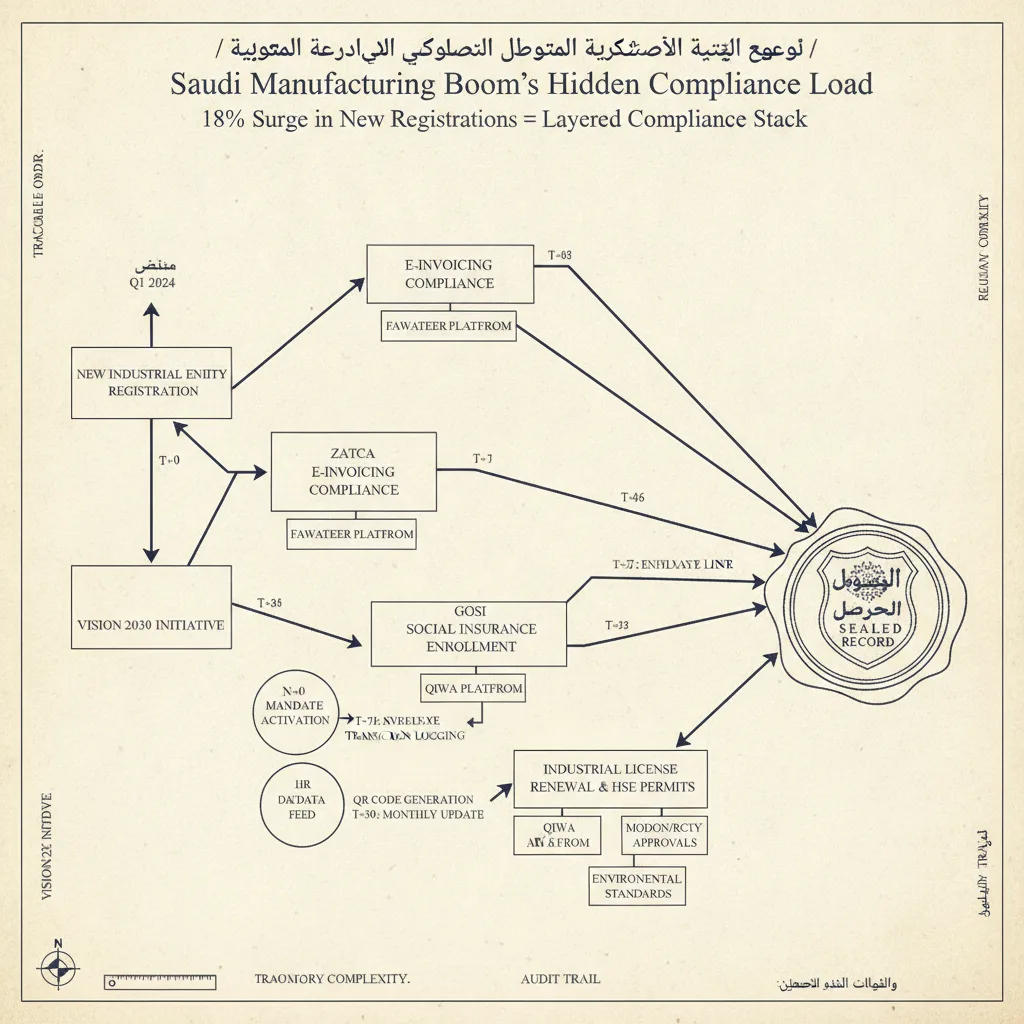
A manufacturer registers its commercial activity with the Ministry of Commerce, receives its file number, and assumes the hard work is done. Within the next 30 days — absent any grace period or government notification — it has already missed the GOSI enrollment window for its first hire, operated without a ZATCA-compliant invoicing system, and started accumulating Nitaqat exposure. The registration certificate is not a permit to operate freely; it is the opening of a compliance clock that runs on multiple, non-synchronized timers.
What the 18% Registration Surge Actually Means on the Ground
Saudi Arabia's manufacturing sector sits at the core of Vision 2030's diversification drive, with the National Industry Strategy providing an explicit framework for industrial development across priority subsectors — automotive components, pharmaceuticals, building materials, and advanced manufacturing in designated cities such as Jubail, Yanbu, and Ras Al-Khair [1]. The ambition is structural: move the economy beyond hydrocarbon processing and build an industrial base that contributes meaningfully to non-oil GDP.
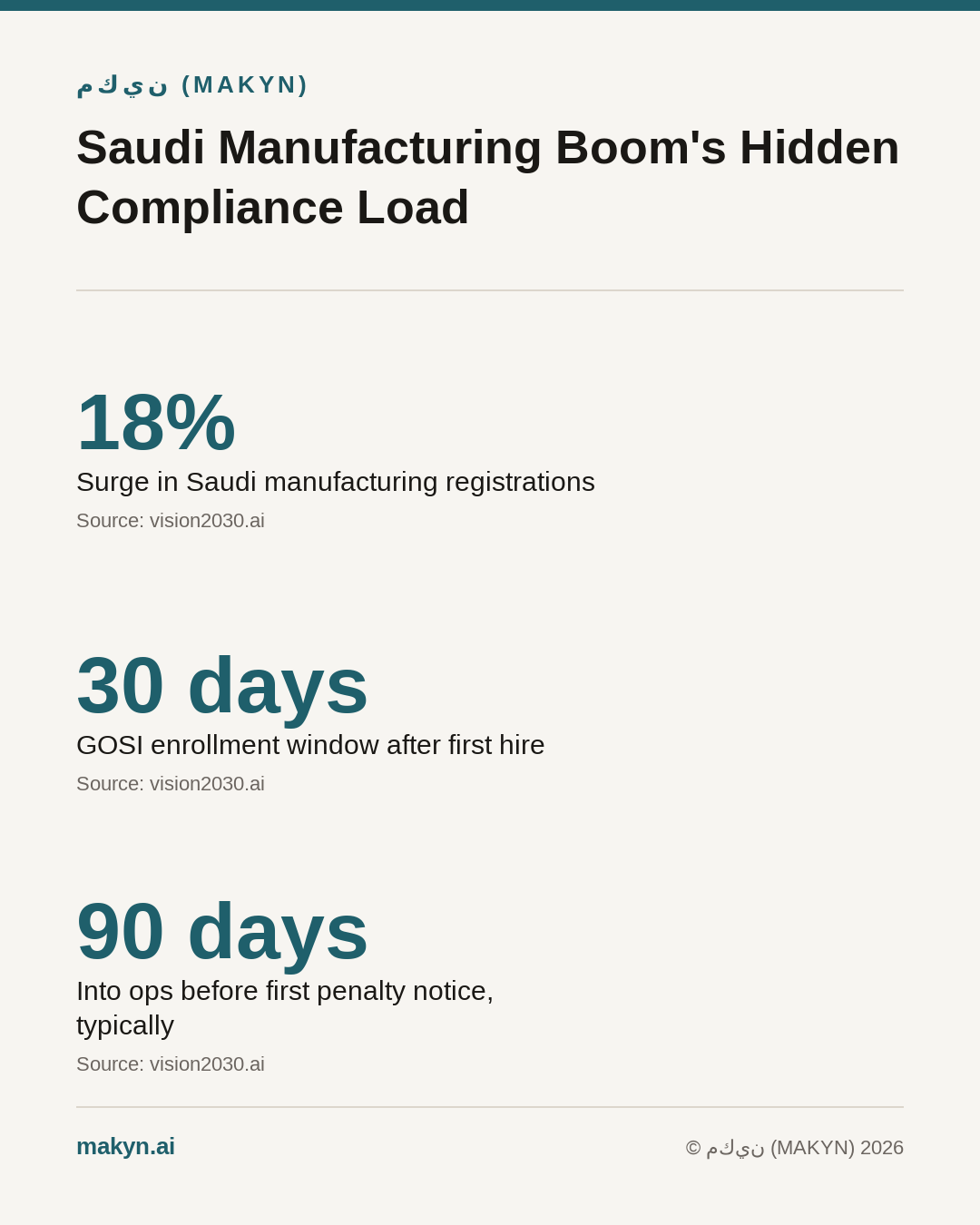
An 18% surge in manufacturing registrations signals that this ambition is translating into action [1]. What it also signals, to anyone managing compliance, is a large cohort of new legal entities that have entered the regulatory ecosystem simultaneously — each one carrying identical statutory obligations from day one, most without a dedicated compliance function in place.
The bottleneck is not capital or logistics. It is awareness. New manufacturers arrive at their first operating day with a business license and no compliance map.
The Compliance Stack Every New Saudi Manufacturer Inherits Immediately
The obligations are not staggered. They activate in sequence across the first weeks of operation, and each one is governed by a different agency with different enforcement timelines:
-
VAT Registration and ZATCA Phase 2 e-invoicing — Any manufacturer expected to exceed the VAT registration threshold must register with the Zakat, Tax and Customs Authority (ZATCA) and immediately comply with Phase 2 FATOORAH requirements. This means every B2B invoice must be issued through a ZATCA-integrated, cryptographically stamped system. There is no provisional period for new registrants.
-
GOSI enrollment — The General Organization for Social Insurance (التأمينات الاجتماعية) requires employer registration and employee enrollment within 30 days of the first hire. Monthly contributions — covering social insurance, occupational hazard, and unemployment insurance — begin in the same payroll cycle.
-
Qiwa registration and Saudization quotas — The Qiwa platform, operated by the Ministry of Human Resources and Social Development, requires all employment contracts to be uploaded and authenticated. Saudization ratios under the Nitaqat system apply from the first payroll run, assigning the entity a compliance band that directly controls its ability to hire and renew work permits for non-Saudi employees.
-
Municipal licensing — A municipal operating license (رخصة البلدية) is required independently of the Ministry of Commerce registration. For manufacturers in MODON industrial cities, an additional city-specific permit applies. The municipal license carries an annual renewal cycle with its own filing calendar.
None of these agencies coordinate their notification to the new entity. The manufacturer must track each obligation independently.
GOSI Enrollment and Saudization: Where New Entities Most Often Stumble
The التأمينات الاجتماعية (GOSI) framework is frequently where new manufacturers incur their first penalty. The structure of contributions involves three components: social insurance, occupational hazard insurance, and — for Saudi employees — unemployment insurance under the SANED program. Each has a different rate and a different base, and the monthly submission deadline is fixed regardless of when in the cycle the entity first registered.
The practical failure pattern is consistent: a new manufacturer hires its founding team before its GOSI registration is complete, believing that the first formal payroll cycle will trigger enrollment automatically. It does not. Retroactive contributions become due, penalties accumulate, and the delay creates a flag on the Ministry of Human Resources system that can delay Qiwa approvals for new hires.
Saudization exposure compounds this. Under Nitaqat, the moment an entity has employees on record, it is assigned a Saudization classification band. A new manufacturer that hires its technical workforce before its Saudi administrative staff — a logical sequencing for a production ramp-up — can find itself in the Yellow band within weeks of opening, restricting its ability to bring in specialized expatriate technicians precisely when it needs them most. The article نطاقات والسعودة: ما يجب على كل صاحب عمل معرفته covers the band structure and risk tiers in detail.
ZATCA, Municipal Licenses, and the Filing Calendar That Starts at Registration
ZATCA's Phase 2 requirements are not aspirational targets for established businesses. They are the baseline for any VAT-registered entity, including those registered yesterday. A manufacturer that issues a tax invoice without a ZATCA-integrated system — even on its first day of sales — has issued a non-compliant invoice. The penalty structure for non-integrated invoices begins at a fixed fine per invoice and escalates for repeated violations.
The filing calendar that opens at registration includes:
- VAT returns — monthly or quarterly, depending on revenue bracket, submitted through the ZATCA portal
- Zakat filing — annual, with specific treatment for Saudi-owned vs. mixed-ownership entities
- GOSI monthly contributions — due on a fixed date each month, with no tolerance for first-month delays
- Qiwa contract uploads — required before any employee's work permit can be renewed or issued
- Municipal license renewal — annual, with the renewal window typically opening 90 days before expiry
These five calendars do not share a common rhythm. A manufacturer that maps them only after receiving a first penalty notice — typically 60 to 90 days into operations — has already accumulated exposure across at least two of them. For a deeper look at ZATCA audit readiness from the invoice level up, see سجل المراجعة للفواتير الإلكترونية: متطلبات زاتكا والفجوة الخفية.
Managing this across a multi-entity industrial group adds another layer of structural difficulty — one examined directly in Compliance Aggregation for Saudi Holding Groups: The Structural Problem.
MAKYN's View: Registration Is Not the Finish Line — It's the Starting Gun
The 18% growth in manufacturing registrations is a genuine signal that Vision 2030's industrial strategy is producing results [1]. But the celebration in the headline obscures what happens inside the new entity on day two.
Finance and compliance teams at newly registered manufacturers are not walking into a simple operating environment. They are walking into a layered regulatory architecture designed for entities that already have compliance functions, integrated systems, and institutional memory. The التأمينات الاجتماعية obligations alone — with their enrollment deadlines, monthly submission cadences, and downstream effects on Qiwa and work permit eligibility — require process discipline from week one, not month six.
The smart response is not to hire a compliance consultant after the first penalty notice. It is to treat registration day as the moment when the compliance calendar goes live. That means mapping every agency obligation — GOSI, ZATCA, Qiwa, municipal licensing — against a single timeline before the first employee is hired or the first invoice is issued.
MAKYN is built for exactly this operating condition. The platform reads regulatory notices across GOSI, ZATCA, Qiwa, and municipal portals, extracts the specific obligation and its deadline, and routes the action to the right person — before the filing window closes. For new manufacturers, that means converting the compliance stack from an unmapped risk into a structured calendar from day one.
اطلب عرضاً توضيحياً لترى كيف تُرسي منصة MAKYN منظومة الامتثال في المنشأة الصناعية منذ يوم التسجيل الأول.
Frequently asked
- When does a new Saudi manufacturer have to register with GOSI?
- A new employer must register with the General Organization for Social Insurance (GOSI) and enroll employees within 30 days of the first hire. Monthly contributions — split between employer and employee shares — begin in the same cycle. Delay triggers retroactive penalties and can affect the entity's status on Qiwa and the Ministry of Human Resources platforms.
- Does ZATCA Phase 2 e-invoicing apply to newly registered manufacturers immediately?
- Yes. The obligation attaches at VAT registration, not at a later milestone. A newly registered manufacturer must have a FATOORAH-compliant, ZATCA-integrated invoicing system active before issuing the first taxable invoice. There is no provisional period for new entities; non-compliant invoices carry financial penalties and can trigger audit flags from day one.
- How does the Nitaqat Saudization system affect a manufacturer in its first year?
- Nitaqat quotas apply from the first payroll cycle, regardless of company age. A new manufacturer is classified into a Saudization band — Premium, Platinum, Green, Yellow, or Red — based on its Saudi-to-total-employee ratio. Operating in the Yellow or Red band restricts the entity's ability to issue work visas and renew existing ones, creating an immediate operational constraint.
- What municipal licensing obligations attach at registration for Saudi industrial entities?
- New industrial entities must obtain a municipal operating license (رخصة البلدية) in addition to their Ministry of Commerce registration and MODON industrial city permit where applicable. The license has an annual renewal cycle. Operating without a valid municipal license can result in forced closure orders and compounds penalties from other regulatory agencies reviewing the entity's standing.
Sources
- 1. Saudi Manufacturing Sector | Vision 2030 — vision2030.ai