Data Sovereignty and Compliance AI in Saudi Arabia
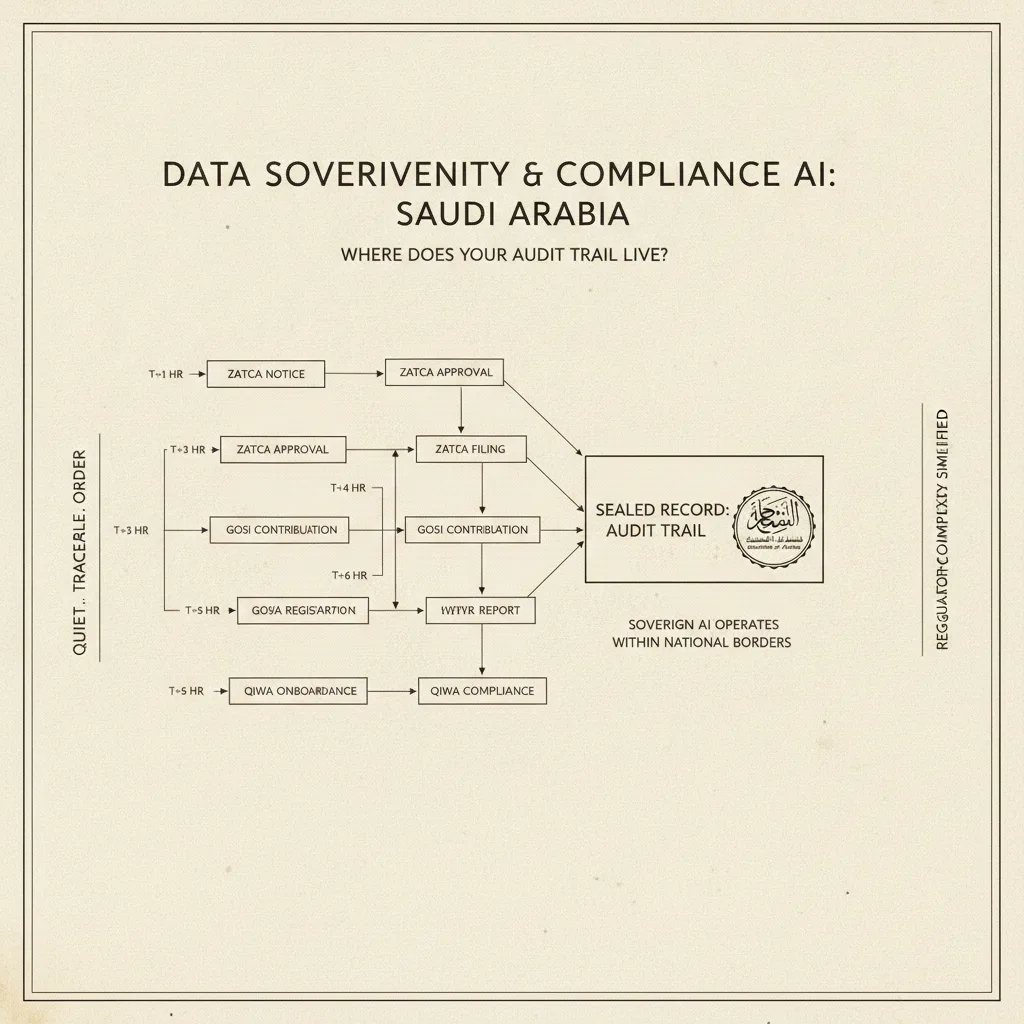
A finance director at a Riyadh-based holding group recently asked an AI compliance vendor a simple question: where does our ZATCA notice data actually go when your platform processes it? The vendor's answer — "our infrastructure is cloud-based and globally distributed" — was not a reassurance. It was the beginning of a compliance exposure the director had not yet priced into her vendor selection decision.
That exchange captures the central problem facing Saudi finance and compliance teams in 2026: the market is filled with AI automation tools that promise to reduce regulatory burden, but almost none of them are asked — let alone required to answer — the question of data residency with legal precision. For entities regulated under Saudi law, that silence is not acceptable.
Why Saudi Compliance Data Is a Sovereignty Question, Not Just a Security One
The instinct to treat data residency as a security concern — something the IT department manages — reflects an older model of regulatory risk. Under Saudi Arabia's current regulatory architecture, data residency for compliance-related information is a legal obligation that falls squarely on the regulated entity, not the vendor.
Saudi Arabia's AI governance structure rests on three overlapping institutional pillars: the Saudi Data and Artificial Intelligence Authority (SDAIA), the National Data Management Office (NDMO), and the Personal Data Protection Law (PDPL) [^2]. These are not parallel frameworks that can be satisfied independently. They are deliberately interlocking, designed so that failure in one dimension — say, inadequate audit logging — triggers exposure under the others.
For a finance team processing ZATCA electronic invoicing notices, GOSI contribution records, or Qiwa workforce data through any AI tool, every item in that data stream likely qualifies as personal data with financial or employment dimensions. PDPL classifies financial data among the sensitive categories requiring the highest standard of lawful processing — explicit consent or a narrow documented basis — and mandates that data subjects be informed when AI is involved in processing, with notices provided in Arabic [^3].
The practical consequence: an AI compliance platform that processes this data without a documented lawful basis, without Arabic-language disclosure capabilities, and without a verifiable Saudi data residency posture is operating outside PDPL's requirements from the first notice it touches.
What PDPL and NCA Guidelines Actually Require from AI Tools
Three frameworks impose binding obligations on AI systems that handle Saudi personal data [^3]. Understanding their scope removes any ambiguity about whether compliance automation platforms fall within scope — they do.
PDPL treats any organization processing personal data of individuals located in Saudi Arabia as subject to the law, regardless of where the organization's infrastructure is physically located [^3]. Cross-border transfer of personal data requires either regulatory approval or contractual adequacy guarantees. For a compliance team, this means that a vendor's claim of "global cloud" infrastructure is not a neutral technical fact — it is a data-transfer event that requires documented legal justification every time it occurs.
NCA Essential Cybersecurity Controls define the technical architecture that PDPL references for enforcement. These controls mandate encryption at rest and in transit, access controls, audit logging, and incident detection. Critically, NCA guidance explicitly addresses AI-specific risks: model poisoning, prompt injection, and unauthorized data extraction [^3]. These are not hypothetical threats. Any AI system that reads regulatory notices, extracts structured compliance data, and routes it to action queues is exposed to all three.
SDAIA's AI Adoption Framework, published in November 2025, establishes five governance pillars as a baseline for all public-sector AI and as an explicit expectation for private-sector suppliers and deployers [^3]: data governance, model accountability, transparency, human oversight, and risk management. Saudi authorities declared January 2026 the "Year of Artificial Intelligence," signaling that enforcement posture is hardening, not softening [^3]. An organization procuring AI compliance tools from a private vendor is a deployer within this framework's scope.
The Four Data-Residency Risks Hiding in Generic Compliance Platforms
Generic AI automation platforms — built for global markets and adapted for Saudi use — carry four structural risks that Saudi-regulated entities rarely price correctly during procurement:
-
Unverifiable residency claims. A vendor may assert Saudi data residency in a sales conversation but lack contractual language, technical controls, or audit evidence to support it. Without a data processing agreement that specifies Saudi-resident infrastructure and permits customer-initiated audits, the claim is legally meaningless under PDPL's accountability standard [^3].
-
Undocumented lawful processing bases. PDPL requires a documented lawful basis for every processing activity involving personal data [^3]. Generic platforms built for multi-jurisdiction deployment often rely on consent frameworks or legitimate-interest assertions that do not map cleanly to PDPL's specific categories — particularly for financial data, which sits in the sensitive-data tier.
-
Audit-trail gaps at the AI inference layer. NCA controls require audit logging of access and processing events [^3]. Most compliance platforms log user actions at the application layer but do not maintain tamper-evident logs of what the AI model accessed, inferred, or routed — a gap that becomes visible only during a regulatory audit. For ZATCA compliance specifically, the audit-trail standard for electronic invoicing records is exacting; a platform that cannot demonstrate what happened to a notice between receipt and action creates an evidentiary void. The audit trail requirements for ZATCA e-invoicing make this gap a direct compliance liability.
-
Arabic-language processing failures. PDPL requires that transparency notices be provided in Arabic [^3]. AI systems trained predominantly on English-language data may extract, classify, or summarize Arabic regulatory content with systematic errors — errors that are invisible until an adverse ZATCA or GOSI determination surfaces. Arabic must be the source of truth, not a translated afterthought.
How Sovereign AI Operations Change the Audit-Trail Standard
The concept of "sovereign AI operations" is sometimes dismissed as a marketing distinction. In the Saudi regulatory context, it has a precise technical meaning: an AI system whose data processing, model inference, and audit-logging capabilities are demonstrably confined to Saudi-resident infrastructure, governed by documented policies that comply with PDPL's lawful-basis requirements and NCA's technical controls [^2][^3].
For Saudi finance teams, this changes the audit-trail standard in three concrete ways.
First, the audit trail must cover the AI layer, not just the user layer. It is insufficient to log that a compliance officer reviewed a ZATCA notice at a given timestamp. The log must also record what the AI system extracted from that notice, what classification it assigned, and what action it triggered — with tamper-evident integrity [^3].
Second, data subject rights under PDPL — access, correction, deletion, and objection — must be executable within thirty days [^3]. If an employee's GOSI record or a supplier's tax identification data passes through an AI inference layer stored outside Saudi Arabia, honoring a deletion request becomes operationally complex and legally exposed.
Third, incident detection and response obligations under NCA controls apply to AI-specific attack vectors, not just perimeter breaches [^3]. A compliance team using a generic AI platform must determine whether that platform's incident-response procedures cover prompt-injection attacks against its compliance data — a question most procurement processes do not ask. The audit trail risks posed by ungoverned AI agents are a direct extension of this problem.
The organizations that build these governance capabilities now will be positioned to demonstrate compliance readiness rather than scramble to reconstruct audit evidence after an inquiry [^2].
Evaluating the Compliance Stack: Questions That Reveal Real Posture
Before any Saudi-regulated entity signs a contract with an AI compliance automation vendor, five questions separate a legally defensible deployment from a liability:
-
Where, exactly, does data reside during AI inference — not storage, but the processing moment itself? Many vendors offer Saudi data storage but route inference through global compute.
-
What is the documented lawful basis for processing financial and employment data under PDPL's sensitive-data category? "Legitimate interest" is not sufficient for PDPL's sensitive-data tier [^3].
-
Does the platform maintain tamper-evident audit logs at the AI inference layer, exportable for NCA-format audits? Application-layer logs are not a substitute.
-
Can Arabic-language regulatory notices be processed as the source of truth, without English-translation intermediaries that introduce error? This is both a PDPL disclosure requirement and a data-quality requirement.
-
What contractual mechanism permits the customer to audit data residency independently? A vendor unwilling to permit audit has, in effect, answered the residency question.
MAKYN's View: The Compliance Stack You Choose Is a Regulatory Decision
The Saudi compliance software market has a structural problem: most platforms were built for markets where data residency is a preference, not a legal obligation, and then adapted for Saudi deployment. Adaptation is not the same as design. A platform built from the ground up to process Arabic-language regulatory notices — ZATCA, GOSI, Qiwa, Ministry of Commerce — within Saudi-resident infrastructure, with NCA-aligned audit logging at every AI inference step, is not a premium variant of a global product. It is a categorically different compliance posture.
MAKYN's position is direct: any compliance intelligence layer that cannot prove Saudi-resident data handling is a liability for its customers, not a solution. This is not a marketing claim about security culture. It is a reading of PDPL's extraterritorial scope, NCA's technical control requirements, and SDAIA's five-pillar governance framework as they apply to AI systems processing regulatory data today [^3].
The 80/20 inversion in compliance work — where teams spend the majority of their time reading, classifying, and routing notices rather than acting on them — is exactly the problem AI automation is positioned to solve. But automation that solves the reading problem while creating a residency, audit-trail, or Arabic-processing liability has not reduced compliance risk. It has moved it off-screen.
Saudi finance and compliance teams deserve a tool that handles the volume without generating the exposure. The evaluation framework for Saudi compliance management software provides a structured starting point for procurement teams who need to test vendor claims against the regulatory standard rather than take them at face value.
If your organization is ready to assess whether your current compliance automation stack meets the residency and audit standards PDPL, NCA, and SDAIA now require, اطلب عرضاً توضيحياً to begin the conversation.
Frequently asked
- Does PDPL require AI systems to store Saudi data inside Saudi Arabia?
- PDPL applies to any organization processing personal data of individuals located in Saudi Arabia, regardless of where infrastructure sits. While the law does not state an absolute on-soil storage mandate, cross-border transfer of personal data requires either regulatory approval or contractual adequacy guarantees — making de-facto residency the only risk-free operational choice for compliance AI handling ZATCA or GOSI records.
- What do NCA Essential Cybersecurity Controls require from compliance automation platforms?
- NCA controls define the technical architecture PDPL references, including encryption at rest and in transit, access controls, audit logging, and incident detection. For AI-specific risks, NCA guidance explicitly addresses model poisoning, prompt injection, and unauthorized data extraction — all of which are live threats when regulatory notices from agencies like ZATCA are processed through third-party AI infrastructure.
- What is SDAIA's AI Adoption Framework and who does it bind?
- SDAIA published its AI Adoption Framework in November 2025. It mandates five governance pillars — data governance, model accountability, transparency, human oversight, and risk management — as a baseline for public-sector AI deployments and as an explicit expectation for private-sector suppliers and deployers working with government entities. Saudi-regulated organizations procuring AI tools from private vendors are therefore within scope.
- Why is data sovereignty a compliance obligation rather than just a security preference in Saudi Arabia?
- Because PDPL, NCA controls, and SDAIA's framework form three overlapping regulatory layers that collectively impose binding obligations on AI systems touching Saudi personal data. A platform that cannot document its data residency, lawful processing basis, and audit trail integrity fails across all three simultaneously — not just one. For finance and compliance teams, that is an enforcement risk, not a vendor-preference question.