Saudi Compliance Software: A Buying Framework for Accounting Firms
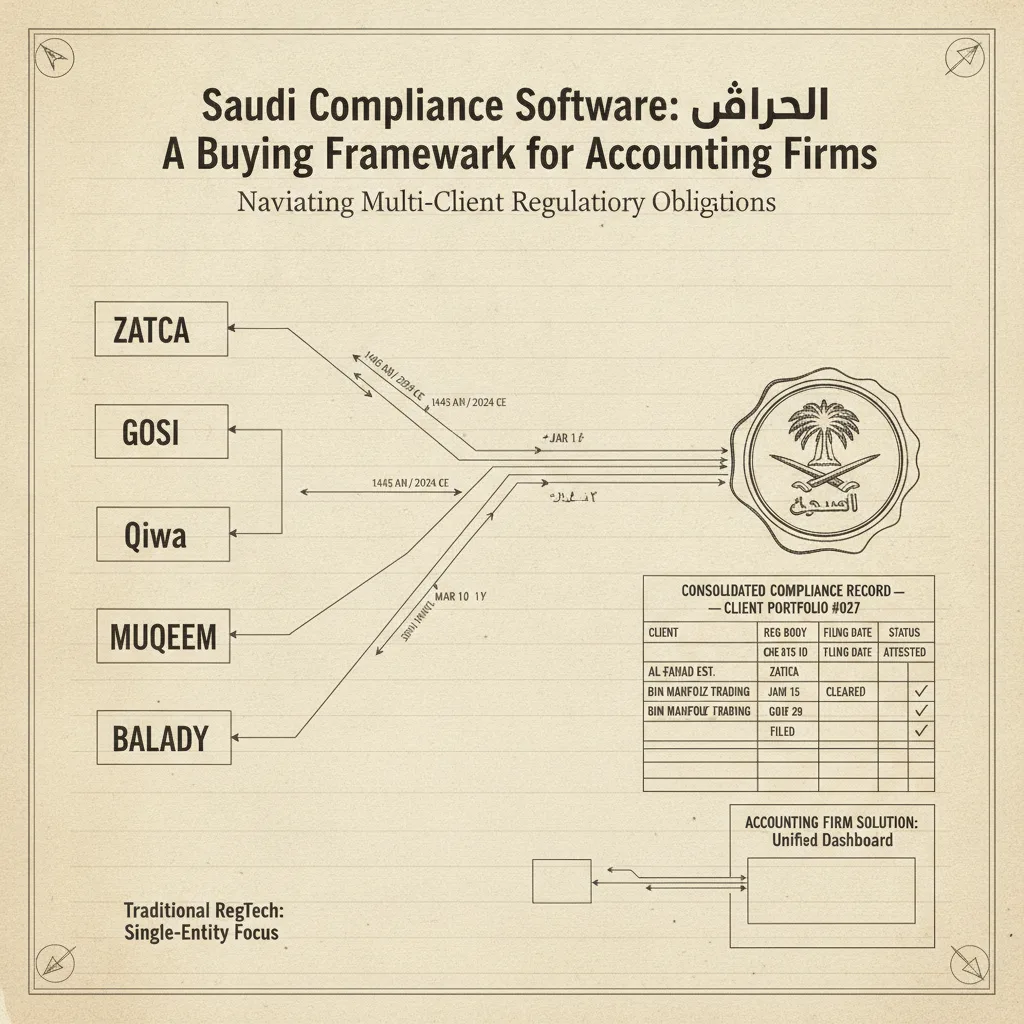
An accounting firm in Riyadh receives a compliance notice for one of its forty active clients — a manufacturing company with unresolved discrepancies flagged by the Zakat, Tax and Customs Authority (ZATCA). The staff member handling the file opens the firm's compliance platform, and discovers the tool has no clean way to isolate that client's ZATCA status from the firm's own entity record. The workaround is a spreadsheet. The compliance software, which the firm licensed eight months ago at considerable cost, was never built for this.
This is not an edge case. It is the defining structural failure of most RegTech tools sold into the Gulf market today.
The single-entity assumption and why it breaks accounting practices
The majority of compliance management platforms are designed around a single organizational actor: one legal entity, one tax number, one regulatory profile. This architecture suits an in-house compliance team at a bank or a manufacturer. It does not suit an accounting firm that manages regulatory obligations for thirty to sixty clients simultaneously, across five or more government bodies, with deadlines that overlap and evidence requirements that must never be commingled.
Saudi Arabia's compliance environment has grown structurally dense since Vision 2030 accelerated mandatory digitisation. PDPL became fully enforceable in September 2024. ZATCA's Phase 2 e-invoicing rollout expanded API-level integration requirements across business categories. Regulatory frameworks that were once sector-specific — SAMA requirements for financial entities, NPHIES standards for healthcare platforms — now bleed into the operational concerns of ordinary business clients that accounting firms service [1]. The surface area of compliance has widened, and every new requirement lands on a firm that may be managing it for dozens of clients at once.
A tool built for a single legal team will handle this with workarounds. Workarounds accumulate. Risk compounds quietly until a deadline is missed or an audit produces conflicting records.
The five regulatory bodies every evaluation must map
Before any vendor demonstration, a procurement team should map the mandatory coverage against these five concurrent regulatory domains:
- ZATCA (Zakat, Tax and Customs Authority) — e-invoicing Phase 2 compliance, VAT return cycles, zakat assessments. Each client entity has its own tax number and filing calendar.
- GOSI (General Organization for Social Insurance) — monthly contribution calculations, Saudization ratios, and employee registration status. Errors here carry direct financial penalties.
- Qiwa (Ministry of Human Resources digital platform) — labor contract validation, Nitaqat (Saudization) band tracking, work permit renewals. Data must be reconciled per client entity.
- Ministry of Commerce — commercial registration renewals, branch licensing, authorized signatory updates. Often missed in compliance tooling because it appears administrative rather than regulatory.
- SDAIA / National Data Management Office (NDMO) — PDPL consent workflows, data processing records, cross-border transfer controls. Fully enforceable and relevant to any client handling personal data [1].
A platform that cannot independently track obligations, deadlines, and evidence for each of these bodies — per client entity — is not a compliance management system for an accounting practice. It is a task manager with regulatory branding.
What multi-principal architecture actually looks like in practice
The phrase "multi-entity support" appears in almost every vendor brochure. The test is whether it describes the product's core data model or a configuration workaround layered on top of a single-entity core.
Genuine multi-principal architecture means:
- Each client entity has its own regulatory obligation register, independent of all others.
- Deadlines, document attachments, and compliance scoring are siloed at the entity level — cross-entity views are aggregated up, never mixed at the source.
- Regulator-ready reports can be exported for a single entity without manual filtering of another entity's records.
- Gap analysis identifies non-compliant areas and references specific regulatory clauses at the entity level, not at the firm level [2].
- Access controls allow a staff member to work on Client A's ZATCA obligations without any visibility into Client B's file.
When evaluating vendors, run this test during the demonstration: ask the sales team to show two fictitious client profiles with overlapping but distinct regulatory calendars, then request a compliance score and a document export for each, separately. If the process requires an administrator to manually filter or re-tag records, the architecture is single-entity regardless of what the specification sheet states.
A structured evaluation framework: the six gates
Frame vendor evaluation around six explicit gates. A platform that does not clear all six should not advance to contract.
Gate 1 — Regulatory coverage breadth. Does the platform carry pre-built frameworks for ZATCA, GOSI, Qiwa, Ministry of Commerce, and PDPL? Or does the firm have to build each regulatory requirement manually? Pre-built frameworks reduce setup time and reduce the risk that a requirement is misconfigured [2].
Gate 2 — Multi-principal data isolation. As described above: can each client entity hold an independent obligation register with zero data bleed to adjacent entities? This is the single most important architectural question.
Gate 3 — Evidence and audit trail management. Can the platform link documents, approvals, and sign-offs through structured workflows tied to specific regulatory clauses? An audit trail that lives in email or a shared folder is not audit-ready [2].
Gate 4 — Compliance scoring per entity. A dynamic scoring model that reflects real-time status — obligations met, pending, and overdue — gives the firm a defensible picture of each client's posture at any moment. If scoring is only available at a firm-wide aggregate level, it is operationally useless for client-level accountability.
Gate 5 — Arabic-language regulatory content and reporting. Saudi regulatory instruments are issued in Arabic. A platform that processes, stores, and reports only in English introduces a translation layer that is both legally risky and operationally slow. The platform should treat Arabic as the source of truth for regulatory text, not a translated overlay.
Gate 6 — Integration and extensibility. ZATCA Phase 2 requires API-level integration with clients' invoicing systems. The platform should expose documented APIs or pre-built connectors, and the firm should verify that client-specific integrations do not require a separate contract with the vendor's professional services team for each deployment [1].
The hidden cost of getting this wrong
The cost of retrofitting compliance architecture after deployment is almost always higher than designing for it from the start [1]. This principle, stated in the context of software development, applies with equal precision to software procurement.
When an accounting firm discovers post-deployment that its compliance tool cannot cleanly separate Client A's GOSI obligations from Client B's, the remediation options are all expensive: rebuild client records manually, pay for vendor customization, or migrate to a replacement platform while managing live regulatory deadlines. None of these options is cheap, and none of them comes without a period of elevated regulatory exposure.
The procurement process itself is the primary risk-control mechanism. A two-week evaluation using the framework above is not overhead — it is the cheapest form of compliance insurance available.
MAKYN's view
The procurement teams we speak with consistently report the same sequence: a vendor demonstrates a polished dashboard, the firm signs, and six weeks into deployment the team discovers that the multi-entity feature is actually a folder hierarchy — separate naming conventions applied to a shared data model. The regulatory obligations are still commingled at the database level.
Our position is direct: for a Saudi accounting firm managing multi-client, multi-agency obligations, the evaluation process must be adversarial, not aspirational. Do not accept a demonstration of the ideal workflow. Demand a demonstration of the firm's actual workflow — forty clients, five regulatory bodies, a ZATCA deadline this Thursday, a GOSI discrepancy for a different client opened simultaneously.
A platform that clears all six gates above, passes the two-profile demonstration test, and treats Arabic regulatory text as a first-class data type rather than a translation problem is rare. But it exists, and the evaluation cost of finding it is orders of magnitude smaller than the operational cost of the alternative.
If your firm is beginning this evaluation, اطلب عرضاً توضيحياً to see how MAKYN handles the multi-principal, multi-agency reality of Saudi accounting practice — before you commit to any platform.
Frequently asked
- What makes compliance software unsuitable for Saudi accounting firms managing multiple clients?
- Most platforms are built around a single entity's regulatory profile. When an accounting firm manages 30–50 clients simultaneously, each with distinct obligations under ZATCA, GOSI, Qiwa, and PDPL, the software must isolate each client's data, deadlines, and evidence trail independently. Tools that lack multi-principal architecture force firms into workarounds — spreadsheets, separate logins, duplicated workflows — that reintroduce the risk the software was meant to eliminate.
- Which Saudi regulatory bodies should a compliance platform cover as a baseline in 2026?
- At minimum: the Zakat, Tax and Customs Authority (ZATCA) for e-invoicing and tax obligations; the General Organization for Social Insurance (GOSI) for payroll contributions; Qiwa for labor contracts and Saudization tracking; the Ministry of Commerce for commercial registration obligations; and the National Data Management Office under SDAIA for PDPL compliance. Sector-specific bodies — SAMA for financial firms, NPHIES for healthcare — add further layers for specialist practices.
- How should a procurement team evaluate a vendor's multi-entity capability before signing?
- Request a live demonstration using two fictitious client profiles with overlapping but distinct regulatory obligations. Ask the vendor to show how the platform assigns separate deadlines, documents, and compliance scores to each entity without cross-contamination. Then ask to export a regulator-ready report for one entity only. If either step requires administrator intervention or manual filtering, the architecture is single-entity regardless of the marketing claims.
- What is the real cost of choosing the wrong compliance platform?
- The direct cost is migration: extracting structured compliance data, audit trails, and evidence documentation from a poorly matched platform is expensive and disruptive. The indirect cost is regulatory exposure during the transition period — missed ZATCA deadlines or incomplete GOSI records carry financial penalties. Compliance architecture retrofitted after deployment almost always costs more than selecting correctly at the outset, a principle equally true for software selection as for software development.
Sources
- 1. Software Regulatory Compliance Requirements Saudi Arabia by Industry (2026) — logiolegion.com
- 2. Compliance Management — www.masterteam.sa