SAP + Cohere: What Saudi Compliance Teams Must Check First
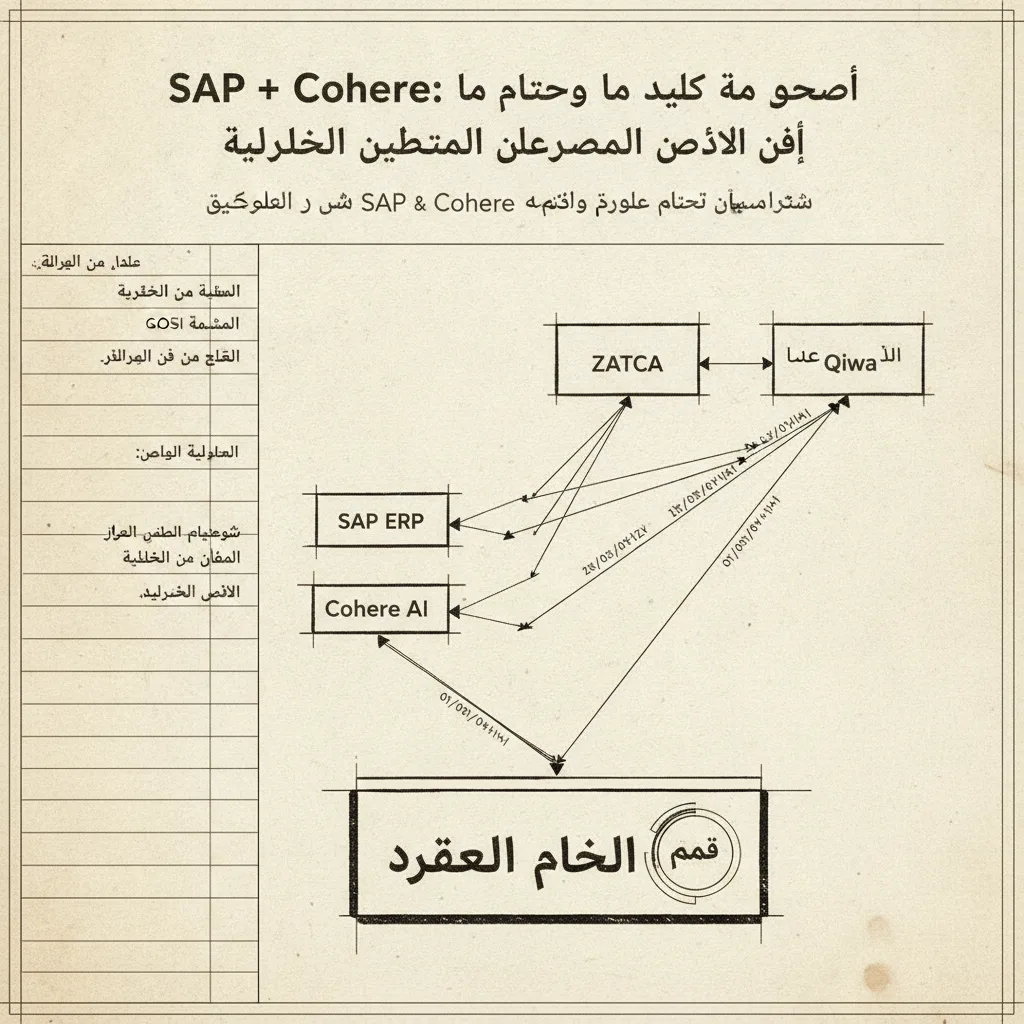
A Saudi finance director reviewing the SAP–Cohere announcement sees a familiar set of assurances: sovereign deployment, regulated-industry readiness, privacy-first design. What the announcement does not contain is a single reference to هيئة الزكاة والضريبة والجمارك (ZATCA), to NDMO data classification tiers, or to the specific audit-trail architecture Saudi e-invoicing law demands. That silence is not an oversight — it is a scoping decision by two companies writing for a global market. The problem is that Saudi compliance offices cannot afford to treat global as a synonym for local.
What SAP and Cohere Actually Announced — and What Stays Vague
In November 2026, SAP made Cohere's enterprise agentic AI platform, North, generally available on SAP Business AI Platform. [1] North allows enterprises to deploy AI agents and workflow automations within their own infrastructure — the core value proposition being that data need not leave an approved boundary to generate an AI response. [1]
The partnership builds on an earlier May 2025 agreement in which SAP and Cohere planned to integrate Cohere's Command, Embed, and Rerank models into SAP AI Core, extending agentic capabilities across finance, HR, sales, and IT workflows. [3] Cohere's models are designed to perform in production environments while "respecting enterprise privacy requirements," and the companies cite finance, healthcare, and government as target sectors. [4]
The November general availability was specifically framed around sovereignty-conscious markets — with the EU AI Cloud product and European data residency as the stated anchors. [2] The announcement references "national expectations of security, privacy, transparency, and accessibility" in the abstract. [1] It does not reference any specific Gulf Cooperation Council regulatory framework, Saudi data law, or ZATCA technical specification.
That vagueness is the starting point for every Saudi procurement review, not a reason to dismiss the technology.
Why 'Regulated Industries' Does Not Automatically Mean Saudi-Compliant
The term "regulated industry" carries significant weight in vendor marketing and almost no legal precision when applied across jurisdictions. What constitutes compliance in a German banking context differs materially from what ZATCA requires of a Saudi entity issuing Phase 2 e-invoices.
Saudi Arabia's compliance architecture for financial records rests on two distinct pillars. The first is ZATCA's e-invoicing technical specification, which mandates that every tax invoice be generated, transmitted, and archived with a tamper-evident cryptographic hash — and that the archived record be the unmodified source document, retrievable on demand. Any processing layer that transforms, summarizes, or re-routes invoice data before archiving creates an ambiguity: is the AI-processed version the authoritative record, or is the original? ZATCA's audit teams will ask that question. The answer must be documented before the system goes live, not after.
The second pillar is the National Data Management Office (NDMO), which classifies data by sensitivity tier and sets residency requirements for each tier. Financial records that touch personal taxpayer data, zakat filings, or customs declarations sit at classification levels that restrict where data may be stored and who may process it. A sovereign deployment architecture certified for EU General Data Protection Regulation purposes does not automatically satisfy NDMO classification rules — the frameworks share principles but diverge in structure and enforcement.
For a detailed account of how AI tools can expose compliance offices to data-handling risk, see When AI Tools Leak Client Data: A Saudi Compliance Wake-Up Call.
The Three Compliance Checkpoints Before Any ERP-Embedded AI Goes Live
Saudi finance and compliance teams should run three sequential checks before authorizing any ERP-embedded AI that touches financial records.
1. Data residency boundary confirmation
Obtain from the vendor a written infrastructure diagram that shows, at the network level, where financial data is processed during an AI query or agent workflow. The question is not whether the vendor claims sovereignty compliance — it is whether the specific data pathway for Saudi financial records stays within NDMO-approved boundaries. This includes intermediate processing nodes, model inference endpoints, and any third-party retrieval-augmented generation (RAG) data stores. If the vendor cannot produce this diagram, the deployment is not ready for Saudi regulated use.
2. Audit-trail integrity under AI transformation
Define in writing, before go-live, what the "source of truth" record is for every financial transaction the AI system touches. ZATCA's e-invoicing requirements are unambiguous: the archived invoice is the legal record. If an AI agent reformats, extracts from, or routes that invoice data as part of a workflow, the organization must demonstrate that the original cryptographically signed record remains primary and unaltered. AI-generated summaries, extractions, or routed outputs must be clearly labeled as derived artifacts — not as the record itself. The audit trail for e-invoices under ZATCA is not a secondary concern; it is the legal minimum.
3. NDMO classification alignment and access logging
Map every data class that the AI system will access against NDMO's classification framework. For each class above the baseline tier, confirm that the AI model and its infrastructure operators hold the appropriate access authorization. Require the vendor to specify how AI-generated access events are logged — meaning: when an AI agent reads a financial record, is that access event attributed to the agent, to the authorized human user, or to the system account? ZATCA and Saudi audit practice expect human-attributable access logs. An unattributed AI access event is a gap that auditors notice.
This is not a theoretical concern. The risk of AI agents touching financial accounts has been documented in Saudi compliance contexts precisely because access attribution is an afterthought in most ERP AI configurations.
Audit Trails, ZATCA E-Invoicing, and Where AI-Generated Outputs Create Recordkeeping Risk
The most acute compliance risk in ERP-embedded AI is not data leakage — it is record mutation. Consider a common North use case: an AI agent that processes incoming invoices, extracts line items, and routes them to the appropriate cost center. In a jurisdiction without strict e-invoicing law, this is a productivity gain. Under ZATCA Phase 2, the same workflow raises a formal question: at what point in the pipeline does the archived record crystallize?
If the AI extraction step modifies the data structure of the original XML invoice before archiving, the archived version may not match the hash ZATCA's system recorded at transmission. That mismatch is an audit finding. If the original is archived intact and the AI output is a separate derived file, the organization must maintain clear version control showing that the derived file was not substituted for the original.
This is not a hypothetical edge case. It is the standard audit pattern ZATCA inspectors apply when reviewing e-invoicing system architecture. Organizations that have not documented the data flow — from transmission, through any AI processing layer, to final archive — will struggle to answer the inspector's first question.
For teams managing zakat filing obligations alongside e-invoicing, the Zakat Filing Lifecycle piece maps where control gaps tend to cluster across the submission cycle.
MAKYN's View: Adopt Deliberately, Not Eagerly
The SAP–Cohere partnership is technically credible. Cohere's focus on on-premises and private-cloud model deployment gives it a genuine sovereignty story that many AI vendors cannot match. SAP's integration depth in enterprise financial workflows means the use cases are real, not theoretical. This is not a product to dismiss.
It is, however, a product to pressure-test before procurement sign-off — and that pressure-test is a compliance function, not an IT function. The questions above are not engineering questions. They are governance questions. Who is the accountable human for each AI-generated output? What is the authoritative record and where does it live? Who authorized the AI system's access to classified financial data, and how is that authorization logged?
Saudi CFOs and compliance officers who let the technology team sign off on ERP-embedded AI without running those three checkpoints are delegating a risk they are not permitted to delegate. ZATCA does not inspect vendor marketing materials during an audit. It inspects audit trails.
If your office is evaluating AI integration into existing ERP or compliance workflows, the first step is a structured gap assessment — not a pilot. اطلب عرضاً توضيحياً to map your specific regulatory obligations before any system configuration begins.
For a wider view of how dedicated regulatory intelligence differs from ERP tax modules, see ERP Tax Modules vs. Regulatory Intelligence: What Saudi Offices Actually Need.
Frequently asked
- What did SAP and Cohere actually announce, and when?
- In November 2026, SAP made Cohere's North agentic AI platform generally available on SAP Business AI Platform. North enables enterprises to deploy AI agents and workflow automations within their own infrastructure. The partnership builds on an earlier May 2025 agreement to integrate Cohere's Command, Embed, and Rerank models into SAP AI Core. The November announcement specifically targets sovereignty-conscious markets and regulated industries.
- Does 'regulated industry' AI compliance cover Saudi ZATCA requirements?
- Not automatically. The SAP–Cohere sovereign AI framing references EU data residency and general regulated-sector needs. Saudi compliance operates under a distinct legal layer: ZATCA's e-invoicing technical specifications require tamper-evident audit trails, and NDMO sets data classification and residency rules for financial records. A product certified for EU regulatory environments is not presumptively compliant with Saudi frameworks — a formal gap assessment is mandatory.
- What specific risk does AI pose to ZATCA audit trails?
- ZATCA requires that every e-invoice record be archived in its original, unmodified form for a minimum retention period and be retrievable on demand during audit. If an AI layer summarizes, reformats, or routes invoice data, the transformed output may not satisfy the 'tamper-evident' requirement. The audit question becomes: is the AI-processed record the authoritative version, or does the original remain intact and primary? That answer must be documented before deployment.
- What three checkpoints should Saudi finance teams run before adopting ERP-embedded AI?
- First, confirm that data residency boundaries meet NDMO classification rules — specifically that financial records processed by AI do not transit unapproved infrastructure or regions. Second, verify that the AI layer cannot alter the source record and that the original audit trail remains primary. Third, obtain written confirmation from the ERP vendor on how AI-generated outputs are logged, versioned, and attributed — so the compliance record is unambiguous under ZATCA inspection.
Sources
- 1. SAP and Cohere Empower Regulated Industries to Innovate and Deploy AI Faster — rss:sap-news
- 2. SAP, Cohere Target EU Compliance with Sovereign AI Cloud Offering — www.vktr.com
- 3. SAP and Cohere Deliver Trusted, Scalable Gen AI | SAP Sapphire | SAP News Center — news.sap.com
- 4. SAP and Cohere Deliver Enterprise-Ready Generative AI with Privacy-First Design - Hiverlab — hiverlab.com