Qiwa–GOSI Compliance Dashboard: What Accountants Need
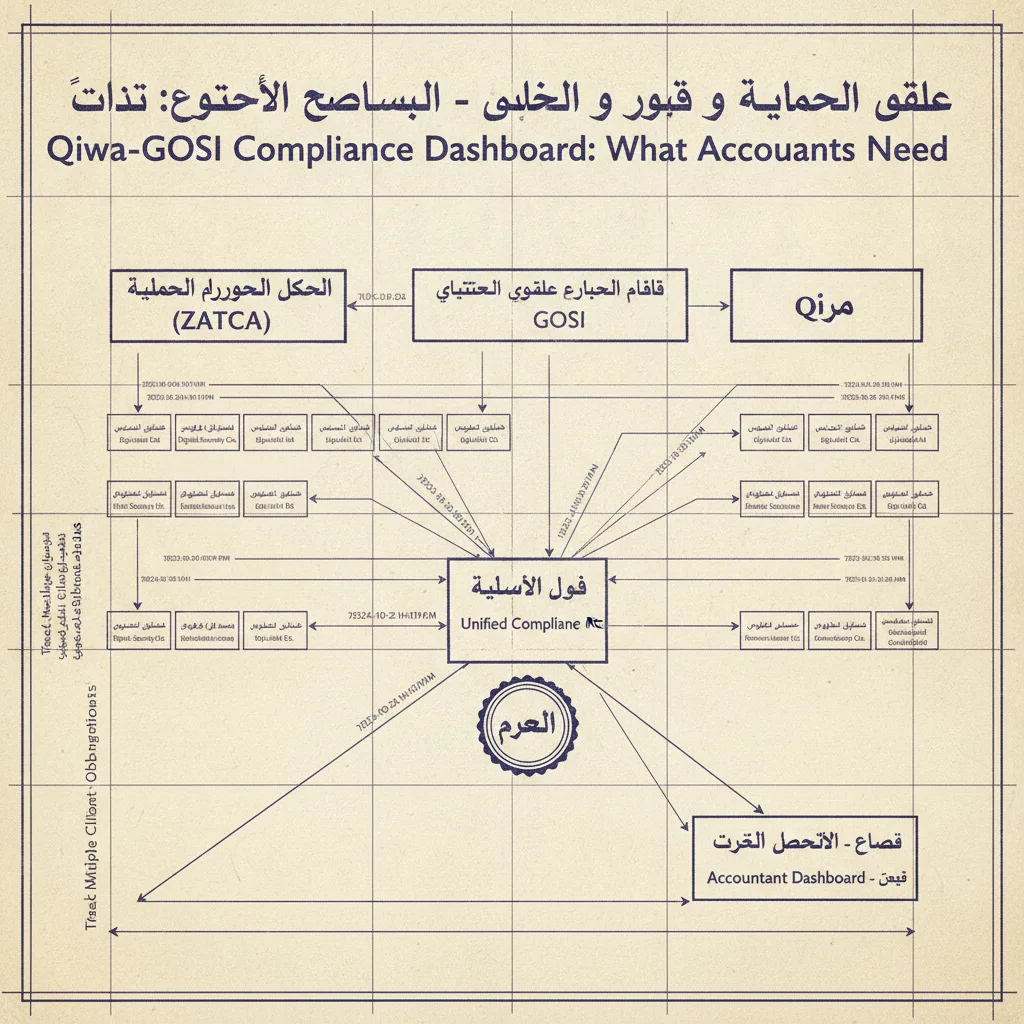
An accountant opens a client's Qiwa portal at 9 a.m. to check work permit status. Then a second session for the next client's GOSI contributions. Then a third for the Nitaqat band. By the time the fourth client's tab loads, two deadlines from the first session are already scrolling off the screen. This is not a workflow problem — it is a structural design mismatch between what the portals were built to show and what a multi-client accountant actually needs to see.
What Qiwa and GOSI Were Built For — and What They Were Not
Qiwa is Saudi Arabia's central labor portal, managing employment contracts, Saudization compliance, and work permit issuance [2]. GOSI — the General Organization for Social Insurance — handles employee social insurance registration, monthly contribution collection, and occupational hazard records [2]. Both platforms are essential. Neither was designed with the accounting firm in mind.
Each portal is scoped to a single commercial registration. The employer logs in, sees their entity, and acts within it. For a business owner managing one company, this is sufficient. For an accountant with twenty Saudi-registered client entities, it means twenty separate login contexts, twenty separate deadline calendars, and no mechanism to surface which client is most at risk on any given morning.
The consequence is predictable: urgent obligations get missed not because accountants are inattentive, but because the signal is buried in the wrong interface. In 2026, Saudi authorities intensified enforcement around employer compliance — automatic work permit suspensions can be triggered without prior notice when Qiwa and GOSI records diverge [3]. An accountant using the default portal architecture has no structural advantage in preventing that.
The Six Data Points Every Client Row Must Expose
A purpose-built accountant view treats each client as a row in a compliance ledger, not a separate login. Each row must surface, at minimum, the following six fields — in real time, not cached from a weekly export:
- Nitaqat band (Platinum / Green / Yellow / Red) — the Saudization classification that determines which government services the client can access, including work permit issuance [3]. A band drop from Green to Yellow is an early warning; a drop to Red is a service suspension waiting to happen.
- GOSI contribution status — whether the current month's social insurance contributions are filed, pending, or overdue, with the exact amount outstanding [2].
- Work permit expiry queue — a sorted list of employee work permits expiring within the next 90 days, with days-remaining per employee and the associated renewal action required.
- Contract documentation rate — the percentage of active employees whose employment contracts are properly recorded on Qiwa [3]. Authorities have increased scrutiny on contract completeness as a standalone compliance metric.
- Payroll cycle alignment — confirmation that the last salary disbursement via the Wage Protection System matches the employee count and salary figures reported to GOSI. Divergence between these two records is among the most common triggers for enforcement action [3].
- Next enforcement deadline — a single, client-specific date field showing the nearest upcoming compliance deadline, whether that is a permit renewal, a GOSI filing window, or a Nitaqat reclassification review.
None of these fields require data that does not already exist in the portals. What they require is aggregation across entities and presentation in a format designed for someone managing many entities simultaneously.
Deadline Windows and Alert Logic That Actually Work
The timing of alerts is as important as the content. An alert fired the day before a GOSI filing deadline has limited operational value — payment processing alone may require 48 to 72 hours. An accountant-facing system needs alerts calibrated to action lead times, not to deadline proximity alone.
A practical alert architecture for Qiwa and GOSI obligations works across three windows:
- 30-day window: Flags work permits entering the renewal eligibility period and Nitaqat bands within two percentage points of a downward reclassification threshold.
- 10-day window: Escalates any GOSI contribution not yet filed for the current cycle, and any contract documentation gap where employees are approaching the maximum period without a recorded contract.
- 5-day window: Issues a final payroll reconciliation prompt before each salary cycle closes — the specific action that, if completed, prevents the most common cause of automatic enforcement: Wage Protection System and GOSI record divergence [3].
Critically, alerts should carry the specific client name and commercial registration number, not a generic "compliance issue detected." When an accountant manages a portfolio, ambiguity at the alert level costs minutes of context-switching that compound across dozens of clients.
Why the Native Portals Cannot Bridge This Gap
It is worth being precise about what Qiwa and GOSI do well, because the argument here is not that the portals are poorly built — it is that they are built for a different user.
Qiwa manages labor contracts and Saudization data with increasing sophistication [2]. GOSI processes contribution filings and provides occupational classification records at scale [2]. Both platforms have improved enforcement integration, which is precisely why mismatches between them carry sharper consequences than they did three years ago.
The limitation is architectural. Single-entity session design is a deliberate security boundary — an employer's data is not exposed to other employers. That boundary, appropriate for the employer, is the exact obstacle for an accountant who needs normalized cross-client data. The portals do not offer an agency-mode view, a consolidated deadline export, or a multi-entity comparison interface. Building a spreadsheet workaround manually is the current standard — and it is a standard that introduces its own error risk every time a field is copied and a cell reference drifts.
What a Reconciliation Workflow Looks Like in Practice
The highest-leverage compliance action available to an accountant in a Saudi client portfolio is the pre-cycle payroll reconciliation [3]. Executed monthly before each salary disbursement, it prevents the most common enforcement trigger. The steps are specific:
- Pull the current GOSI-registered employee list for the client entity.
- Compare against the Wage Protection System payroll roster for the same cycle.
- Identify any employee present on one list but absent from the other — new hires not yet registered with GOSI, or terminated employees still appearing in a payroll batch.
- Resolve discrepancies before the salary transfer is processed.
- Confirm GOSI contribution amount matches the updated payroll figure.
- File and retain confirmation reference numbers for the audit record.
This process, done manually across twenty clients, takes hours and is subject to human error at every comparison step. Done with structured data already extracted from both portals into a unified view, it becomes a checklist confirmation rather than a data assembly task.
MAKYN's View: The Problem Is Data Architecture, Not Accountant Diligence
Accountants managing Saudi compliance portfolios are not failing because they lack knowledge of what Qiwa and GOSI require. They are operating against a data architecture that was never designed to serve them. The portals are authoritative sources — they are not access interfaces for intermediary professionals managing compliance at scale.
The correct intervention is not a training course on portal navigation. It is a layer that reads the authoritative portal data, normalizes it across client entities, and presents obligation timelines in the format an accountant can act on within a working session. The Arabic source documents remain the legal record; the cross-client view is the operational surface.
MAKYN is built on this premise. It reads government notices — including Qiwa and GOSI correspondence — extracts the obligation, deadline, and responsible party, and routes it into a timeline that spans clients without collapsing the source document integrity. An accountant using MAKYN does not lose the portal; they gain a view the portal was never designed to provide.
If you manage compliance for multiple Saudi-registered entities and are currently relying on manual session-switching and spreadsheet reconciliation, اطلب عرضاً توضيحياً to see how a structured obligation timeline changes the daily workflow.
Frequently asked
- Why can't accountants just use the standard Qiwa and GOSI portals?
- Both portals are designed around the employer entity, not the accounting firm. Each login is scoped to one commercial registration. An accountant managing ten clients must switch sessions ten times, with no consolidated deadline view, no cross-client alert queue, and no comparative Nitaqat band display. The information exists — the interface architecture prevents efficient access to it.
- What is the most common compliance failure that a dashboard would catch early?
- Payroll-GOSI misalignment. When a company processes salaries through a wage protection mechanism but fails to update GOSI contribution records to match the new headcount or salary figure, the two systems diverge. Saudi authorities can read that divergence as non-compliance and issue an automatic work permit suspension. A 5-day pre-cycle alert window is the standard mitigation.
- What is Nitaqat and why must it appear on an accountant's dashboard?
- Nitaqat is the Saudi Saudization classification system — Platinum, Green, Yellow, or Red — assigned based on the ratio of Saudi nationals in a company's workforce. The band directly determines what services an employer can access, including work permit issuance. An accountant managing Saudization strategy across clients needs current band status and the headcount delta required to reach the next band.
- How does MAKYN help accountants manage Qiwa–GOSI obligations across multiple clients?
- MAKYN reads and extracts compliance data from government portal notices — including Qiwa and GOSI correspondence — and routes obligations by deadline across client entities. This converts the fragmented per-entity portal experience into a single obligation timeline that accountants can act on, with source Arabic documents preserved as the record of truth.
Sources
- 1. Saudi Business Compliance Portals: All You Need to Know (2026 Update) — teleportmanpower.com
- 2. Qiwa & GOSI Compliance for Foreign Employers - EXPANDWAY — expandway.sa