When Compliance Automations Fail Silently
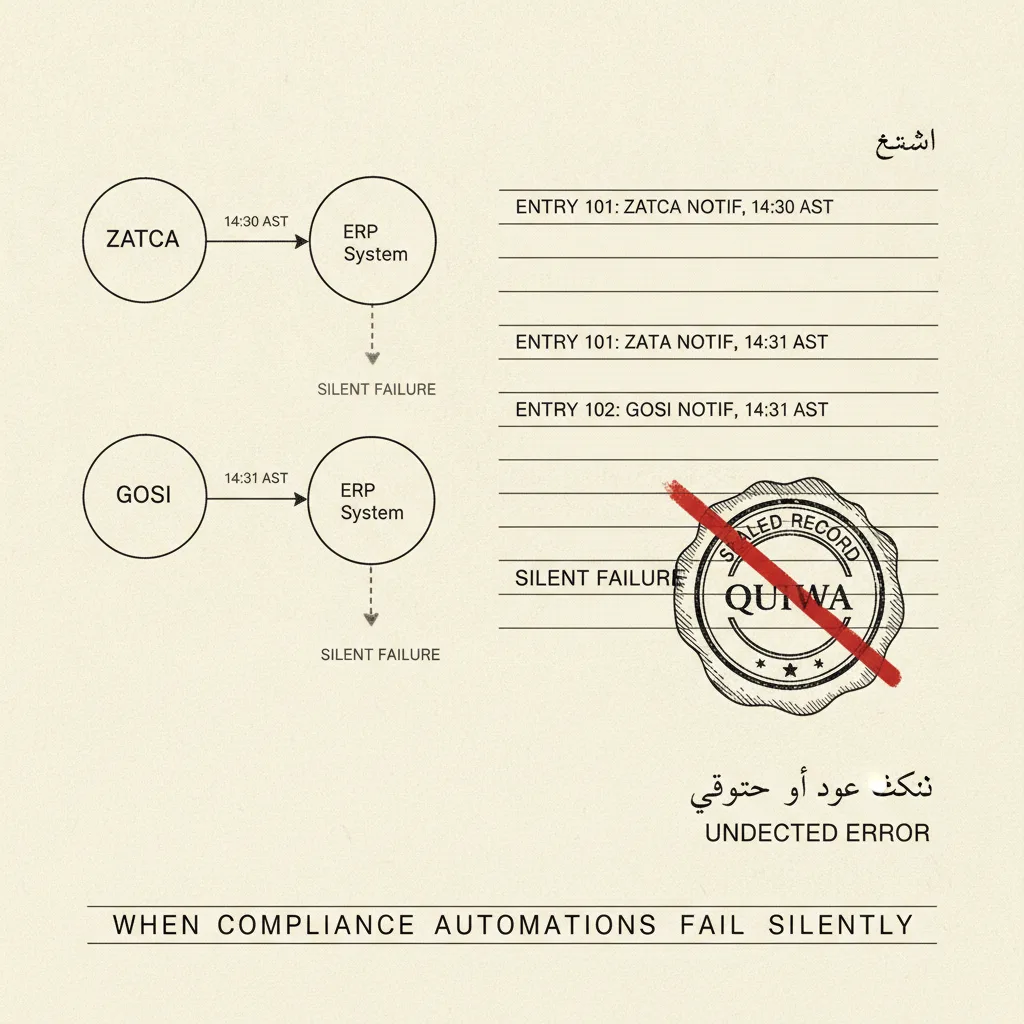
A compliance manager at a mid-sized accounting office in Riyadh spends a Monday morning reassured by a green dashboard. Every ZATCA submission indicator shows success; every General Organization for Social Insurance (GOSI) notification route appears active. By Wednesday, a client receives a penalty notice — for a filing the system logged as complete three weeks earlier. The automation did not fail loudly. It failed quietly, and the silence was indistinguishable from success.
This is not a hypothetical. It is the structural risk embedded in any compliance pipeline that treats execution as success and has no independent means of verifying that submissions actually reached their destination, were accepted, and were logged in a form that survives a regulatory inspection.
What a silent compliance failure actually looks like — and what it costs
A silent failure in a regulatory workflow has a specific anatomy. The automation runs. No exception is thrown. No alert fires. The status field in the internal database reads "submitted." But the payload was malformed, the credential had expired forty-eight hours earlier, or the receiving endpoint returned a soft error that the integration layer interpreted as an acknowledgement rather than a rejection.
The cost accumulates across two timelines. The immediate cost is the regulatory penalty for a late or missing filing — fines that ZATCA and GOSI can issue per occurrence, per entity, and in some cases retroactively across the audit window. The deferred cost is more corrosive: when the firm's own records show "submitted" and the regulator's records show "not received," the audit trail itself becomes evidence of internal control failure rather than a defence against it [1].
Audit trails that are missing or incomplete do not merely fail to help — they actively implicate the firm. A regulator examining a compliance workflow expects to see not just what was submitted, but when the submission was initiated, what the system's response was, and who — human or automated process — took each subsequent action [1]. A pipeline that logs only final states, not intermediate steps, cannot satisfy that expectation.
The four points where Saudi regulatory automations break without warning
Compliance pipelines connecting to ZATCA's Fatoora platform, GOSI's employer portal, or the Ministry of Human Resources and Social Development's Qiwa system share a common failure topology. Four structural break points account for the vast majority of undetected errors.
1. API credential expiry. Integration credentials — OAuth tokens, API keys, digital certificates — carry expiry dates that are frequently longer than a single sprint cycle but shorter than the compliance calendar. When a credential expires, the integration layer often receives a 401 or 403 response and, if error handling is poorly configured, interprets this as a transient network issue rather than an authentication failure. The job retries silently, fails silently, and eventually exhausts its retry budget and stops — with no outbound alert.
2. Schema drift. Regulatory portals update their data schemas. ZATCA has issued multiple format revisions as Phase Two e-invoicing has expanded [see /b/makyn/zatca-phase-two-einvoicing-audit-readiness]. An automation built against an earlier schema continues submitting records that conform to the old format. The portal may accept them with a warning it does not surface to the integration, or reject them with an error code the integration is not configured to handle. In either case, the internal dashboard shows no failure.
3. Queue starvation. Batch-processing automations typically place records into a queue and run a consumer process on a schedule. If the consumer process crashes or is inadvertently stopped — a dependency restart, a memory limit, a failed deployment — new records accumulate in the queue while the status monitor reports the consumer as "running" because the process identifier still exists. No records are processed. No alert fires. The backlog grows invisibly until a scheduled check (if one exists) or a human investigation uncovers it [3].
4. Dependency failure with graceful degradation. Many compliance pipelines pull data from internal ERP systems or third-party data feeds before constructing a regulatory payload. When that upstream source becomes unavailable, a well-intentioned "graceful degradation" setting may instruct the automation to use the last-known value rather than halt. The automation continues to run, submitting records built on stale data, without any indication that the source of truth is no longer current.
These four failure modes share one property: they produce outputs that look identical to successful outputs from the perspective of any monitoring system that only checks whether the process ran, not whether the process produced a valid, accepted result.
How audit-trail requirements under ZATCA and GOSI raise the stakes for undetected errors
The audit-trail obligations attached to Saudi regulatory compliance are not administrative formalities. ZATCA's e-invoicing framework requires that each invoice's full lifecycle — generation, cryptographic signing, submission, clearance or reporting confirmation — be reconstructible from tamper-evident records [1]. GOSI's employer-facing obligations require that payroll-linked notifications and registration changes be traceable to the specific submission event, not merely to an internal record of intent.
What this means in practice: an automation that submits a record without capturing the regulator's response — the clearance UUID, the acknowledgement timestamp, the rejection code — has produced a compliance record that is incomplete by definition. If that automation also fails silently, the firm is left with a log that says "we tried" and no evidence of outcome. That combination — silent failure plus incomplete audit trail — is the condition most likely to convert a technical fault into a legal exposure [1].
The audit trail obligations for regulatory notices extend beyond e-invoicing. For firms managing multi-client portfolios, the problem compounds: a single broken automation may affect dozens of client entities simultaneously, and the discovery lag is proportional to the number of entities involved. For a discussion of how this plays out across holding structures, see Compliance Aggregation for Saudi Holding Groups.
Incomplete audit trails also interact badly with data-handling obligations. As detailed in ما يعنيه اختراق البيانات لمسؤول الامتثال السعودي, the absence of clear action logs makes it impossible to reconstruct what personal or financial data was processed, by which system, and under what authorisation — a secondary exposure that compounds the original filing failure [2].
A monitoring checklist: five controls every compliance team should have in place
Effective monitoring does not require replacing an automation platform. It requires wrapping that platform in a layer of observability that is independent of the platform's own reporting. The following five controls represent the minimum viable monitoring posture for any Saudi compliance automation [2] [3].
Control 1 — End-to-end health-check pings. At a minimum every four hours, an independent process should authenticate with each regulatory portal, submit a test transaction (in a sandbox environment or via a designated health-check endpoint), and verify that a valid acceptance response is returned. This tests the full connectivity and authentication chain, not just whether the local process is running.
Control 2 — Dead-letter queues with escalation rules. Every record that fails processing — at any stage — should be routed to a dead-letter queue. The dead-letter queue should be monitored; accumulation above a defined threshold (for example, more than three records in a rolling two-hour window) should trigger an immediate alert to a named human owner, not merely an entry in a log file [3].
Control 3 — Credential-expiry calendars with advance alerts. Every API key, OAuth token, and digital certificate used in a compliance integration should be registered in a central credential inventory with its expiry date. Automated alerts should fire at 30, 14, and 3 days before expiry — to a human who is responsible for renewal, not to a shared inbox that may not be monitored.
Control 4 — Schema-validation gates. Before any record is dispatched to a regulatory endpoint, it should pass through a validation layer that checks conformance against the current published schema. Records that fail validation should be held, logged with a specific error code, and escalated — not silently discarded or queued for infinite retry. The validation schema should itself be versioned and updated whenever ZATCA or GOSI publishes a format change.
Control 5 — Immutable, external action logs. The automation engine's own logs are not a sufficient audit trail, because they can be modified, rolled back, or lost alongside the engine itself [1]. Every compliance-relevant action — submission initiated, response received, record accepted, record rejected, retry attempted — should be written to a log store that is physically separate from the automation engine, is append-only, and carries a trusted timestamp. This is the record that survives a platform failure and satisfies a regulator's request for evidence.
For teams managing Saudi labor law obligations specifically — Saudization ratios, Qiwa filings, Nitaqat tier calculations — the same five controls apply to the Qiwa integration layer. A Nitaqat calculation that runs on stale headcount data, submitted without a response-capture step, is precisely the kind of silent failure that surfaces only when a Ministry of Human Resources inspector requests the underlying records. See Nitaqat Compliance for Accounting Offices for the specific obligation tiers.
MAKYN's view: observable automation is the only kind that belongs in a regulated workflow
The compliance technology market has a persistent framing problem. Automation is sold as a solution to manual-process risk — and it is, under controlled conditions. But the implicit assumption embedded in that sale is that an automated process will report its own failures. In practice, most automation platforms are optimised to report success and to handle failures gracefully — which too often means silently.
A compliance workflow that cannot demonstrate, on demand, that every submission was initiated, received, accepted, and logged in a tamper-evident record is not a compliance workflow. It is a liability with a green dashboard.
MAKYN's position is straightforward: monitoring and audit-trail visibility are not add-ons to a RegTech pipeline. They are the structural conditions under which a pipeline becomes legally defensible. An automation that processes ZATCA or GOSI filings without observable failure detection is operationally useful only until it breaks — at which point it is worse than the manual process it replaced, because the manual process would at least have produced a human who noticed the problem.
This matters particularly for accounting offices managing multiple clients under Saudi labour law and employment compliance frameworks. The volume of filings — GOSI contributions, Qiwa updates, Nitaqat reports — makes full manual oversight impossible. But the solution to volume is not to automate blindly; it is to automate with visibility. Every automated action should produce a record. Every failure should produce a signal. Every signal should reach a person with the authority and the information to act [2] [3].
For firms evaluating whether their current tooling provides this level of observability, the MAKYN audit and diagnostic process begins by mapping each regulatory integration to its monitoring coverage — identifying, specifically, which failure modes are currently invisible. The question to ask of any existing automation is not "does it run?" but "would we know, within two hours, if it stopped working correctly?" If the answer is no, the pipeline is not compliant infrastructure. It is an unmonitored risk.
For further context on the broader landscape of AI-driven compliance tools and their limitations, see AI Bookkeeping Tools Miss What Saudi Offices Actually Need and When AI Agents Touch Financial Accounts: What Saudi Compliance Teams Must Know.
Frequently asked
- What is a silent compliance failure in a Saudi regulatory workflow?
- A silent compliance failure occurs when an automated process — such as a ZATCA e-invoice submission or a GOSI notification router — stops functioning without triggering any error alert. The team believes filings are being handled; deadlines pass unmet. The danger is not the technical fault itself but the absence of any signal that a fault has occurred, leaving no opportunity to intervene before a regulatory penalty is issued.
- Why do audit trails matter for automated ZATCA and GOSI processes?
- Audit trails document every automated action: what was submitted, when, by which system, and with what result. Without them, a firm cannot demonstrate to ZATCA or GOSI that a filing was attempted, let alone completed. Regulators treat an undocumented automated action the same as a missing action. An incomplete audit trail therefore compounds the original failure and eliminates the firm's primary line of defence during an inspection.
- At which points do compliance automations typically break without warning?
- Four points are most common: API credential expiry (the integration stops authenticating silently), schema drift (the regulator updates a field format and the automation submits malformed data without knowing), queue starvation (a backlog-processing job halts while its dashboard shows 'running'), and dependency failure (a third-party data feed goes offline and the automation uses stale or null values rather than raising an exception).
- What monitoring controls should a Saudi compliance team put in place?
- Every team should implement at minimum: (1) scheduled health-check pings that verify end-to-end connectivity to ZATCA and GOSI portals; (2) dead-letter queues that capture and flag any record that fails processing; (3) credential-expiry calendars with advance alerts; (4) schema-validation gates that reject, log, and escalate any non-conforming submission before it is sent; and (5) immutable, timestamped action logs stored separately from the automation engine itself.
Sources
- 1. How Strong Audit Trails Power FinTech Compliance: Importance & Purpose — fraxtional.co
- 2. Compliance monitoring in 2026: Best practices and tools — www.scrut.io
- 3. Workflow Audit Guide: Find Hidden Failures in Automation - Cflow — www.cflowapps.com