ERP Tax Modules vs. Regulatory Intelligence in Saudi Arabia
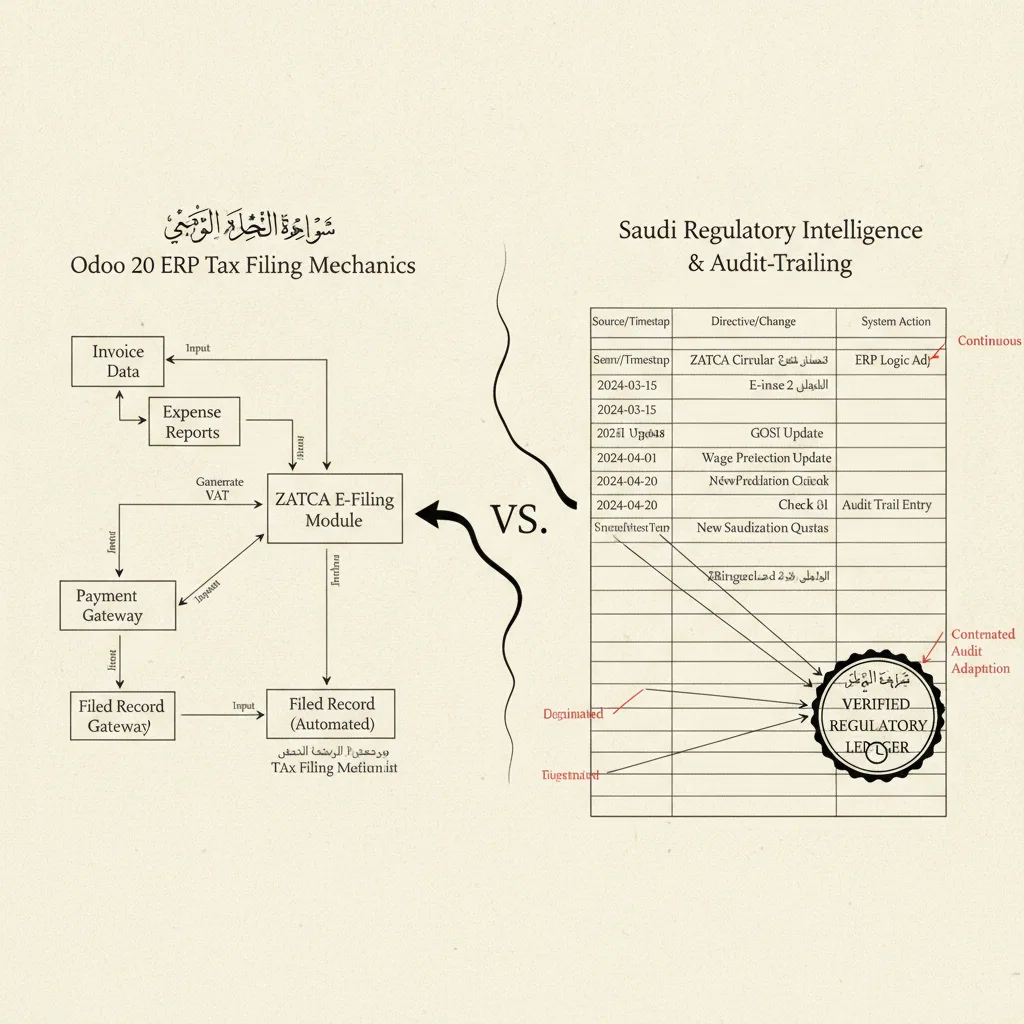
A Saudi accounting office receives a notice through هيئة الزكاة والضريبة والجمارك's portal on a Tuesday afternoon. The notice requires a response within fifteen business days. The ERP is open on three screens across the office. None of them flag the notice, because none of them were designed to.
This is not a software bug. It is an architectural mismatch — one that the latest ERP update will not fix, and one that carries real penalty exposure for every multi-client accounting practice operating in the Kingdom today.
What ERP Tax Compliance Modules Actually Do — and What They Don't
ERP tax modules are transaction processors. They calculate VAT on invoices, apply the correct rate by commodity classification, produce the XML or JSON payload required by هيئة الزكاة والضريبة والجمارك's e-invoicing infrastructure, and generate the periodic filing summary an accountant submits. When the data is clean and the configuration is correct, they do this reliably.
What they do not do is watch for incoming regulatory signals. An ERP has no mechanism to poll ZATCA's portal for new circulars, cross-reference a penalty notice against the correct client entity in a multi-client portfolio, assign a response deadline to a named accountant, or create an audit trail proving that a received notice was acted upon within the required window.
This is not a criticism of ERP design. ERPs are optimized for the ledger — debits, credits, period-close. The regulatory notice problem lives one layer upstream, in the space between the regulator's outbox and the accountant's inbox.
The Saudi Regulatory Notice Problem ERPs Were Never Designed to Solve
هيئة الزكاة والضريبة والجمارك has accelerated its digital outreach considerably. Its updated mobile application now enables taxpayers to monitor obligations, track returns and payments, access account statements, and submit and follow up on reports and notifications [2]. Separately, ZATCA activated a "Digital Report" service through the Beneficiary Engagement Center "Amer," providing structured channels for complaints, service-conversion requests, and development proposals [1].
Each of these channels represents a vector through which a compliance-relevant signal can reach — or fail to reach — an accounting office. The mobile app is useful for a single taxpayer monitoring their own account. For an office managing dozens of client entities across different Nitaqat bands, VAT filing periods, and GOSI contribution cycles, the problem compounds: which notice belongs to which entity, who is responsible for acting on it, and what is the documented proof that action was taken?
GOSI and the Human Resources and Social Development Ministry (HRSD) operate their own notification systems with their own cadences and their own penalty frameworks. The regulatory notice landscape a Saudi accounting office must monitor is not one portal — it is at minimum three agencies, each with distinct timelines and consequence structures.
No ERP module spans all three. Very few span even one completely.
Five Gaps Between an ERP Tax Module and a Compliance-Intelligence Layer
The distinction between transaction-processing compliance and notice-intelligence compliance is best understood through the specific failure modes that emerge when offices conflate the two:
-
Ingestion gap. ZATCA, GOSI, and HRSD each issue notices through their own digital channels. An ERP processes data fed into it — it does not pull notices from external regulatory portals. Any notice that never enters the ERP creates zero alert and leaves zero trail in the ERP log.
-
Attribution gap. In a multi-client office, a notice must be matched to the correct legal entity. The ERP knows its own chart of accounts; it does not automatically disambiguate a penalty notice addressed to one of forty client entities with similar names or overlapping ownership structures.
-
Deadline-routing gap. A regulatory notice carries an implicit or explicit response deadline. ERP task management, where it exists, is oriented around period-close calendars — not the variable, notice-triggered deadlines that ZATCA and GOSI impose.
-
Audit-trail gap. When a regulator later asks for proof that a notice was received and responded to, the ERP's transaction log shows the resulting journal entry — not the chain of custody for the notice itself. These are different records, and auditors treat them differently. For a detailed treatment of what Saudi law actually requires, see Audit Trails for Regulatory Notices: What Saudi Law Actually Requires.
-
Multi-agency gap. Saudization compliance under Nitaqat, GOSI contribution confirmations, and ZATCA VAT notices each have distinct regulatory owners, distinct response formats, and distinct penalty regimes. An ERP tax module addresses one of these at most. For a closer look at how the Nitaqat dimension compounds the compliance picture, see نطاقات والسعودة: ما يجب على كل صاحع عمل معرفته.
How Saudi Accounting Offices Are Bridging the Gap Today
The offices that have recognized this structural problem are not waiting for ERP vendors to solve it. The approaches in use vary in sophistication:
Manual monitoring protocols. A designated staff member checks ZATCA's portal and GOSI's platform on a fixed daily schedule, logs each notice in a shared spreadsheet, and assigns it manually. This works until staff turnover, leave, or volume exceeds the protocol's capacity — typically around the mid-year Zakat filing cycle when notice volume concentrates.
Email-forwarding rules. Portal notifications sent to a registered email address are filtered and forwarded to a team inbox. The attribution and deadline-routing problems remain unsolved; the inbox becomes a liability when no one owns it during a busy period.
Hybrid workflow tools. Some offices have built notice-tracking layers in general-purpose workflow software. These require ongoing maintenance as portal formats change and create their own audit-trail questions when the underlying platform is not Saudi-hosted. The data-sovereignty implications of this approach are worth examining carefully — see Data Sovereignty and Compliance AI in Saudi Arabia.
Purpose-built compliance-intelligence systems. A smaller number of offices have moved to systems designed specifically for the notice-ingestion, attribution, and routing problem. These systems sit upstream of the ERP, verify the obligation, route it to the named accountable party, and pass confirmed data downstream into the ERP for period-close processing. The Zakat filing lifecycle piece The Zakat Filing Lifecycle: Where Internal Compliance Teams Lose Control maps where this upstream layer matters most.
The gap between the first three approaches and the fourth is not primarily a technology gap. It is an architectural recognition: the ERP is not the beginning of the compliance process. It is somewhere in the middle.
What the Upstream Layer Must Actually Do
A compliance-intelligence layer that genuinely solves the notice problem must accomplish five things that no ERP module currently covers:
- Pull notices from ZATCA's portal, the ZATCA mobile application's notification infrastructure [2], GOSI's employer portal, and HRSD's Qiwa platform on a continuous basis — not just at period-close.
- Classify each notice by agency, obligation type, and urgency tier before any human reviews it.
- Match the notice to the correct legal entity within the office's client portfolio without requiring a human intermediary to recognize the match.
- Route the classified, attributed notice to the named accountable accountant with a documented timestamp — creating the audit trail that proves receipt and assignment.
- Pass the verified obligation downstream into the ERP as a confirmed input, not as a raw notice that still requires manual interpretation.
This sequence is what the compliance-literature calls the "ingestion-to-ERP" pipeline. Every office in Saudi Arabia has one, whether it has been designed intentionally or has assembled itself through improvisation. The question is whether the improvised version will hold under regulatory scrutiny — specifically under the kind of scrutiny that follows a ZATCA field review or a GOSI contribution dispute.
For a structured framework for evaluating whether a given software solution addresses this pipeline, see Evaluating Saudi Compliance Management Software: A Buying Framework.
MAKYN's View: Stop Expecting Your ERP to Read ZATCA Circulars for You
The ERP vendor community has done useful work. Phase Two e-invoicing integration is more reliable than it was two years ago. VAT return preparation inside modern ERP environments is considerably less manual than the spreadsheet-and-portal workflows it replaced. These are real improvements.
They are also improvements to the wrong part of the problem for most Saudi accounting offices.
The structural risk sitting in most practices today is not that VAT is calculated incorrectly inside the ERP. It is that a ZATCA notice, a GOSI contribution discrepancy alert, or an HRSD Saudization compliance flag arrived through a digital channel that no one in the office was watching systematically — and that by the time the ERP reflected the resulting liability, the response window had already closed.
Offices that conflate "we have a good ERP" with "we have solved compliance" are carrying a hidden exposure that no software update addresses. The exposure is upstream, in the notice-ingestion layer. Solving it requires acknowledging that the ERP is a downstream system — useful, necessary, but positioned too late in the compliance sequence to catch what arrives at the top.
MAKYN is built for that upstream layer: ingesting notices from هيئة الزكاة والضريبة والجمارك, GOSI, and HRSD; classifying and attributing them to the correct entity; routing them with a timestamped, immutable audit trail; and feeding verified obligations into whatever ERP or accounting platform the office already uses. The ERP does not need to be replaced. It needs to be fed correctly.
If your office is ready to map its current notice-ingestion process against what a proper compliance-intelligence layer requires, اطلب عرضاً توضيحياً. The diagnostic is free. The penalty exposure from not running it is not.
Related reading: AI Bookkeeping Tools Miss What Saudi Offices Actually Need · How Accounting Firms Should Track ZATCA Notifications Systematically · ربط محرك الضريبة بـ ERP: ما تحتاجه المكاتب السعودية فعلاً
Frequently asked
- What does a ZATCA tax compliance module in an ERP actually do?
- ERP tax modules calculate VAT on transactions, generate e-invoices in the required format, and produce filing summaries. They operate on data already inside the system. They do not monitor ZATCA's portal or mobile app for new circulars, penalty notices, or compliance alerts — that ingestion step happens entirely outside the ERP.
- Why can't Saudi accounting offices rely on the ZATCA mobile app alone for compliance tracking?
- The ZATCA mobile app lets users track obligations, returns, and payments for a single taxpayer profile. A multi-client accounting office managing dozens of entities needs each notice classified, attributed to the correct client, assigned a response deadline, and audit-trailed — functions the app was not designed to perform at portfolio scale.
- What is a regulatory notification-intelligence layer?
- It is a system that sits upstream of the ERP and handles the continuous ingestion of notices from ZATCA, GOSI, and HRSD. It classifies each notice by type and urgency, routes it to the responsible accountant or entity, and creates a dated, immutable audit trail — so that no obligation enters the ERP without a verified paper trail of who saw it and when.
- How does conflating ERP compliance with regulatory intelligence create audit risk?
- When an office assumes its ERP covers compliance end-to-end, notices arriving through ZATCA's portal or Digital Report service go untracked. If a penalty is later disputed, there is no audit trail proving the notice was received and acted upon within the required window — a gap that the ERP's transaction log cannot retroactively fill.
Sources
- 1. ZATCA Launches New Digital Report Service — zatca.gov.sa
- 2. ZATCA Mobile Application Updates 2026 — zatca.gov.sa