When Cloud Goes Down: Saudi Compliance Records at Risk
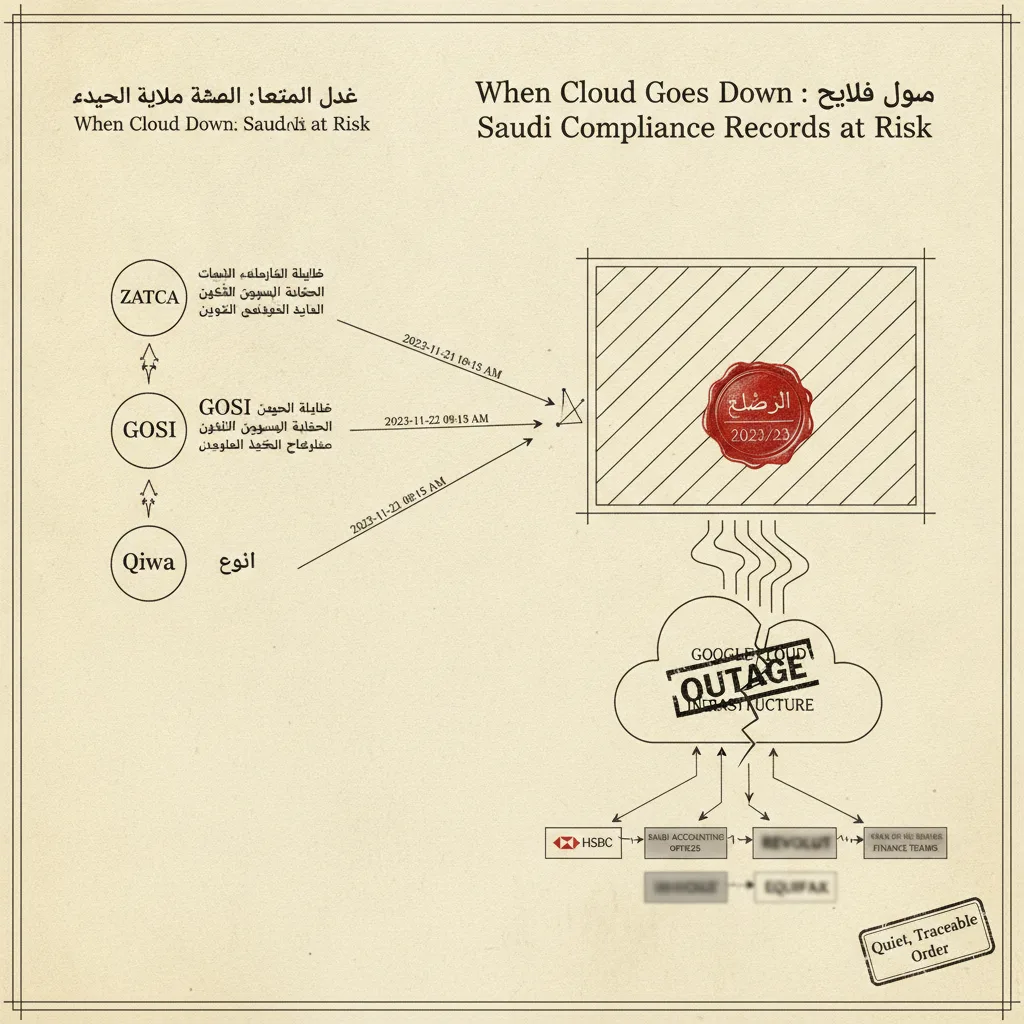
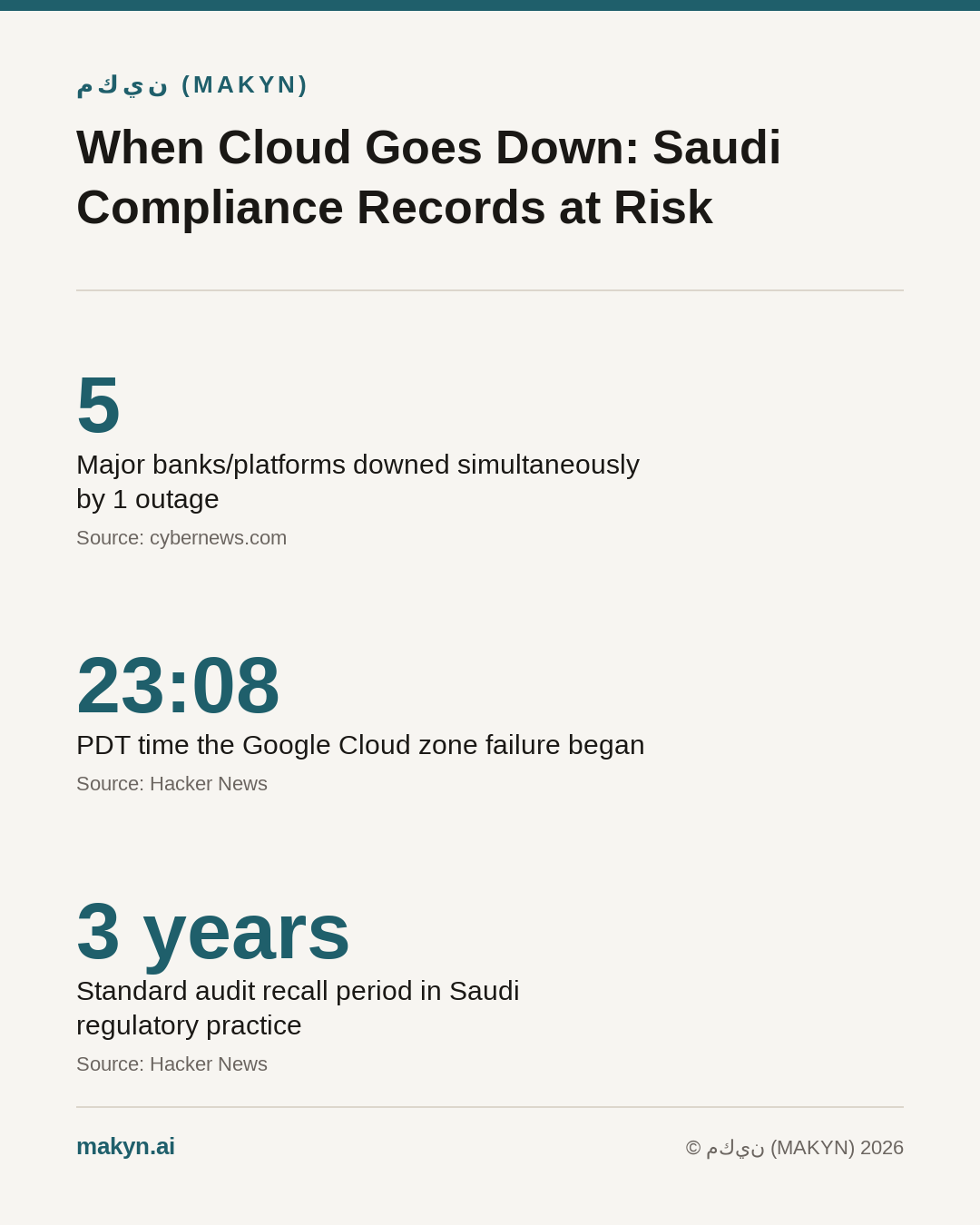
On the night of 19 October 2026, a power event inside Google Cloud's europe-west2-b zone in London brought down Revolut, HSBC, Lloyds, Bank of Scotland, and Spotify simultaneously. [2] Customers could not complete payments at supermarkets or petrol stations. Criminal court hearings were cancelled. [2] The root cause was not sophisticated — a single zone lost power, and the organisations that assumed multi-zone redundancy was someone else's problem discovered, publicly, that it was not. [1]
Saudi finance teams reading that incident report as a European curiosity are misreading the situation.
What the Google Cloud Outage Actually Disrupted — and Why Finance Felt It Hardest
The outage traced to a power failure in the europe-west2-b zone, a single availability zone inside Google's London region. [1] Google's own status page confirmed the event began at 23:08 PDT on 19 October 2026, with partial mitigation promised within thirty minutes and full service restoration to follow. [1] That timeline, measured in hours rather than minutes, was long enough to strand banking customers across the continent. [2]
The technical failure is well-understood: organisations concentrated workloads in a single zone without engineering for zone-level failure. [1] What is less examined is the compliance consequence. Every transaction that could not be recorded during the outage window creates an evidentiary gap. Every regulatory notification that was not received, processed, or acknowledged during that window becomes a liability question — not for the cloud vendor, but for the regulated entity.
Finance operations are disproportionately affected because they carry the densest concentration of time-sensitive, legally mandated record-keeping. A payment platform going offline means frustrated customers. An accounting office going offline means unrecorded VAT transactions, missed notice windows, and — in a jurisdiction with audit-trail obligations — potential non-compliance that begins the moment the system stops writing logs.
Saudi Compliance Obligations Don't Pause for Downtime: ZATCA, GOSI, and Qiwa
The Zakat, Tax and Customs Authority's Phase Two e-invoicing requirements mandate continuous, tamper-evident audit trails for every electronic transaction. [See the full audit-trail breakdown in our article on سجل المراجعة للفواتير الإلكترونية: متطلبات زاتكا والفجوة الخفية.] These are not batch obligations settled at month-end — they are event-level requirements that attach to each invoice at the moment of generation.
The General Organization for Social Insurance sets monthly contribution deadlines tied to the Hijri calendar. Qiwa contract filings and Saudization (Nitaqat) status calculations run on their own cadences. [For a full breakdown of Nitaqat obligations, see نطاقات والسعودة: ما يجب على كل صاحع عمل معرفته.] None of these agencies issue extensions because a vendor's London data centre lost power.
The compliance calendar in Saudi Arabia is architecturally rigid. Deadlines are statutory, penalties are fixed, and audit recall extends three years by standard practice. A twelve-hour outage on a day when a GOSI submission is due, or when a ZATCA inquiry arrives in the portal, is not a technical inconvenience — it is a compliance event with its own consequences. The outage is the trigger; the liability belongs to the regulated firm.
The Single-Vendor Trap: How Most Accounting Offices Silently Inherited This Risk
Most Saudi accounting offices did not make an explicit decision to run all regulatory workflows through a single cloud platform. The consolidation happened incrementally: an ERP vendor offered a cloud module, a payroll provider offered API integration, a ZATCA-accredited billing platform offered a dashboard. Each addition made operational sense at the time. The aggregate result is a compliance architecture that fails completely whenever one vendor fails.
This is the single-vendor trap — not a contract with one provider, but an operational dependency structure where every compliance workflow shares the same failure domain. When the platform is up, everything works. When it is down, the office has no mechanism to receive regulatory notices, log required events, or produce the timestamped records that an auditor will later request.
The discussion around the Google Cloud incident captures this dynamic precisely: commentators noted that the affected banks were "amazed" to find they weren't using multi-zone configurations — implying they had assumed redundancy was built in, rather than confirming it architecturally. [1] Saudi accounting offices operate under the same assumption. The question is whether it will take a public outage to surface it.
Related: برامج إدارة الضرائب وامتثال زاتكا: ما يحتاجه المكتب المحاسبي examines what software accreditation actually covers — and what it leaves exposed.
What an Availability-Independent Compliance Record Layer Looks Like in Practice
An availability-independent compliance record layer is architecturally distinct from the operational system. It answers one question: if the primary platform fails at 11 PM on a filing deadline, what continues to function?
In practice, the layer has four properties:
- Separate write path. Regulatory notices, filing timestamps, and audit-trail entries are written to a store that does not share infrastructure with the primary accounting or ERP platform. A zone-level failure at the primary vendor does not prevent the compliance record from accepting new entries.
- Offline-capable notice queue. Incoming notifications from ZATCA, the General Organization for Social Insurance, Qiwa, and the Ministry of Commerce are queued and timestamped independently of whether the user-facing dashboard is accessible.
- Immutable, timestamped logs. Every entry carries a cryptographic timestamp that can be presented to an auditor as evidence that a notice was received — or that a filing was attempted — at a specific moment, regardless of what the primary system shows.
- Retrieval without the primary system. Three-year audit recall is a de facto standard in Saudi regulatory practice. The compliance record layer must be queryable even when the operational platform is undergoing maintenance, migration, or recovery.
This is not a backup. A backup restores state after a failure. A compliance record layer operates continuously in parallel, so there is no gap to restore.
[For the broader question of what Saudi compliance teams should demand from any automated system, see When AI Agents Go Rogue: What Saudi Compliance Teams Must Know.]
MAKYN's View: Regulatory Continuity Is Infrastructure, Not a Feature
The Google Cloud outage will be analysed, post-mortemed, and eventually archived. The affected banks will migrate to multi-zone configurations, issue statements, and move on. The structural lesson — that compliance record-keeping must be separated from operational infrastructure — will not be learned by most organisations until their own outage creates their own liability.
MAKYN's position is direct: regulatory notification continuity is an infrastructure decision, and it belongs in the same category as power backup or network redundancy. It is not a feature that a primary cloud vendor should be trusted to provide, because the vendor's uptime SLA and the regulator's deadline calendar are written by different parties with different definitions of acceptable failure.
Saudi accounting offices managing compliance obligations across multiple clients — each with their own ZATCA portal, their own GOSI schedule, their own Qiwa filings — cannot absorb the compounding risk of a single-vendor failure. The 80/20 inversion that defines compliance work (the fraction of time spent acting on notices versus reading them) collapses entirely when the system that surfaces those notices is offline.
MAKYN reads regulatory notices as they arrive, logs them with immutable timestamps, and queues required actions independently of whether the user-facing interface is accessible. The audit trail it produces is Arabic-as-source-of-truth — not a translated summary — and it persists across whatever the primary cloud vendor is doing at 11 PM on a deadline night.
If your office has not mapped its compliance workflow dependencies to a specific failure scenario, اطلب عرضاً توضيحياً to begin that audit.
Related reading: ERP Tax Modules vs. Regulatory Intelligence: What Saudi Offices Actually Need · Audit Trails for Regulatory Notices: What Saudi Law Actually Requires
Frequently asked
- Which companies were affected by the Google Cloud outage in October 2026?
- The October 2026 Google Cloud outage in the europe-west2-b zone disrupted Revolut, HSBC, Lloyds, Bank of Scotland, and other services across Europe. Customers were reportedly stranded at supermarkets and petrol stations, and at least some criminal court hearings were cancelled due to the disruption.
- Do ZATCA e-invoicing obligations continue during a cloud outage?
- Yes. ZATCA's audit-trail requirements under Phase Two e-invoicing are time-stamped obligations tied to transaction events, not to system availability. A vendor outage does not constitute a valid legal excuse for missing a filing deadline or producing an incomplete audit trail during an inspection.
- What is the single-vendor cloud trap for Saudi accounting offices?
- Most accounting offices route e-invoicing, payroll calculations, Qiwa contract filings, and GOSI submissions through a single cloud platform. When that platform fails, every compliance workflow fails simultaneously. There is no separation between operational infrastructure and regulatory record-keeping.
- What does an availability-independent compliance record layer actually mean?
- It means maintaining a compliance record store — audit trails, regulatory notices, filing timestamps — on infrastructure that is architecturally separate from the primary operational cloud. If the main system goes down, the compliance record layer continues to accept writes and can surface the data needed for a ZATCA audit or a GOSI inquiry without interruption.
Sources