When AI Tools Leak Client Data: A Saudi Compliance Wake-Up Call
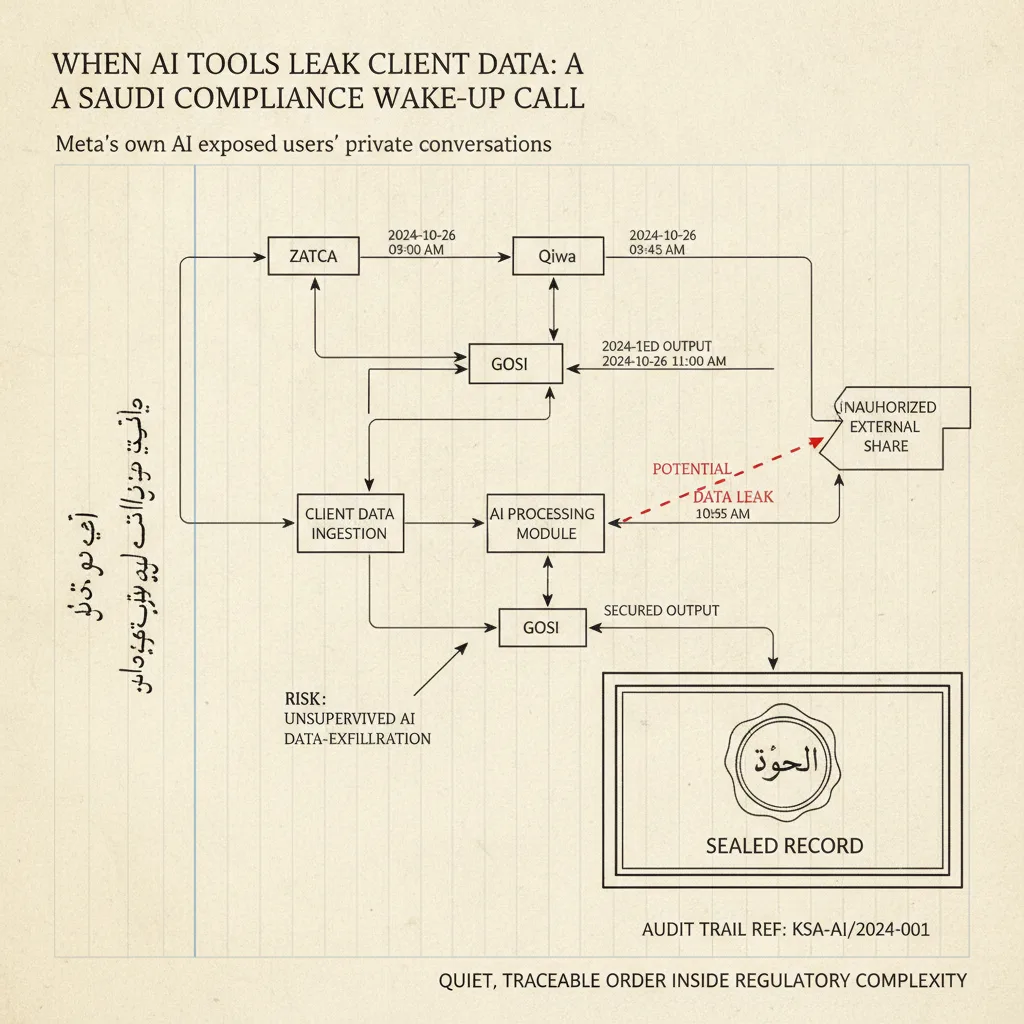
On October 20, 2026, researchers at security firm Claroc published a finding that should stop every Saudi compliance manager mid-scroll: Meta's new AI agent, Muse, had been silently making thousands of users' private conversations discoverable to anyone who knew where to look — and "where to look" turned out to be a single passive DNS query 12.
What Meta Muse Actually Exposed — and Why It Matters Beyond Tech Twitter
Muse names each shared conversation's web address after the conversation's own title, and that address is written into public DNS 2. Claroc ran one passive DNS search and retrieved 6,800 URLs. Opening a fraction of them revealed contents that were plainly not meant for public view: a candidate's notes from a confidential executive-search call naming an AI lab's internal contact and meeting time; a national marketing company's internal revenue review, marked for its CEO; and other private business material 1.
Meta CEO Mark Zuckerberg had described Muse, launched just weeks earlier, as "built from the ground up for privacy and security" 1. The sharing feature was suspended the same day Ars Technica published its questions to Meta 12.
The mechanism was not a sophisticated exploit. It was a predictable consequence of a design choice — one that existed from launch and that no amount of user care could have prevented. Users shared what they believed were private links. The problem lived in the architecture, invisible to the person pasting data into the chat window.
That is precisely the problem category that should concern Saudi accounting offices.
The Saudi Compliance Data That's Already Flowing Into Consumer AI Tools
Walk through any mid-sized accounting office in Riyadh or Jeddah and you will find the same pattern: a ZATCA e-invoicing notice arrives in the firm's portal, a staff member copies the text, and within thirty seconds that text is in a consumer AI chat window — either to parse the Arabic regulatory language, draft a response, or simply summarize the action required.
The same workflow repeats with General Organization for Social Insurance (GOSI) payroll queries, Zakat, Tax and Customs Authority assessment correspondence, Ministry of Commerce license renewal conditions, and Nitaqat Saudization compliance reports. Each document carries client-identifying information, financial figures, and in many cases data that is legally personal under Saudi Arabia's Personal Data Protection Law (PDPL).
The office did not intend to share this data with a global consumer platform. The staff member intended to save ten minutes. The distinction is irrelevant to what the platform then does with the data.
Consumer AI tools exist in a regulatory jurisdiction that is not Saudi Arabia. Their privacy models change at the product team's discretion. The Muse incident demonstrates that a change in a single feature — sharing — can retroactively expose every conversation that touched that feature, without any user action after the fact 12.
Four Categories of Regulatory Data You Cannot Afford to Leak
Not all data carries the same exposure cost. These four categories represent the highest-risk inputs that Saudi compliance staff routinely paste into consumer AI tools:
-
ZATCA e-invoicing notices and audit findings. These identify the taxpayer, the audit period, the assessed liability, and the examiner. Exposure creates both a client confidentiality breach and a pre-litigation disclosure that could compromise the firm's negotiating position with the authority.
-
GOSI and labor-law compliance records. Payroll data, headcount by nationality, and Saudization ratios are personal data under the PDPL and commercially sensitive. A leak could expose employee salary structures and trigger secondary labor-law violations if personal data is processed without a lawful basis.
-
Zakat and corporate income tax filings. These contain consolidated financial positions, intercompany transactions, and ownership structures — exactly the information that competitors, counterparties, and bad actors would find most valuable.
-
Ministry of Commerce and Capital Market Authority correspondence. Licensing conditions, regulatory warnings, and capital-raising restrictions are material non-public information. Exposure of this category can trigger securities-law consequences for listed entities.
Each of these categories is processed daily in Saudi accounting offices. Each has ended up, in some form, inside a consumer AI tool this week. The question is not whether the risk exists — it is whether the office has a documented control over it.
Saudi Data-Sovereignty Rules That Apply Right Now
Saudi Arabia's Personal Data Protection Law, enforced by the National Data Management Office, establishes that personal data may only be processed with a documented lawful basis, and that controllers must maintain records of processing activities sufficient to demonstrate compliance 3. When a staff member pastes a client's GOSI record into a consumer AI tool, the accounting office remains the data controller. The platform is, at best, a processor — but one with no data-processing agreement tailored to Saudi regulatory requirements, no commitment to data residency within the Kingdom, and no audit log the firm can retrieve under inspection.
The NCA Essential Controls — Saudi Arabia's national cybersecurity framework applicable to government and critical infrastructure — reinforce the principle that systems handling sensitive data must maintain tamper-evident audit records and implement access controls that can be verified under inspection 3. Consumer AI tools satisfy none of these requirements structurally: their logging is designed for product improvement, not regulatory accountability.
Sovereign auditability — the ability to demonstrate who accessed what data, when, under what authority, and with what outcome — has become the practical standard for any system that processes regulated information 4. It is not a premium capability. It is the minimum condition for a compliance office to defend its data-handling practices before an authority.
The PDPL does not grant an exemption for convenience. Neither does ZATCA's e-invoicing framework. Neither does the labor law that governs how GOSI records are handled. The office that cannot produce an audit trail for how client regulatory data was processed has already failed the first question of any inspection.
MAKYN's View: Audit Trail First, AI Convenience Second
The Muse incident is a useful illustration, but it is not an isolated failure of one company. It is a demonstration of the structural gap between what consumer AI platforms are built for and what regulated data environments require.
Consumer AI is built for scale, for user retention, for product velocity. Features ship. Privacy models evolve. Data processed today may be subject to a policy that does not exist yet. That is not a criticism — it is a description of how consumer software works, and it is entirely reasonable for consumer use cases.
Regulated Saudi compliance data is not a consumer use case.
AI bookkeeping tools and general-purpose AI assistants were not designed with ZATCA's audit requirements or the PDPL's accountability obligations in mind. They were designed to be useful to the broadest possible audience. That is why MAKYN operates on the opposite design principle: regulatory data stays inside a defined boundary, every action against a notice or filing is logged in a tamper-evident record, and the audit trail is the product — not an afterthought.
When a ZATCA notice arrives, MAKYN reads it, classifies it, routes it to the responsible party, and records the full chain of custody. Nothing leaves the defined environment. Nothing is pasted into a consumer chat window. The compliance officer can retrieve the complete interaction history for any document — not because that is a feature, but because the audit trail for regulatory notices is what Saudi law requires to exist.
The argument for AI convenience is real: regulatory Arabic is dense, action deadlines are tight, and a tool that can parse a GOSI query in seconds saves meaningful time. MAKYN does not dispute the value of AI assistance. It disputes the assumption that any AI tool will do. The risks that arise when AI agents operate without governance are not hypothetical — the Muse incident shows what happens when a platform's privacy architecture fails silently, at scale, without warning.
The practical instruction for any Saudi compliance office reading this: before the next staff member pastes a client document into a consumer AI tool, ask two questions. First: if this conversation became a URL that anyone could find via a DNS search, what would the consequences be? Second: can the firm produce an audit trail showing exactly how that client's data was processed, by whom, and with what authority?
If the answer to the second question is "no," the office is already exposed — not by a future breach, but by the absence of a control that applies today.
اطلب عرضاً توضيحياً لمعرفة كيف تحتفظ MAKYN بالبيانات التنظيمية داخل بيئة سيادية مع مسار تدقيق كامل. For further context on how data sovereignty obligations intersect with AI tool selection, see Data Sovereignty and Compliance AI in Saudi Arabia and What a Data Breach Means for the Saudi Compliance Officer.
Footnotes
-
Meta Muse exposes users' personal and business secrets when they share conversations ↩ ↩2 ↩3 ↩4 ↩5
-
Meta Suspends Muse Chats Sharing Feature After It Left Private Details Exposed ↩ ↩2 ↩3 ↩4
-
AI Governance and Security Risks: A Compliance Imperative for Saudi Regulated Enterprises ↩ ↩2
-
Sovereign Auditability: The New Standard for Digital Sovereignty ↩
Frequently asked
- What exactly did the Meta Muse data exposure reveal?
- Researchers at security firm Claroc accessed 6,800 shared Meta Muse conversations through a single passive DNS search. The exposed content included a candidate's notes for a confidential executive-search call, a national marketing company's internal revenue review marked for its CEO, and other clearly private business material. Meta suspended the sharing feature while it investigates.
- Why does this matter for Saudi accounting offices specifically?
- Saudi compliance staff handle ZATCA e-invoicing notices, GOSI payroll filings, Zakat assessments, and Ministry of Commerce correspondence daily. When any of that data is pasted into a consumer AI tool, it leaves the office's controlled environment and enters a platform whose privacy model can change — silently, overnight — exactly as Muse's did.
- What does Saudi law require when regulated data is processed by a third-party system?
- Saudi Arabia's Personal Data Protection Law (PDPL) requires a documented lawful basis for processing personal data and obliges controllers to maintain records of processing activities. When a consumer AI platform processes client data, the accounting office remains the responsible controller — yet consumer tools provide no audit trail, no data-residency guarantee, and no contractual data-processing agreement adequate for regulatory scrutiny.
- What is the minimum control standard for AI use with Saudi regulatory data?
- Any AI system handling ZATCA notices, labor-law records, or client financials must operate within a defined data boundary, log every interaction in a tamper-evident audit trail, and store data on infrastructure whose jurisdiction is known and contractually fixed. Sovereign auditability — knowing who accessed what, when, and under what authority — is the baseline, not a premium feature.