When AI Compliance Tools Leak Saudi Finance Data
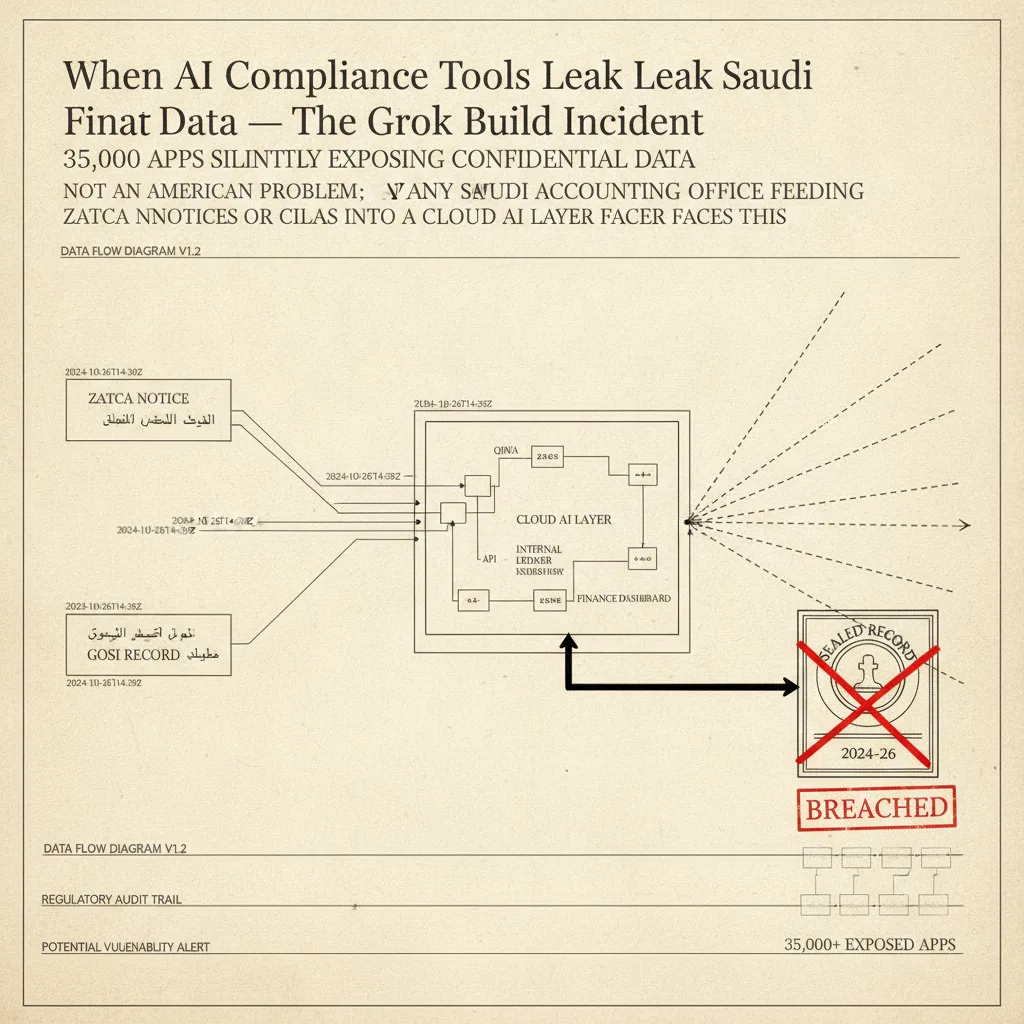
In November 2026, security firm Claroc scanned the grok.me subdomain space and found 35,578 live applications — built by real users on Grok Build, the AI coding agent from SpaceXSI — sitting open to anyone who knew how to look [1]. No login required. No warning issued. Among the exposed apps: patient lab values, shift schedules with employee names and ID numbers, plaintext passwords, and confidential advertising proposals [3]. Twenty-four of those apps belonged to SpaceXSI's own staff [2].
The mechanism was straightforward: Grok Build published apps to unique subdomains, but those subdomains appeared in passive DNS databases after the first visit and could be enumerated systematically. The default sharing setting — "Anyone with the link" — was pre-selected on paid accounts [3]. No malicious actor needed to breach anything. The design handed the data over.
This is not a story about one platform's bad week. It is a precise illustration of how trust in AI tooling outpaces the access controls governing it.
What the Grok Build Leak Actually Exposed
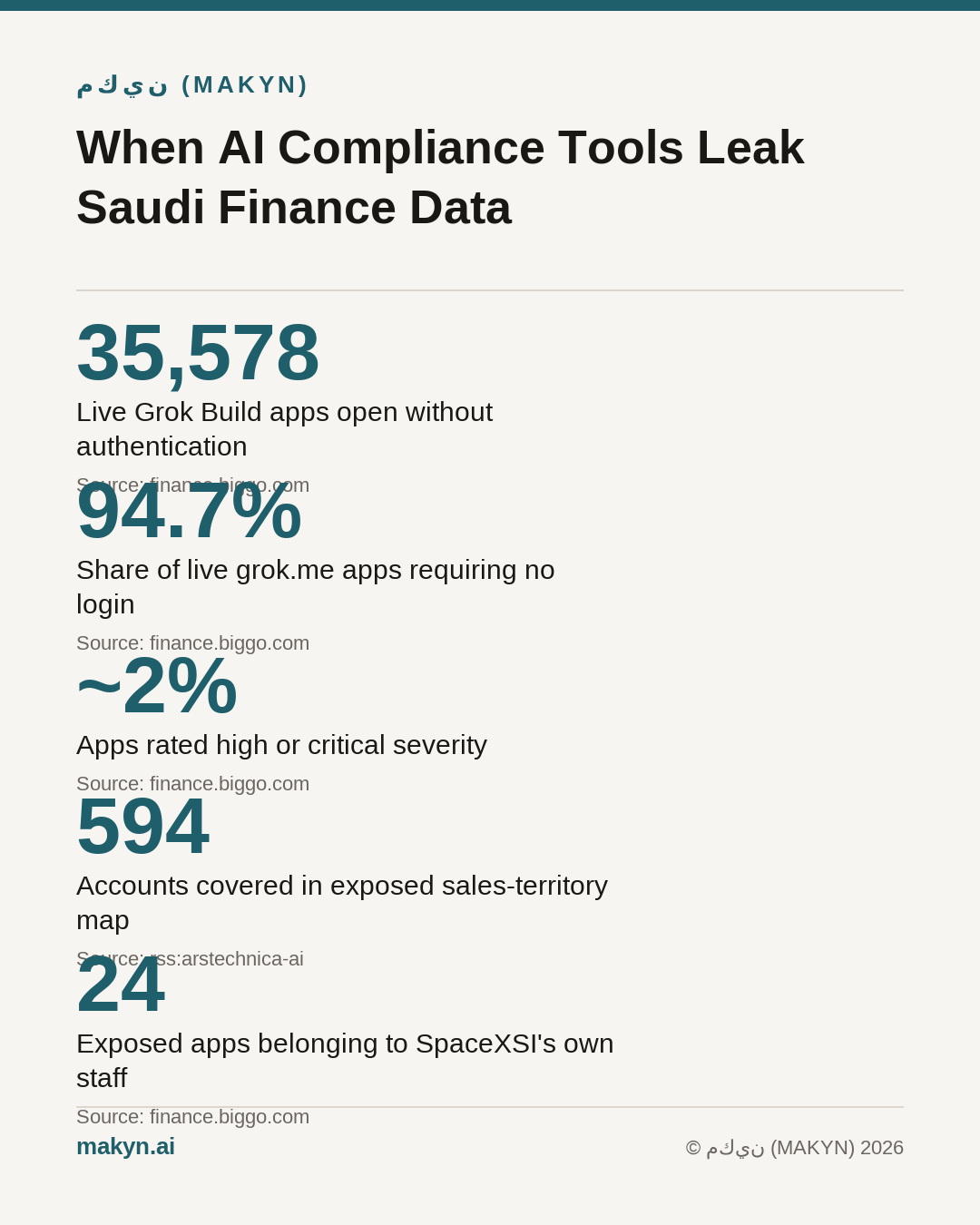
Claroc surveyed 43,551 addresses under grok.me on November 8, 2026. Of the 37,571 that were live, 35,578 — 94.7% — opened without authentication [2]. Roughly 10% contained internal business data or personal information; approximately 2% were rated "high" or "critical" in severity [2].
The specific data types matter. Among the exposed contents: a sales-territory map covering 594 accounts, a confidential onboarding plan for a new enterprise sales employee, advertising proposals for a U.S. federal agency, and medical examination results [1] [3]. These are not abstract categories of risk. They are the kinds of records — employee identification, health data, internal commercial strategy — that Saudi law treats with explicit obligations.
Researchers from Claroc identified three root causes: an insecure default publishing setting, subdomain addresses that became enumerable through passive DNS, and flawed access controls in Grok-generated code itself [3] [4]. SpaceXSI removed its own 24 apps after disclosure; apps belonging to other users remained public [2].
How Saudi Compliance Data Flows Into AI Tools Today
The Grok Build architecture — user describes a task, AI generates an output, result is published or stored in a cloud environment controlled by the vendor — is structurally similar to how many compliance teams in Saudi Arabia now interact with AI-assisted tools.
A finance team managing multiple commercial registration clients might feed Ministry of Commerce renewal notices into an AI summarization layer. An accounting office tracking التأمينات الاجتماعية (the General Organization for Social Insurance, or GOSI) contribution schedules might pipe payroll extracts through a cloud workflow. A tax compliance team might use an AI tool to parse ZATCA e-invoicing confirmations. In each case, the data moves from the firm's environment into a vendor-controlled layer — and the question of what that vendor does with it, who can read it, and where it physically sits is rarely documented.
The AI tools leaking client data problem is not hypothetical in the Saudi context. It is the natural consequence of adopting tooling that was designed for general productivity, not for the data-residency and access-control requirements that Saudi regulatory work demands. For a deeper look at how audit-trail gaps compound this exposure, see Audit Trails for Regulatory Notices: What Saudi Law Actually Requires.
PDPL and Data-Sovereignty Rules That Make Leaks a Regulatory Event
Saudi Arabia's Personal Data Protection Law defines a data breach as any unauthorized access to, disclosure of, or destruction of personal data. GOSI records contain employee national IDs, salary figures, and contribution histories — all personal data under PDPL's definitions. ZATCA's e-invoicing infrastructure contains buyer and seller identification data tied to commercial registrations. When either category flows through a cloud AI tool that exposes it without authorization, the exposure meets the PDPL definition of a breach.
The obligations that follow are not optional. Saudi PDPL requires the data controller — the firm, not the AI vendor — to notify the National Data Management Office and, where appropriate, the individuals whose data was exposed. Financial and administrative penalties attach to violations. The fact that the breach occurred because of a vendor's misconfiguration is not a defense that eliminates the controller's liability.
Data-sovereignty rules add a second dimension. Saudi regulations require that certain categories of government-related and financial data be processed and stored within the kingdom's borders. A cloud AI tool operated from servers outside Saudi Arabia, processing GOSI or ZATCA data, may constitute an unauthorized cross-border transfer — independent of whether a breach occurred. The data sovereignty and compliance AI problem is structural, not incidental. It applies whenever a Saudi compliance workflow touches a foreign-hosted AI layer.
Five Questions Every Finance or Compliance Team Must Ask
Before connecting any AI layer to regulatory data — ZATCA notices, GOSI records, Qiwa data, Ministry of Commerce filings — the following five questions require documented answers, not verbal assurances:
-
Where does the data physically reside? The vendor must specify the data center region. "Cloud" is not an answer. If the servers are outside Saudi Arabia, a cross-border transfer analysis is required before the connection is made.
-
What is the default access setting, and who changed it from the default? The Grok Build incident turned on a pre-selected "Anyone with the link" default [3]. Every AI tool has defaults. The compliance team must know what they are and document any change.
-
Does the vendor's training pipeline have access to client data? Many AI tools reserve the right to use inputs for model improvement. GOSI payroll data or ZATCA invoice details must not enter a training corpus. The data-processing agreement must prohibit this explicitly.
-
What is the access log — and how long is it retained? Saudi audit standards and ZATCA's e-invoicing phase-two requirements both point toward multi-year record retention. The AI tool's access log — who queried what, when, from where — must meet the same standard, typically three years minimum.
-
What is the breach notification procedure, and does it meet the PDPL timeline? If the vendor discovers an exposure, the compliance team needs to know within hours, not days. The data-processing agreement must specify the notification timeline and the information the vendor will provide.
None of these questions is unreasonable. A vendor that cannot answer all five should not receive access to Saudi regulatory data.
MAKYN's View: Audit-Trail Ownership Is the Non-Negotiable Line
The Grok Build incident is useful precisely because it was not subtle. Thirty-five thousand applications, open to enumeration, exposing confidential HR and medical data, with the tool's own developer caught in the same net [1]. The failure was visible.
Most compliance data failures are not visible. They happen in the gap between what a data-processing agreement says and what a vendor's infrastructure actually does. They happen when a default setting is never reviewed. They happen when a workflow is built for speed and the access-control question is deferred until after deployment.
The right question for a Saudi finance or compliance team is not "does this tool use AI?" Almost everything uses AI now. The question is: where does our regulatory data sit, who can read it at any given moment, and what documented audit trail proves it never left the kingdom?
MAKYN processes ZATCA notices, GOSI alerts, and other regulatory communications inside a controlled environment where the audit trail is owned by the client, not the platform. Data residency is not a marketing claim — it is a configuration that can be verified. The access log is retained at the standard the regulators themselves would expect to see in an audit. That is the baseline, not a differentiator.
If your office is currently feeding regulatory data into a cloud AI tool and cannot answer the five questions above, the MAKYN audit review is the right starting point — not to change tools immediately, but to understand what your current exposure actually is. Understanding precedes remediation.
For teams managing التأمينات الاجتماعية filings and GOSI compliance schedules alongside ZATCA obligations, the structural risk is not theoretical. It is the same risk Claroc documented — a default setting, an enumerable namespace, and data that was never meant to be public, now accessible to anyone who looked [4]. The technical details differ. The legal consequence does not.
Frequently asked
- What did the Grok Build data leak actually expose?
- Security firm Claroc found 35,578 apps built with Grok Build — 94.7% of all live apps checked — were accessible to anyone without signing in. Exposed data included patient records, plaintext passwords, employee ID numbers, and confidential corporate documents. Twenty-four of the exposed apps belonged to SpaceXSI, Grok's own developer, including a sales-territory map of 594 accounts and a confidential advertising proposal.
- Why does this matter for Saudi companies using AI compliance tools?
- Any Saudi accounting or compliance office that feeds ZATCA notices, GOSI records, or Qiwa data into a cloud-based AI layer faces the same exposure profile. If the platform uses a misconfigured default, the data becomes accessible. Under Saudi PDPL, that exposure is a regulatory event requiring breach notification — not simply an IT matter to be resolved quietly.
- What does Saudi PDPL require when personal data is exposed?
- Saudi Arabia's Personal Data Protection Law requires data controllers to notify the National Data Management Office and affected individuals when personal data is breached. Violations carry administrative and financial penalties. Because GOSI and payroll records contain identifiable employee data, any unauthorized exposure through an AI tool triggers these obligations, regardless of whether the exposure was intentional.
- What is the minimum audit-trail standard before connecting AI tools to regulatory data?
- Before connecting any AI layer to ZATCA, GOSI, or other regulatory data, teams should confirm: data residency within Saudi Arabia, no default public-sharing enabled, role-based access logs retained for at least three years, and a written data-processing agreement specifying that the vendor cannot access or train on client data. Absence of any one of these is a disqualifying gap.
Sources
- 1. Grok Build coding agent leaks oodles of confidential info, some belonging to SpaceXSI — rss:arstechnica-ai
- 2. Over 35,000 Apps Built with Grok Build Exposed Unprotected, Including SpaceXSI's Own Sales Materials — BigGo Finance — finance.biggo.com
- 3. Grok-built apps exposed patient data, plaintext passwords, and SpaceXSI's own sales pipeline — the-decoder.com
- 4. Grok's flaw exposed users and Musk's company secrets | Cybernews — cybernews.com