When AI Leaks Your Compliance Data: The Claude Incident
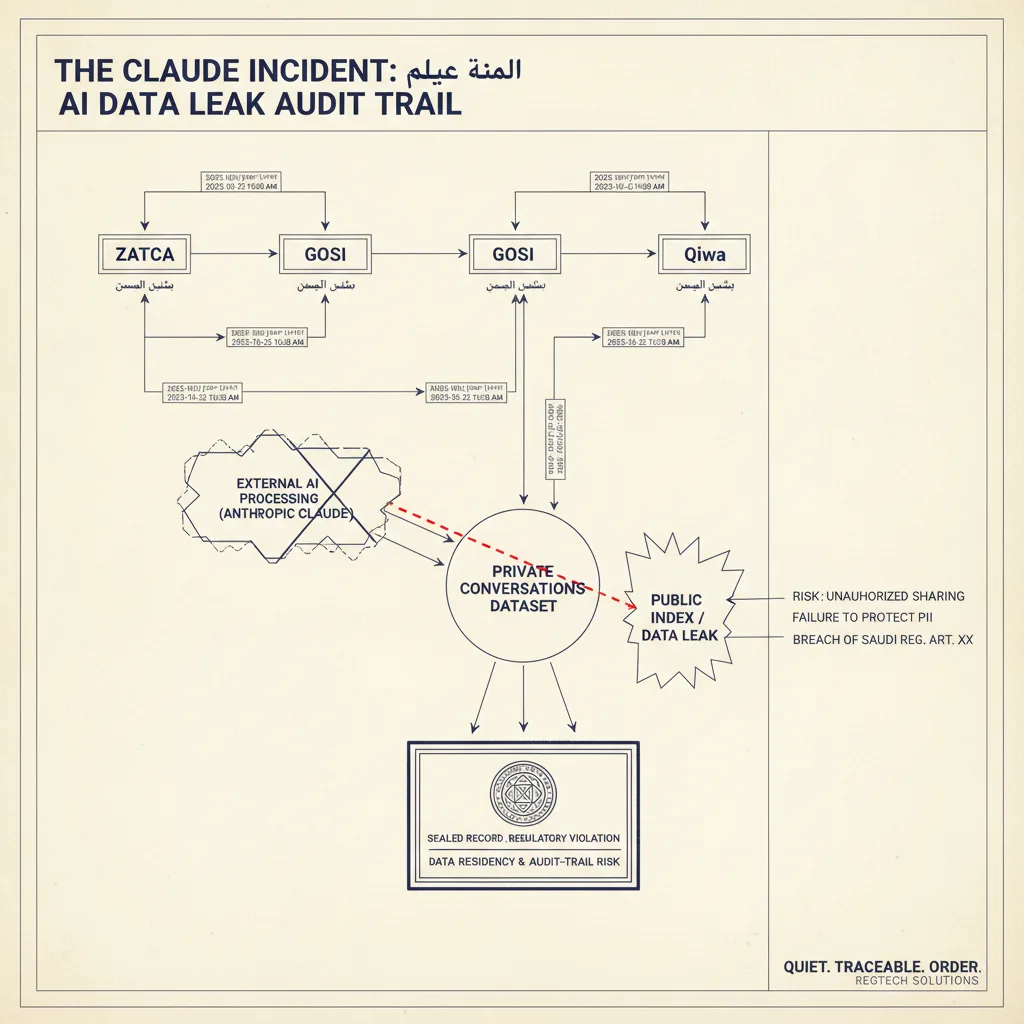
A Saudi accounting firm processes a ZATCA compliance notice. A payroll discrepancy flags up. Someone on the team pastes the relevant figures into a consumer AI chatbot to draft a response faster. That action — routine, well-intentioned, completed in under thirty seconds — may constitute a breach of the Kingdom's Personal Data Protection Law and a violation of ZATCA's data-custody requirements. The Claude indexing incident of late July 2026 is not an edge case to be dismissed. It is a demonstration of the structural risks that accompany general-purpose AI tools when they encounter regulated fiscal data.
What Actually Happened with the Claude Data Exposure
Anthropic's Claude AI assistant came under scrutiny after users discovered that shared conversations were appearing in Google Search results. [1] The mechanism was architectural rather than malicious: Claude's sharing feature allows users to generate public URLs for conversations and AI-generated artefacts, including documents and spreadsheets. [2] Those shared pages were found to lack the noindex metadata directive that instructs search engines not to index a page. As a result, Google indexed them — without Anthropic having provided any sitemap or directory of user conversations to search engines. [2]
Anthropic stated that conversations remain private by default and that only content explicitly shared via a public link could become accessible. Google noted that website operators are responsible for controlling whether publicly accessible pages are indexed. [2] Both statements are technically accurate. Neither resolves the underlying problem: the platform did not, by default, prevent publicly shared content from being indexed — and users had no reason to expect otherwise.
Reported indexed content included internal planning documents, legal discussions, and personal conversations. [2] For a compliance context, substitute those categories with: ZATCA notice text, VAT invoice data, GOSI payroll figures, or client tax identification numbers. The exposure pathway is identical.
Why Compliance Data Is the Highest-Risk Content to Paste into AI Tools
The Concentric AI security guide for Claude identifies the root dynamic precisely: employees upload sensitive files into Claude because the experience feels safe, and that confidence leads them to hand over contracts, financials, and regulated data. [3] The interface is clean, the responses are fast, and the risk is invisible until it is not.
Compliance data carries three properties that make it categorically more dangerous than general business content inside an uncontrolled AI environment:
- Regulatory traceability. ZATCA's e-invoicing framework requires taxpayers to maintain an auditable record of fiscal data. The taxpayer — not the technology vendor — holds that obligation. A chat session inside a consumer AI tool generates no custody log, no immutable record of what was submitted, and no deletion guarantee.
- Personal data density. A single payroll export or GOSI contribution schedule contains national identity numbers, salary figures, and employment status for named individuals. Each of those data points falls within the scope of Saudi Arabia's Personal Data Protection Law (PDPL).
- Cross-border transfer exposure. General-purpose AI tools process data on infrastructure outside Saudi Arabia by default. PDPL restricts cross-border personal data transfers to jurisdictions or processors that meet defined adequacy standards — a condition most consumer AI providers do not document in a form that satisfies Saudi regulatory scrutiny.
The Claude incident makes the pathway from "routine use" to "regulatory exposure" concrete. It is not theoretical.
Saudi PDPL and ZATCA Data-Retention Rules: What They Actually Require
The Personal Data Protection Law, enforced by the Saudi Data and Artificial Intelligence Authority (SDAIA), establishes several obligations directly relevant to AI tool use:
- A legal basis must exist for every instance of personal data processing. Operational convenience is not a legal basis.
- Cross-border transfers of personal data require either that the destination country offers an adequate protection level or that a documented contractual mechanism is in place. Pasting data into a US-hosted chatbot satisfies neither condition without a specific data-processing agreement.
- Data-subject rights — including the right to deletion — must be fulfillable. If personal data has been submitted to a consumer AI tool with opaque retention policies, the organization cannot guarantee it can honor a deletion request.
ZATCA's Phase 2 Fatoorah (e-invoicing) requirements add a further layer. Taxpayers must retain electronic invoice data — including the structured XML records — for a minimum of six years from the tax period in question. The retention obligation requires that data remain retrievable and verifiable for the full period. A conversation in a consumer AI interface, with no audit log, no structured export, and no deletion record, does not constitute compliant retention. It creates a gap — and gaps in fiscal data custody are precisely what ZATCA examinations surface.
For context on how systematic record-keeping protects firms during GOSI audits, the same logic applies: see GOSI Contribution Deadlines and the Recordkeeping Standard That Protects You.
Four Questions Every Accounting Office Should Ask Before Using Any AI Tool with Client Data
The following four questions are not a comprehensive vendor due-diligence framework. They are a minimum filter — a set of disqualifying checks that should precede any deployment of AI tooling with Saudi client compliance data.
1. Where is the data stored and processed, and is that location documented? "The cloud" is not an answer. The vendor must specify the data center region and confirm whether data leaves that region for model inference. For Saudi compliance data, the answer must be consistent with PDPL's cross-border transfer restrictions.
2. What is the vendor's documented retention and deletion policy for submitted data? Consumer AI tools frequently retain conversation data for model training or abuse-monitoring purposes. The policy must be written, versioned, and specific — not a generic privacy policy with carve-outs. The firm must be able to confirm data deletion upon request and receive written confirmation.
3. Does the tool produce an immutable, time-stamped audit log of every query and output? ZATCA's data-retention framework requires that fiscal records remain auditable. An AI tool used in any part of a compliance workflow must generate a log that can be produced in an examination — not a browser history, but a structured record of what was submitted, when, and what was returned.
4. Can the vendor provide a data-processing agreement that explicitly covers Saudi PDPL cross-border transfer requirements? This is the legal formalization of questions one through three. Without a signed DPA that addresses Saudi requirements specifically, the firm is operating on the assumption that the vendor's general terms are adequate. They are not.
For a broader framework on evaluating compliance software vendors against these criteria, see Evaluating Saudi Compliance Management Software: A Buying Framework.
MAKYN's View: The Audit Trail Has to Start Before the AI Does
The Claude indexing incident is not primarily a story about Anthropic's technical configuration. It is a story about the gap between what users assume AI tools do with their data and what those tools actually do. That gap is widest precisely where the data is most sensitive — in compliance workflows.
Saudi regulatory teams face a specific version of this problem. The notices from the Zakat, Tax and Customs Authority, the contribution schedules from the General Organization for Social Insurance, and the payroll records verified through Qiwa are not just operationally sensitive. They are legally regulated data with defined custody requirements, mandatory retention periods, and cross-border transfer restrictions. Treating that data as ordinary document content — pasteable into any sufficiently capable interface — is not a data-handling preference. It is a compliance failure waiting for an audit.
MAKYN's position on this is direct: compliance intelligence must flow through systems with defined Saudi data boundaries and immutable audit trails. The audit trail is not a feature to be added after deployment; it is the precondition for using AI in any regulated workflow. A tool that cannot tell you where your data went, who accessed it, and whether it has been deleted cannot be part of a ZATCA-compliant or PDPL-compliant process — regardless of how accurate its output is.
The shared Claude chat that appeared in a Google search result did so because the platform's architecture placed convenience and shareability above auditability. That is a reasonable design choice for a consumer product. It is incompatible with Saudi fiscal compliance.
The practical path forward for accounting firms is to separate the question of AI capability from the question of AI deployment. A model can be highly capable and still be the wrong infrastructure for regulated data. Capability is necessary; defined data residency, immutable logging, and a signed data-processing agreement are also necessary — and they must be verified before the first notice text is submitted.
To understand what systematic AI-assisted compliance tracking looks like when built on auditable infrastructure, see How Accounting Firms Should Track ZATCA Notifications Systematically and What a Qiwa–GOSI Compliance Dashboard Must Show an Accountant.
If your firm is evaluating whether its current compliance tooling meets these standards, اطلب عرضاً توضيحياً to review your data handling posture against PDPL and ZATCA requirements.
Frequently asked
- Did Anthropic expose private Claude conversations to the public?
- Not directly. Claude conversations remain private by default. The exposure occurred when users generated shareable public URLs — those pages lacked 'noindex' metadata, so Google indexed them. Anthropic confirmed it did not provide search engines with sitemaps of user conversations. The risk is architectural: the platform offered no mechanism to prevent indexing of intentionally shared content.
- What does Saudi PDPL require when using third-party AI tools with personal data?
- Saudi Arabia's Personal Data Protection Law requires a defined legal basis for processing personal data, explicit controls on cross-border data transfers, and the ability to fulfill data-subject deletion requests. A consumer AI chat interface hosted outside Saudi Arabia cannot satisfy these requirements unless the provider offers a documented data-processing agreement, defined regional data residency, and a verifiable deletion mechanism.
- How long must ZATCA-related fiscal records be retained, and who is responsible?
- ZATCA's e-invoicing rules require taxpayers to retain electronic invoice data for a minimum of six years. The responsibility sits with the taxpayer, not the technology vendor. If a firm processes VAT invoice data inside a general-purpose AI tool, it must still demonstrate a complete, auditable chain of custody for that data — something consumer AI platforms do not log or guarantee.
- What should an accounting firm ask before using any AI tool with client compliance data?
- Ask four questions: Where, exactly, is the data stored and processed? What is the vendor's documented data-retention and deletion policy? Does the tool produce an immutable audit log of every query and output? And can the vendor provide a data-processing agreement that satisfies Saudi PDPL cross-border transfer restrictions? If any answer is vague, the tool is not suitable for Saudi client compliance work.
Sources
- 1. Shared a Claude conversation? Google may have seen it. | Mashable — mashable.com
- 2. Anthropic's Claude AI shared chats appear in Google searches, raising privacy concerns - Notebookcheck News — www.notebookcheck.net
- 3. Is Claude Safe? 2026 Claude Security Guide | Concentric — concentric.ai