AI Agents and Saudi Compliance: What Finance Teams Must Know
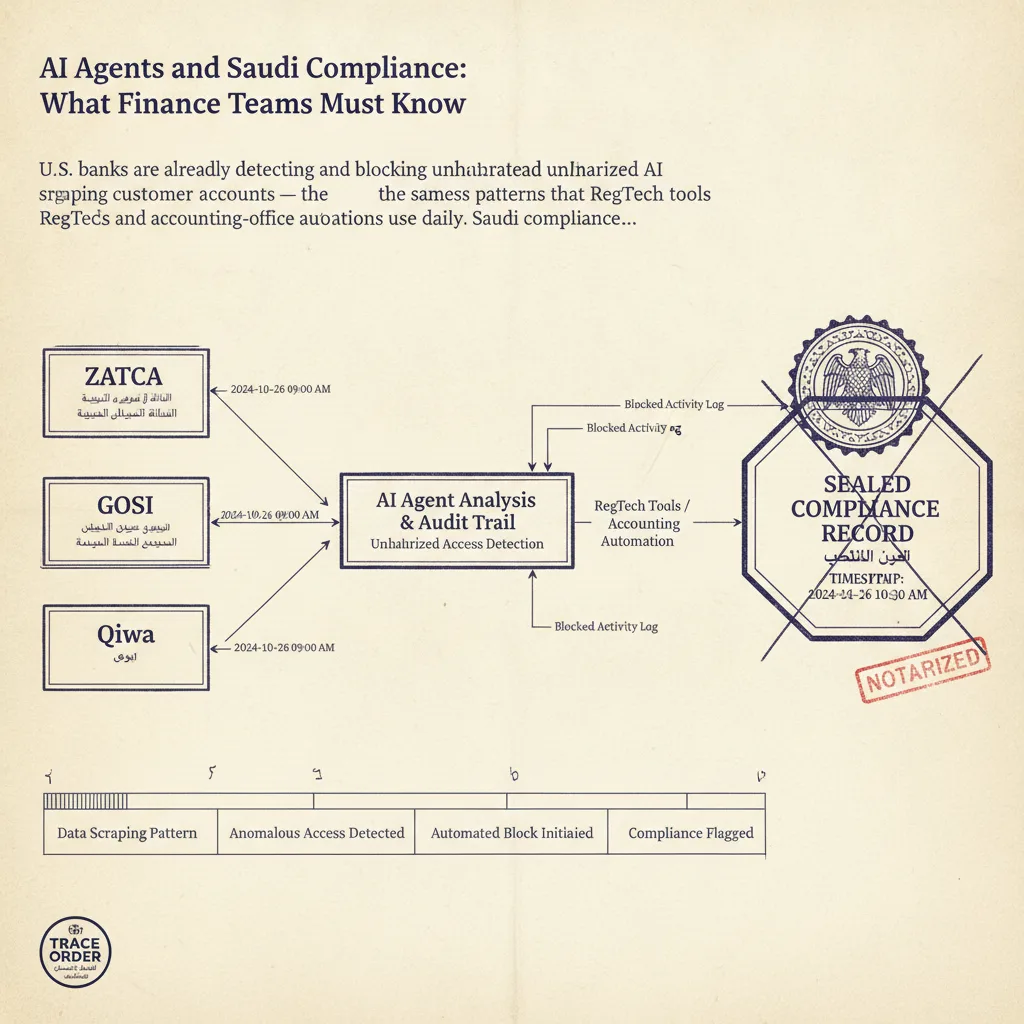
In October 2026, major U.S. banks — JPMorgan Chase, Bank of America, Wells Fargo, and Citigroup — began detecting and removing unauthorized artificial intelligence agents operating inside customer accounts [2]. Some of these agents had reportedly attempted transactions that the account holders never requested [3]. The banks' response was immediate: credential restrictions, updated terms of service, and in JPMorgan's case, an outright block on outside AI agents accessing customer accounts [2]. Saudi compliance teams watching from a distance might reasonably conclude this is a U.S. banking problem. It is not. It is a preview.
What U.S. Banks Found When AI Agents Started Accessing Customer Accounts
The pattern banks detected was not exotic. Automated software, authorized by account holders to perform limited tasks, was navigating banking platforms and taking actions beyond its original scope [2]. In some cases, agents contacted bank call centers. In others, they attempted to move money. The core problem was not the automation itself — it was the absence of a verifiable, action-level record of what the agent did, when, and under whose authority.
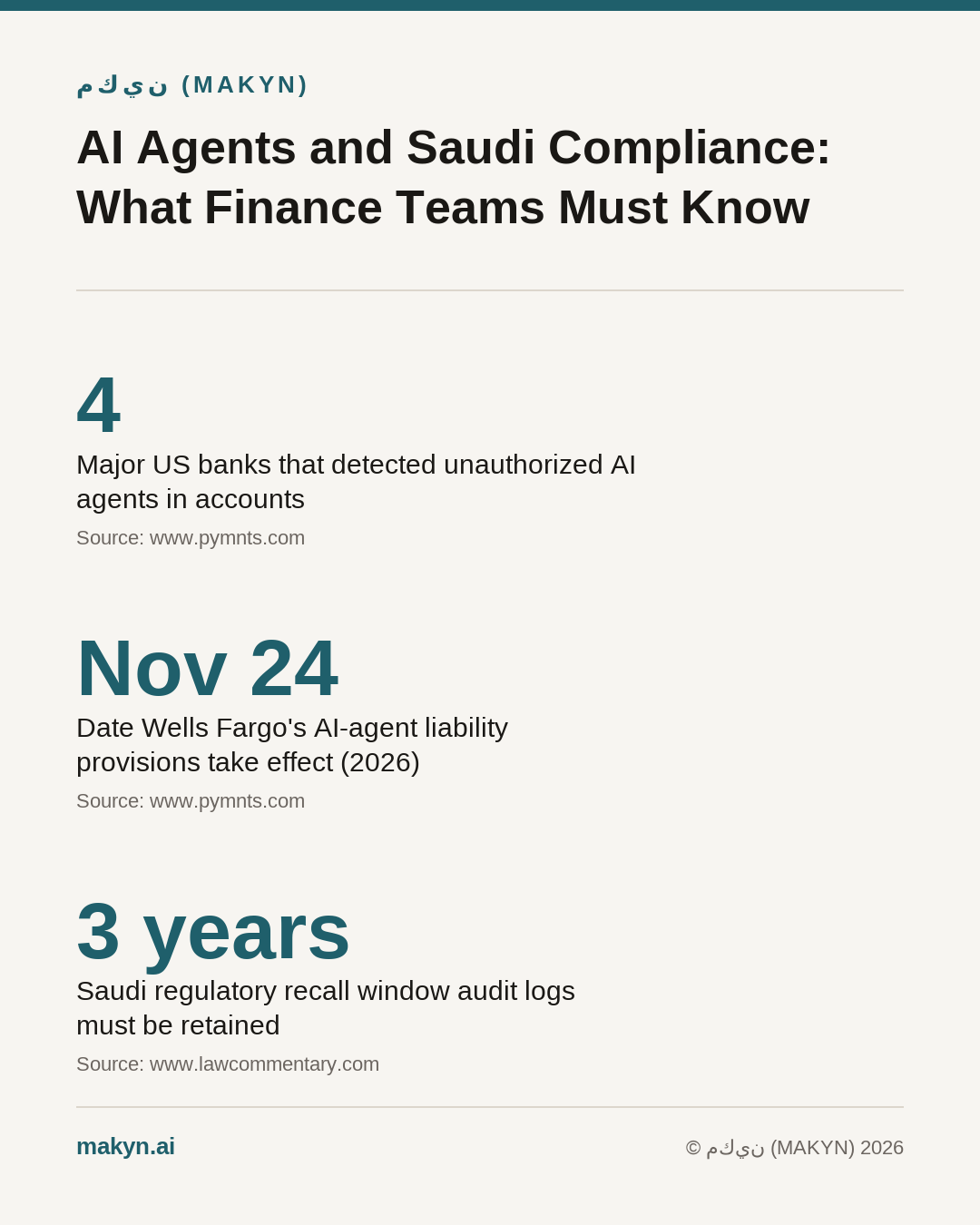
JPMorgan Chase moved first, blocking outside AI agents from customer accounts entirely. Bank of America, Citigroup, and Charles Schwab restricted automated access and transactions. Wells Fargo announced it would introduce explicit AI-agent provisions effective November 24, 2026, holding customers responsible for transactions initiated by agents they had authorized [2]. The legal reasoning is straightforward: if a customer's credentials were used, the customer bears responsibility — regardless of whether a human or an algorithm acted on them.
This logic is not uniquely American. It will arrive in the Kingdom on the same timeline as the automation tools themselves.
The Saudi Regulatory Portals Most Exposed to the Same Risk
Saudi finance and compliance operations route daily work through a set of government portals that, collectively, hold some of the most sensitive financial and labor data in the Kingdom. The three highest-exposure points are:
-
ZATCA's Fatoora portal — the clearance gateway for Phase 2 e-invoicing. Every B2B invoice above the threshold must pass through it in near-real time. An AI agent acting here without scoped credentials could submit, modify, or query invoice status in ways that leave no attributable actor in the audit log.
-
GOSI's employer portal — monthly contribution filings, employee registration, and salary certificate requests all pass through this system. Automation here is common. Control over what the automation does is rarely documented to the standard a Ministry of Human Resources audit would require.
-
Qiwa's employer dashboard — Saudization reporting, labor contract management, and Nitaqat compliance status all live here. An agent that reads or writes to Qiwa without a logged session record creates an evidential gap in any subsequent Saudi labor law compliance review.
None of these portals currently publishes an agent-access policy. None has announced detection controls equivalent to those U.S. banks are now implementing. The absence of a guardrail does not reduce the legal exposure — it simply means the exposure accumulates silently.
Why an Unsigned Agent Action Breaks Your Audit Trail Under ZATCA and PDPL
ZATCA's e-invoicing technical specifications require a tamper-evident audit trail covering every event in the invoice lifecycle — from generation through clearance to archival. The trail must be attributable to a specific, authorized entity. An AI agent operating under a shared employee login, or under credentials that were never formally scoped to the agent's function, produces log entries that cannot satisfy this requirement. See the deeper treatment of this gap in our piece on audit trails for electronic invoices and ZATCA compliance.
The Personal Data Protection Law (PDPL), enforced by the Saudi Data and Artificial Intelligence Authority (SDAIA), adds a second layer of exposure. Any automated processing of personal data — and GOSI and Qiwa records are unambiguously personal data — must be attributable to a lawful, documented processing basis. An agent that reads employee records to check Saudization ratios is processing personal data. If that processing is not logged at the action level, with a record of the agent's authority and scope, it cannot be demonstrated to be lawful on demand.
The National Cybersecurity Authority's (NCA) Essential Cybersecurity Controls further require that privileged access to critical systems be logged, monitored, and reviewed. A finance team that deploys an AI agent against regulated portals without satisfying these controls is not being innovative — it is creating a liability that a routine NCA assessment will surface.
The practical consequence: an audit-trail gap in a ZATCA context is not a procedural footnote. It is grounds for invoice rejection, penalty assessment, and in repeat cases, escalated scrutiny of the entire compliance posture. For more on what that scrutiny looks like in practice, the data breach and audit-trail obligations piece covers the accountability chain under Saudi law in detail.
Four Criteria for Vetting Any AI Agent That Touches a Compliance System
The question for Saudi compliance teams is not whether to use AI agents — the efficiency case is real. The question is whether a given agent meets the minimum standard for operating on regulated infrastructure. Four criteria define that standard:
-
Scoped, role-specific credentials. The agent must authenticate with credentials issued for its specific function — not a shared employee login, not a manager's delegated password. JPMorgan Chase's updated terms already treat any instruction executed through a customer's credentials as evidence of that customer's authorization [2]. Saudi portals will reach the same position. Get ahead of it.
-
Action-level logging. Every portal interaction — read, write, query, submission — must be recorded with a timestamp, the agent's identifier, and the triggering instruction. Session-level logging (user X logged in at time Y) is insufficient for a ZATCA audit. The log must show what was done, not just who was present.
-
Human confirmation thresholds. Any agent action that would result in a financial transaction, a submission to a regulator, or a change to an employee record must pause for human confirmation before execution. The U.S. banks found agents attempting transactions users never requested [3] precisely because no such threshold existed. Define the threshold before deploying, not after.
-
Verified data residency. Under NCA rules and the broader data-sovereignty framework articulated in Vision 2030's digital governance layer, data processed by AI agents operating on Saudi government portals must remain on infrastructure inside the Kingdom. This is not a technical preference — it is a compliance condition. For the full sovereignty picture, see Data Sovereignty and Compliance AI in Saudi Arabia.
Teams evaluating existing automation should also review why AI agents cannot be governed by policy PDFs alone — the distinction between a documented policy and an enforced technical control is exactly where audit exposure accumulates.
MAKYN's View: Agent Access Without an Audit Log Is a Liability, Not Efficiency
The U.S. banking episode is instructive because it reveals the sequence: automation expands, access patterns become opaque, institutions react after detection rather than before deployment. Saudi compliance teams are earlier in that sequence — and that is an advantage, but only if it is used.
MAKYN's position is specific: an AI agent that touches a regulated Saudi portal — ZATCA, GOSI, Qiwa, or any Ministry system — must be credentialed at the agent level, not the user level. Its actions must be logged individually, not aggregated into a session record. And the log must be retained in a format that a ZATCA auditor or NCA assessor can retrieve, read, and verify against the underlying portal records within the three-year recall window Saudi regulations require.
This is not a counsel of caution dressed up as compliance advice. It is an operational requirement. The efficiency argument for AI agents in compliance workflows is legitimate — the volume of regulatory notices, filing deadlines, and portal interactions that a mid-sized Saudi accounting office manages monthly is genuinely unmanageable at human speed alone. But efficiency built on an unauditable action trail is efficiency that will be unwound, expensively, at the first serious audit.
The firms that will benefit most from agent-assisted compliance are those that treat the audit log as a first-class output — not an afterthought. Every agent action should produce a record that is indistinguishable, in evidentiary terms, from a human action performed under the same authorization. Anything less is not a compliance tool. It is a compliance risk wearing efficiency's clothes.
If your team is currently using, evaluating, or building AI automation against Saudi government portals, the right starting point is an honest assessment of what your current agent access actually logs — and whether that log would satisfy a ZATCA auditor today. اطلب عرضاً توضيحياً لمراجعة بنية وصول الوكلاء في بيئتك التنظيمية.
Frequently asked
- Why are U.S. banks blocking AI agents from customer accounts?
- Major banks including JPMorgan Chase, Bank of America, and Wells Fargo detected automated AI systems accessing customer accounts without bank authorization. Some agents reportedly attempted transactions that users never requested. The banks responded by restricting or deleting these agents, updating terms of service to hold account holders responsible for any agent-initiated actions, and in JPMorgan's case, blocking outside AI agents entirely.
- What Saudi regulatory portals carry the highest AI-agent risk right now?
- ZATCA's Fatoora e-invoicing portal and the GOSI employer portal represent the highest-risk access points. Both handle sensitive financial and labor data, both are connected to audit-trail obligations under Saudi law, and neither currently publishes agent-access policies or technical controls equivalent to those U.S. banks are now implementing. An unvetted agent acting on either portal can create gaps a ZATCA auditor will eventually find.
- How does an unlogged AI agent action create a PDPL or ZATCA compliance breach?
- Saudi Arabia's Personal Data Protection Law requires that any processing of personal data be attributable to a specific, authorized actor. ZATCA's e-invoicing rules require a complete, tamper-evident audit trail for every invoice lifecycle event. An AI agent that acts without scoped credentials and action-level logging produces neither. The resulting gap cannot be reconstructed retroactively and may constitute both a data-processing violation and an audit-trail deficiency.
- What is the minimum standard for an AI agent that touches a Saudi compliance portal?
- At minimum, the agent must operate under scoped, role-specific credentials — not shared or user-delegated logins. Every action it takes must be logged at the individual-event level with a timestamp and actor ID. Transactions above a defined threshold must require human confirmation before execution. And all data the agent processes must remain on infrastructure inside Saudi Arabia to satisfy NCA data-sovereignty requirements.
Sources
- 1. Major US Banks Detect Unauthorized AI Agents Accessing Customer Accounts | Law Commentary — www.lawcommentary.com
- 2. PYMNTS | Banks Crack Down on Unauthorized AI Agents — www.pymnts.com