AI in Saudi Accounting: The Compliance Risk Nobody Is Naming
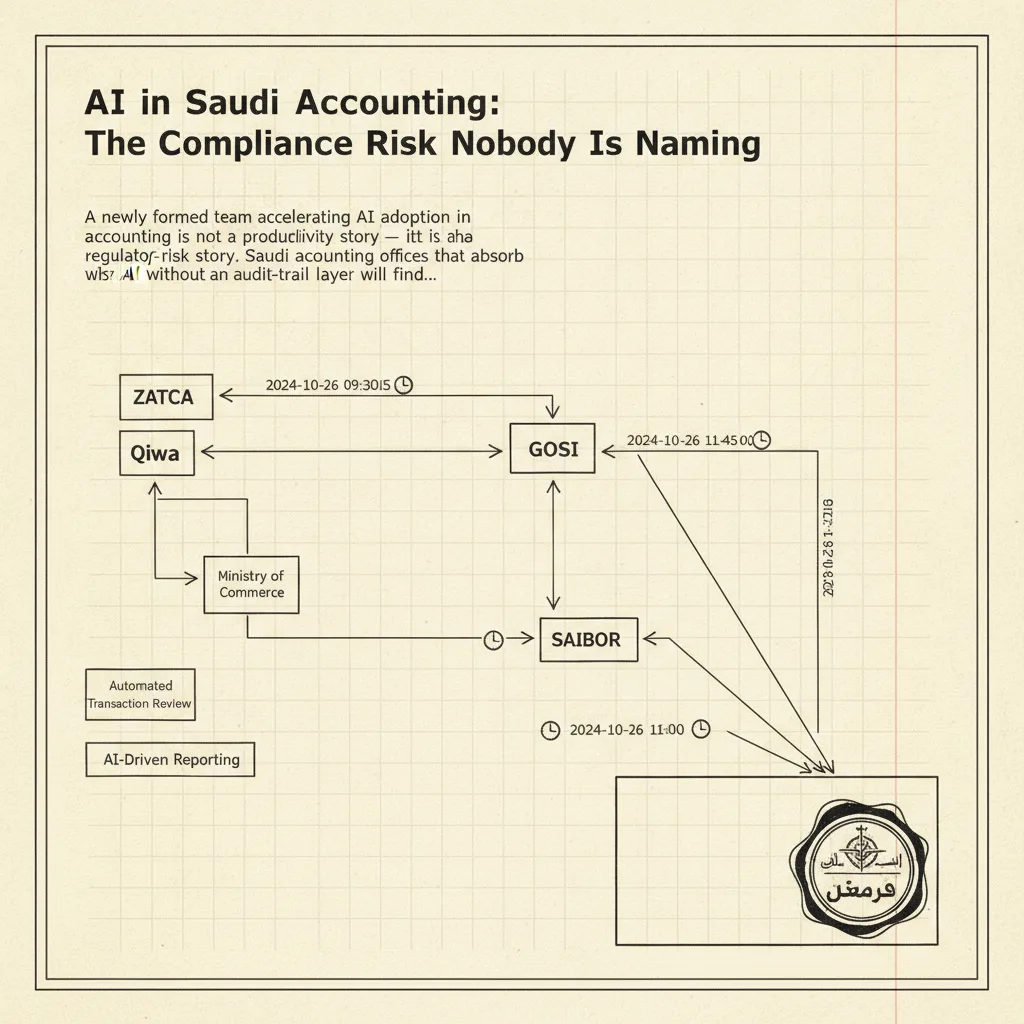
A new wave of AI adoption is moving through Saudi accounting offices, promoted as an efficiency advance and aligned, in its advocates' telling, with Vision 2030's digital transformation mandate. The framing is almost entirely about speed: faster reconciliations, automated exception-flagging, reduced manual entry. What the conversation is not about — and what Saudi compliance teams will discover at the worst possible moment — is what happens when the General Organization for Social Insurance (GOSI) or the Zakat, Tax and Customs Authority (ZATCA) questions a decision that an algorithm made.
That question is not hypothetical. It is the structural condition of operating inside Saudi Arabia's compliance environment.
What the New AI-in-Accounting Push Actually Involves — and What It Leaves Out
The current push centers on embedding AI into transaction classification, payroll processing, invoice exception handling, and provision estimation. These are legitimate productivity targets. The problem is that they are also precisely the processes that Saudi regulators scrutinize most closely.
ZATCA's clearance-based e-invoicing architecture means that invoice data flows into a regulatory system before the transaction is settled. AI tools that touch invoice classification or VAT exception routing are therefore operating inside a system that is already being watched. Any misclassification — whether caused by a flawed model, a stale training set, or an edge case the system was never designed to handle — becomes a regulatorily visible event, not an internal correction.1
The adoption conversation rarely includes this. It presents AI as a layer that sits on top of accounting workflows. In practice, in Saudi Arabia, it sits inside a regulatory feedback loop.
Where Saudi Compliance Obligations Make AI Adoption Uniquely Risky
Three obligations make the Saudi context structurally different from other markets where AI accounting tools have been deployed.
ZATCA audit scrutiny of AI-driven classifications. When an external auditor or ZATCA examiner asks why a group of transactions was classified a particular way, a satisfactory answer is not "the model is highly accurate." It is a traceable, criteria-based explanation connecting inputs to outputs in a logical chain.2 Saudi organizations that cannot produce this face extended reviews, higher audit fees, and a weakened evidentiary position — even if the classification was technically correct.2
GOSI contribution disputes. GOSI contribution calculations depend on payroll classifications that employees and employers contest through administrative challenge. If an AI tool auto-classifies employment categories or adjusts contribution bases, and a worker later files a dispute with the التأمينات الاجتماعية, the employer must reconstruct exactly how the AI reached its output on a specific date for a specific employee. Without a timestamped, attributable record, the employer has no defensible evidence.
Nitaqat tier assessments. Saudization percentage calculations flow directly from workforce classification data. AI tools that assist in workforce categorization introduce a failure mode that is invisible until a Qiwa audit surfaces an inconsistency — at which point the classification history must be reproduced.
As the academic literature on AI in Saudi financial auditing notes, AI adds the least where compliance obligations rest on judgment — estimates, going-concern assessments, and disputed classifications — and adds the most where evidence is structured and transaction-level.1 Saudi compliance work is disproportionately concentrated in the judgment-heavy category.
The Audit-Trail Gap: Why Automation Without Recordkeeping Fails Regulatory Scrutiny
The audit-trail gap is the distance between how quickly AI is adopted and how slowly its documentation matures.2 Most Saudi organizations that have deployed AI in finance did so through fast operational decisions, driven by a technical team or an external vendor, without designing a parallel system for how those decisions would be reviewed by a regulator.
The gap surfaces at the worst moment: annual audit fieldwork, or an unsolicited inquiry from ZATCA or GOSI. At that point, the organization must explain a decision the system made months earlier, using evidence the system was never configured to preserve.2
Three failure modes are common:
- No explainability record. The AI produced an output; nobody logged the criteria it applied. The model may have changed since. The original logic is unrecoverable.
- No human approval point. The AI routed a decision and it was acted upon. There is no named individual who reviewed and approved the output before it became a financial fact.
- No change log. The model's classification criteria were updated — to fix an error, to handle a new VAT category, to reflect a regulatory amendment — but the change was not dated, documented, or attributed to a decision-maker.
Each of these gaps is individually manageable before deployment. After a regulatory inquiry, none of them is. For more on how automation tools in accounting offices encounter these exact limits, see مكاتب المحاسبة والأتمتة: ما تفعله n8n وما تعجز عنه.
Four Questions Every Saudi Accounting Office Should Ask Before Deploying AI on Regulatory Data
These are not aspirational questions. They are the operational tests that an auditor — internal or external — will apply when a decision is contested.2
-
Can we explain any AI-driven decision from the past 90 days without relying on a single person's memory? If the answer depends on the availability of one technical staff member, the organization has a key-person dependency embedded in its compliance infrastructure.
-
Is every material criteria change logged with its date and reason? This applies to any update to classification rules, threshold settings, or exception-handling logic. A model that was retrained in March but whose retraining is undocumented creates a 90-day gap in the audit trail.2
-
Is there a named human approval point for each automated output that affects a regulatory obligation? ZATCA and GOSI do not accept algorithmic authority. A human must have reviewed and approved each material output before it became a financial or compliance fact.
-
Is the audit trail extractable in a format a ZATCA or GOSI examiner can read without specialist assistance? An audit trail that exists only inside a vendor's proprietary system — accessible only through API or vendor support — is not operationally available to a regulator on a short inspection timeline.
Offices deploying AI on e-invoicing workflows should cross-reference سجل المراجعة للفواتير الإلكترونية: متطلبات زاتكا والفجوة الخفية for the specific recordkeeping obligations that ZATCA's Phase Two architecture imposes. The risks of AI tools accessing financial data without adequate controls are further examined in When AI Agents Touch Financial Accounts: What Saudi Compliance Teams Must Know.
MAKYN's View: AI Accelerates Compliance Work Only When the Evidence Layer Comes First
The adoption sequence matters more than the tool itself. Organizations that deploy AI first and design the evidence layer later will face a structural problem: the records needed to satisfy a ZATCA or GOSI inquiry will be incomplete for the period before the evidence layer existed. That period will, by definition, be the period under audit.
MAKYN's position is specific: AI is only operationally safe in a Saudi compliance context when every machine-read notice, auto-extracted figure, and automated classification is logged, timestamped, and attributable to a named decision point. This is not a configuration preference — it is a prerequisite for the system's output to constitute admissible evidence when التأمينات الاجتماعية or ZATCA opens an inquiry.
The alternative — deploying AI for speed and retrofitting the documentation afterward — produces a compliance posture that is worse than the manual process it replaced. A manual process, however slow, leaves a paper trail. An undocumented AI process leaves nothing.
For Saudi accounting offices that have already deployed AI tools without an audit-trail layer, the first step is a gap assessment: map every regulatory data flow the AI touches, identify where no timestamped log exists, and assign a named human approval point retroactively where possible. This is not a remediation; it is a risk containment measure. The gaps that predate the assessment will remain gaps.
The offices that will navigate Saudi Arabia's AI-in-compliance environment without regulatory exposure are those that treat the evidence layer as infrastructure — not as a documentation task to be completed after the fact. If your office is evaluating where to begin, اطلب عرضاً توضيحياً to see how MAKYN structures the audit-trail layer before AI deployment, not after.
Footnotes
Frequently asked
- What does ZATCA actually require when an AI system makes a tax classification decision?
- ZATCA requires that any financial classification be traceable to a criteria-based logic chain connecting inputs to outputs. When an auditor asks why a transaction was classified a specific way, the organization must produce a plain-language explanation — not a model accuracy metric. A missing audit trail rarely produces an immediate formal finding, but it extends reviews, raises audit fees, and weakens the organization's evidentiary position.
- Why is the General Organization for Social Insurance (GOSI) a specific AI risk area for Saudi employers?
- GOSI contribution calculations depend on payroll classifications that are contested through administrative challenge. If an AI tool auto-classifies employees or adjusts contribution bases, and that classification is later disputed, the employer must reconstruct the decision logic. Without a timestamped, attributable record of how the AI reached its output, the employer has no defensible evidence to present in a GOSI dispute.
- What is the audit-trail gap, and why does it appear after AI deployment rather than before?
- The audit-trail gap is the distance between how quickly AI is adopted and how slowly its documentation matures. Most Saudi organizations deploy AI tools through fast operational decisions driven by technical teams or vendors, without designing how those decisions will be reviewed by regulators. The gap surfaces only when audit fieldwork begins — at which point it is too late to retrofit the evidence layer.
- What four questions should a Saudi accounting office ask before deploying AI on regulatory data?
- First: can we explain any AI-driven decision from the past 90 days without relying on a single person's memory? Second: is every material criteria change logged with its date and reason? Third: is there a named human approval point for each automated output? Fourth: is the audit trail extractable in a format a ZATCA or GOSI examiner can read without specialist assistance?